Acne Treatment · Oral Antibiotics · Antibiotic Resistance
How Long Should You Take Antibiotics for Acne?
Acne antibiotics are not something to stop after two weeks, but they are not meant to be taken indefinitely either.
Hello.
I am Bo Won Lee, M.D., Medical Director of Springday Clinic Sinchon-Hongdae in Seoul.
In acne consultations, I often hear questions like these:
“How long should I take antibiotics for acne?”
“I took them for two weeks, but I am still breaking out. Does that mean they are not working?”
“Is it harmful to take acne antibiotics for a long time?”
“Is it okay to take them for several months?”
“Do doxycycline, minocycline, and azithromycin all have different treatment durations?”
These questions may sound simple, but they are actually very important.
Acne antibiotics are not like antibiotics for a simple cold-related infection, where treatment may end after just a few days.
At the same time, they are not medications that should be continued for months or years without a clear plan.
Acne is a chronic inflammatory skin condition.
That means it takes time to judge whether a treatment is truly working.
However, antibiotics are still antibiotics.
The longer they are used, the more seriously we need to consider the issue of antibiotic resistance.
Today, let us discuss how long acne antibiotics should generally be taken, and how physicians usually decide when to continue, stop, or change treatment.
The Short Answer
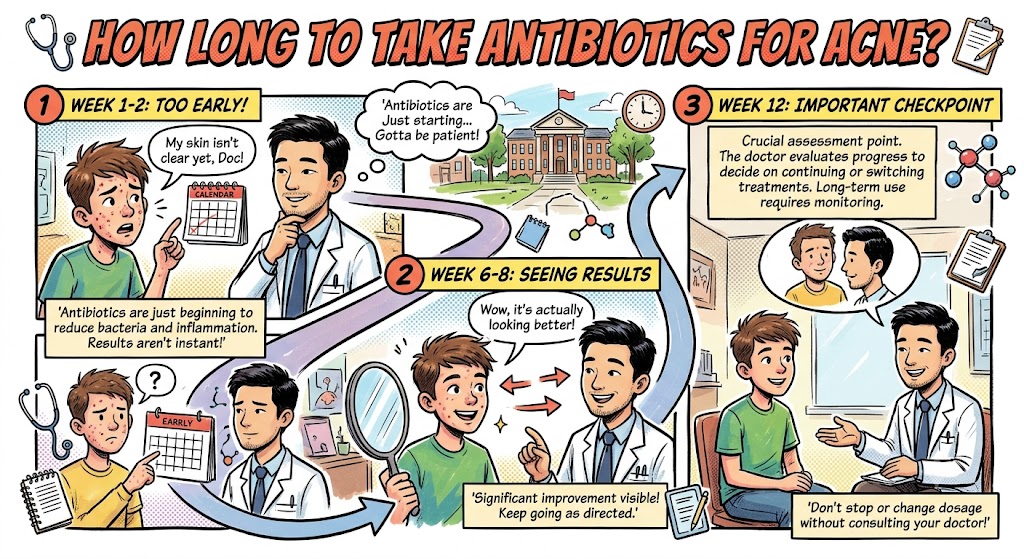
For acne, oral antibiotics are usually evaluated over an 8- to 12-week period.
More specifically:
1–2 weeks
Too early to conclude whether the antibiotic is effective or not.
6–8 weeks
A reasonable time point to start seeing whether inflammatory acne is moving in the right direction.
12 weeks
An important checkpoint to formally evaluate treatment response.
3–4 months
Continuing beyond this period without a clear reason should be approached cautiously.
More than 6 months
Generally not recommended except in exceptional situations with careful reassessment.
In other words, acne antibiotics are neither medications that can be judged after just a few days, nor medications that should be continued indefinitely.
The goal is to reduce inflammation during an appropriate treatment window, then transition to a maintenance plan that does not rely on long-term antibiotic use.
Why Two Weeks Is Usually Too Early to Judge
Acne antibiotics do not simply “kill bacteria on the skin surface.”
They are used in acne treatment for two major reasons:
First, they reduce the influence of Cutibacterium acnes, a bacterium associated with acne.
Second, they help reduce inflammatory reactions around acne lesions.
Acne treatment requires time because existing inflammation needs to calm down, and new inflammatory lesions need to appear less frequently.
Therefore, it is very common for patients to feel, after only one or two weeks, “I am still getting acne,” or “I do not think this is working.”
Of course, if the medication is clearly unsuitable, causes significant side effects, or seems to worsen the condition, adjustment may be needed.
However, if there are no major problems, it is usually more appropriate to observe the response for at least 6–8 weeks before deciding whether the treatment is effective. Changing antibiotics too quickly may make a potentially effective treatment look like a failure.
Why the 12-Week Checkpoint Matters
In acne antibiotic treatment, 12 weeks is an important clinical checkpoint.
Many acne guidelines evaluate treatment response around a 12-week treatment period.
At 12 weeks, physicians should assess:
- Have inflammatory acne lesions decreased?
- Are new breakouts occurring less frequently?
- Are there still large nodular lesions or acne lesions with scarring risk?
- Are there any side effects?
- Was the medication taken consistently?
- Was topical treatment used properly alongside the antibiotic?
- Are there aggravating factors such as cosmetics, masks, lifestyle, or menstrual cycles?
If acne has improved sufficiently, reducing or stopping the oral antibiotic should be considered.
If acne has improved but is not yet fully controlled, the antibiotic may sometimes be continued for a limited additional period. However, this should not be an automatic extension. There should be a clear goal and a plan for reassessment.
If there is inadequate response after about 12 weeks, simply continuing the same antibiotic may not be the best strategy. The overall treatment plan should be reviewed.
If response is insufficient after 12 weeks, reassess:
- Whether topical therapy was used correctly
- Whether adherence was adequate
- Whether the condition may actually be folliculitis, rosacea, or an acneiform eruption
- Whether hormonal factors are involved
- Whether isotretinoin should be considered
- Whether the acne has a high risk of scarring
Why Should Acne Antibiotics Not Be Taken for Too Long?
The biggest reason is antibiotic resistance.
Long-term antibiotic use may affect not only Cutibacterium acnes, but also other bacteria on the skin surface and bacteria in the oral and gut microbiome.
Also, taking antibiotics for a long time does not mean that the root causes of acne have been fully corrected.
Acne is not caused by bacteria alone. It is influenced by:
- Sebum production
- Abnormal follicular keratinization
- Inflammation
- Hormonal factors
- Skin barrier condition
- Lifestyle factors
- Cosmetics
- Masks or friction
- Genetic tendency
These factors work together in a complex way.
Antibiotics mainly help reduce inflammation. Therefore, trying to suppress acne for a long time with antibiotics alone is not a good long-term strategy.
Good acne treatment is not about keeping patients on antibiotics for as long as possible. It is about using antibiotics appropriately when needed, then stopping them at the right time.
Oral Antibiotic Monotherapy Is Not Recommended
There is one important principle in acne treatment:
Oral antibiotics alone are generally not recommended as monotherapy for acne.
When oral antibiotics are used, topical treatments are usually used together.
Common topical treatments used together may include:
- Benzoyl peroxide
- Topical retinoids such as adapalene
- Azelaic acid
- Combination products when appropriate
Benzoyl peroxide is especially important because it may help reduce the risk of antibiotic resistance when used as part of acne treatment.
Oral antibiotics help reduce inflammation more quickly, while topical treatments help prevent clogged pores and reduce recurrence. Topical therapy is the foundation of maintenance treatment.
A simple analogy is this:
Antibiotics help calm down the fire when inflammation is active.
Topical maintenance treatment helps prevent the fire from starting again.
This is why topical maintenance treatment remains important even after oral antibiotics are stopped.
Does the Duration Differ by Antibiotic Type?
Many patients assume that each antibiotic has a completely different fixed duration.
“Is doxycycline taken for a certain number of weeks, minocycline for another, and azithromycin for another?”
Each antibiotic does have its own characteristics.
However, the overall principle is similar for most oral antibiotics used in acne.
In most cases, treatment response is assessed around 8–12 weeks, and at around 12 weeks the physician decides whether to continue, reduce, stop, or change treatment.
The difference is less about “how many weeks can this specific antibiotic be taken?” and more about “which antibiotic is appropriate for this specific patient?”
1. Doxycycline
Doxycycline is one of the most commonly used oral antibiotics for acne.
It is often used for moderate inflammatory acne, especially when red papules or pustules repeatedly appear.
Like other acne antibiotics, doxycycline is usually assessed over an 8- to 12-week period. If acne is improving, reducing or stopping the antibiotic within about 3–4 months is often considered.
Important points when taking doxycycline:
- It may cause stomach discomfort or heartburn.
- It should be taken with enough water to reduce esophageal irritation.
- Avoid lying down immediately after taking it.
- Photosensitivity may occur, so sun protection is important.
- Iron, calcium, magnesium, and antacids may interfere with absorption.
Doxycycline can be a useful medication, but clear instructions on how to take it are very important.
2. Minocycline
Minocycline is another tetracycline-class antibiotic that has long been used for acne treatment.
It may be effective for inflammatory acne, but it should not be described as “always stronger than doxycycline” or “safe to take for a longer time.”
With minocycline, side effects such as dizziness, pigmentation, and rarely autoimmune reactions or liver-related issues may require more detailed explanation.
The duration principle is similar:
Assess response over 8–12 weeks,
re-evaluate around 12 weeks,
and reduce antibiotic dependence within about 3–4 months whenever possible.
Minocycline is not an antibiotic that should be taken longer simply because it feels “stronger.” It should be selected based on the patient’s condition and side effect profile.
3. Sarecycline
Sarecycline is a tetracycline-class antibiotic developed specifically for acne treatment.
It is often described as having a narrower antibacterial spectrum than older tetracyclines such as doxycycline or minocycline. Theoretically, this may have advantages regarding gut microbiome impact and antibiotic resistance.
However, one point should not be misunderstood.
Sarecycline is not an antibiotic that can be taken indefinitely.
Sarecycline is still an antibiotic. Treatment response should also be assessed around the 12-week mark, and unnecessary long-term use should be avoided.
In other words, sarecycline may be described as an acne-focused antibiotic, but it should not be described as an antibiotic that justifies long-term use.
4. Tetracycline and Lymecycline
Tetracycline-class antibiotics have been used in acne treatment for a long time.
Depending on the specific medication, there may be differences in dosing convenience, food interactions, gastrointestinal side effects, photosensitivity, and availability by country.
Lymecycline is often discussed in European acne guidelines and clinical practice, while doxycycline and minocycline may be more familiar in many Korean clinical settings.
The basic principle remains the same: start evaluating the direction of response after about 6–8 weeks, formally reassess at around 12 weeks, and avoid prolonged use without a clear reason.
5. Macrolide Antibiotics
Macrolide antibiotics include erythromycin, azithromycin, clarithromycin, and roxithromycin.
These medications have been used for acne in the past and have been discussed in some studies.
However, in current acne treatment, tetracycline-class antibiotics are more commonly discussed as standard first-line oral antibiotics.
Macrolides may be considered in selected situations, such as:
- When tetracycline-class antibiotics cannot be used
- When pregnancy potential or other restrictions limit medication choices
- When side effects or contraindications make other options difficult
- When patient-specific circumstances leave few alternatives
However, antibiotic resistance is an important concern with macrolides. Erythromycin in particular is used more cautiously now because of resistance issues.
Azithromycin has been compared with doxycycline in some studies, but these data should not be interpreted as justification for unrestricted long-term use.
Roxithromycin and clarithromycin may be used in some clinical settings, but they are not strongly positioned as standard first-line oral antibiotics for acne in major international guidelines. Therefore, macrolides should be understood as selected alternatives in certain situations, not as antibiotics that can be taken longer simply because they are different.
6. TMP-SMX and Trimethoprim
TMP-SMX and trimethoprim are not common first-line choices for acne.
They may be considered in selected cases, such as difficult-to-treat acne or situations where other antibiotics cannot be used.
However, these medications can rarely cause serious drug reactions, so they should not be chosen casually for routine acne treatment.
They are best understood as limited alternatives rather than standard first-line acne antibiotics.
Summary by Antibiotic Type
Doxycycline
Assess response over 8–12 weeks; usually consider reducing or stopping within about 3–4 months.
Minocycline
Similar duration principle to doxycycline, but side effect counseling is especially important.
Sarecycline
An acne-focused antibiotic, but not a justification for unnecessary long-term use.
Tetracycline / Lymecycline
Start assessing direction after 6–8 weeks and formally reassess around 12 weeks.
Macrolides
Alternative options when tetracyclines cannot be used; long-term use requires caution due to resistance.
TMP-SMX / Trimethoprim
Not common first-line choices; considered only in selected situations.
Ultimately, the antibiotic name is less important than the treatment strategy.
When should the response be evaluated?
When should the antibiotic be reduced?
When should it be stopped?
What maintenance treatment should follow after stopping it?
Will Acne Come Back After Stopping Antibiotics?
Acne may return after stopping antibiotics.
However, the answer is not simply, “Then I should keep taking antibiotics.”
If acne quickly relapses after antibiotics are stopped, the treatment strategy should be re-evaluated.
- Was maintenance treatment sufficient?
- Was a topical retinoid used consistently?
- Was benzoyl peroxide or azelaic acid used appropriately?
- Is sebum control needed?
- Are hormonal factors involved?
- Is isotretinoin indicated?
- Is there a high risk of acne scarring?
Extending antibiotics can feel like an easy solution. But good acne treatment should be safe, sustainable, and focused on reducing relapse over the long term.
When Should Isotretinoin Be Considered Instead?
Not every acne patient needs isotretinoin.
However, in some situations, it may be more appropriate to consider isotretinoin rather than repeatedly extending oral antibiotics.
- Repeated nodular acne
- Cystic acne
- Rapidly developing acne scars
- Acne that improves only while taking antibiotics and relapses immediately after stopping
- Inadequate response after about 12 weeks of appropriate treatment
- Moderate to severe acne involving the face, chest, or back
- Significant psychological stress caused by acne
Isotretinoin can affect sebum production, follicular keratinization, inflammation, and the acne-related bacterial environment.
However, it requires careful medical supervision because of pregnancy-related contraindications, dry lips, dry skin, and possible changes in liver enzymes or lipid levels.
What If You Want to Change Antibiotics After Two Weeks?
This is a common situation in acne clinics.
“I took antibiotics for two weeks, but I still have acne.”
“I do not think this medication works for me.”
“Can I switch to something stronger?”
In this situation, I usually check several things first:
- Was the medication taken consistently?
- Was it skipped because of stomach discomfort?
- Was topical treatment used together?
- Was topical treatment stopped because of irritation?
- Is the acne related to menstrual cycles?
- Were there changes in masks, cosmetics, sunscreen, or cleansing products?
- Was there exposure to workout supplements or steroid-related substances?
- Could this be folliculitis rather than acne?
Two weeks is usually too early to define treatment failure.
If side effects are significant, the treatment may need to be changed. But switching antibiotics after only two weeks simply because acne is still appearing may not be a good strategy.
Acne treatment is not about changing medications frequently. It is about allowing the current treatment enough time to work, then evaluating it at the right time.
When Should Antibiotics Be Stopped?
The decision to stop antibiotics is not based only on the calendar.
Several factors are considered together:
- Are new inflammatory lesions decreasing?
- Are large painful lesions no longer recurring?
- Has the skin entered a more stable phase?
- Can the patient continue topical maintenance treatment?
- Does the patient have a realistic skin care routine after stopping antibiotics?
- Are there still lesions with high scarring risk?
Antibiotics are a tool to stabilize acne.
The goal is not to keep taking antibiotics, but to reach a point where acne can be maintained without them.
Therefore, when stopping antibiotics, it is important to have a maintenance plan rather than simply stopping treatment altogether.
Key Points to Remember
First
Do not stop antibiotics or continue them for a long time without medical guidance.
Second
Topical treatment should usually be used together with oral antibiotics.
Third
Treatment response should be reassessed around 12 weeks.
Fourth
If antibiotics are repeatedly needed, the overall cause and treatment plan should be reviewed.
Fifth
Acne with scarring risk should not be left untreated for too long.
Acne scars often last much longer than acne itself. If deep, painful acne repeatedly develops, treatment intensity should not be delayed too much.
Final Thoughts
Oral antibiotics can be very helpful in acne treatment.
They may play an important role in inflammatory acne, painful red acne, and recurrent pustular acne.
However, the goal of acne antibiotics is not long-term use.
The goal is to reduce inflammation for an appropriate period,
evaluate response around 12 weeks,
reduce or stop antibiotics within about 3–4 months when possible,
and transition to topical or other maintenance treatments.
Good acne treatment does not end with choosing the right antibiotic.
It requires a plan for when to start, how long to continue, when to reduce, when to stop, and how to maintain results afterward.
Acne antibiotics are not medications that work better simply because they are taken longer.
They should be used when needed, for the right duration, and stopped appropriately.
Key Takeaway
Acne antibiotics are usually evaluated over 8–12 weeks. A formal reassessment around 12 weeks is important, and prolonged use without a clear reason should generally be avoided.
This article is intended for general medical education. The appropriate antibiotic, dosage, and treatment duration may vary depending on acne type, severity, scarring risk, previous treatment response, pregnancy potential, underlying medical conditions, and other medications.
References
[1] Reynolds RV, Yeung H, Cheng CE, et al. Guidelines of care for the management of acne vulgaris. Journal of the American Academy of Dermatology. 2024.
[2] American Academy of Dermatology. American Academy of Dermatology issues updated guidelines for the management of acne. 2024.
[3] NICE Guideline NG198. Acne vulgaris: management. National Institute for Health and Care Excellence.
[4] Nast A, et al. EuroGuiDerm Guideline for the Treatment of Acne. Update 2025.
[5] Korean Dermatological Association. Acne vulgaris. Public disease information.
[6] Baldwin H, et al. Oral Antibiotic Treatment Options for Acne Vulgaris. Journal of Clinical and Aesthetic Dermatology. 2020.
[7] Armstrong AW, et al. Oral Tetracyclines and Acne: A Systematic Review for Dermatologists. Journal of Drugs in Dermatology. 2020.
[8] Kim JE, Park AY, Lee SY, et al. Comparison of the Efficacy of Azithromycin Versus Doxycycline in Acne Vulgaris: A Meta-Analysis of Randomized Controlled Trials. Annals of Dermatology. 2018.
[9] Hayashi N, Kawashima M. Efficacy of oral antibiotics on acne vulgaris and their effects on quality of life: minocycline, roxithromycin and faropenem. Journal of Dermatology. 2011.
[10] FDA Prescribing Information. SEYSARA, sarecycline tablets. U.S. Food and Drug Administration.
Reference Mapping
1. “For acne, oral antibiotics are usually evaluated over an 8- to 12-week period.” → [3], [5]
2. “One to two weeks is usually too early to judge whether the antibiotic is effective.” → [5]
3. “At around 12 weeks, treatment response, side effects, adherence, and combination therapy should be evaluated.” → [3]
4. “If acne has cleared, stopping the oral antibiotic while continuing topical maintenance treatment should be considered.” → [3]
5. “If acne has improved but not fully cleared, additional treatment with topical therapy may be considered for a limited period.” → [3]
6. “Continuing antibiotic-containing treatment beyond six months should be reserved for exceptional circumstances.” → [3]
7. “Systemic antibiotic use should generally be limited to around three months.” → [4]
8. “Long-term antibiotic use is associated with antibiotic resistance concerns.” → [1], [2], [3], [4]
9. “Oral antibiotic monotherapy is not recommended.” → [3]
10. “Benzoyl peroxide and other non-antibiotic topical therapies are important when oral antibiotics are used.” → [1], [2], [3]
11. “Doxycycline is one of the commonly used oral antibiotics for acne.” → [1], [2], [3], [6]
12. “Minocycline should not be described as automatically superior to doxycycline or appropriate for longer use.” → [6], [7]
13. “Minocycline requires counseling about dizziness, pigmentation, and rare autoimmune reactions.” → [6], [7]
14. “Sarecycline is an acne-focused tetracycline-class antibiotic, but it does not justify unnecessary long-term use.” → [6], [7], [10]
15. “The efficacy of sarecycline beyond 12 weeks and safety beyond 12 months have not been established.” → [10]
16. “Macrolides may be considered when tetracyclines cannot be used, but resistance concerns require caution.” → [4], [5], [6], [8]
17. “Azithromycin has been compared with doxycycline in some studies, but this does not justify unrestricted long-term use.” → [8]
18. “Roxithromycin has some study data, but it is not strongly positioned as a standard first-line acne antibiotic in major international guidelines.” → [9]
19. “TMP-SMX and trimethoprim are not common first-line acne antibiotics and are reserved for selected cases.” → [6]
20. “Isotretinoin may be considered for nodular, cystic, scarring, or treatment-resistant acne.” → [1], [3], [5]
21. “If acne repeatedly relapses after stopping antibiotics, maintenance therapy, sebum control, hormonal factors, and isotretinoin indication should be reassessed.” → [1], [3], [5]
22. “The goal of acne antibiotics is not prolonged use, but appropriate use followed by non-antibiotic maintenance.” → [1], [2], [3], [4]
Certainty Level
High — The main principles on acne antibiotic duration are consistent with NICE NG198, AAD 2024, EuroGuiDerm 2025, and Korean Dermatological Association public information. The role of roxithromycin and clarithromycin in acne treatment is based on more limited evidence, so that portion should be interpreted with moderate to low certainty.
#acneantibiotics #oralantibioticsforacne #acnetreatmentduration #howlongtotakeantibioticsforacne #doxycyclineforacne #minocyclineforacne #antibioticresistance #inflammatoryacne #acnetreatmentseoul #springdayclinicsinchonhongdae


