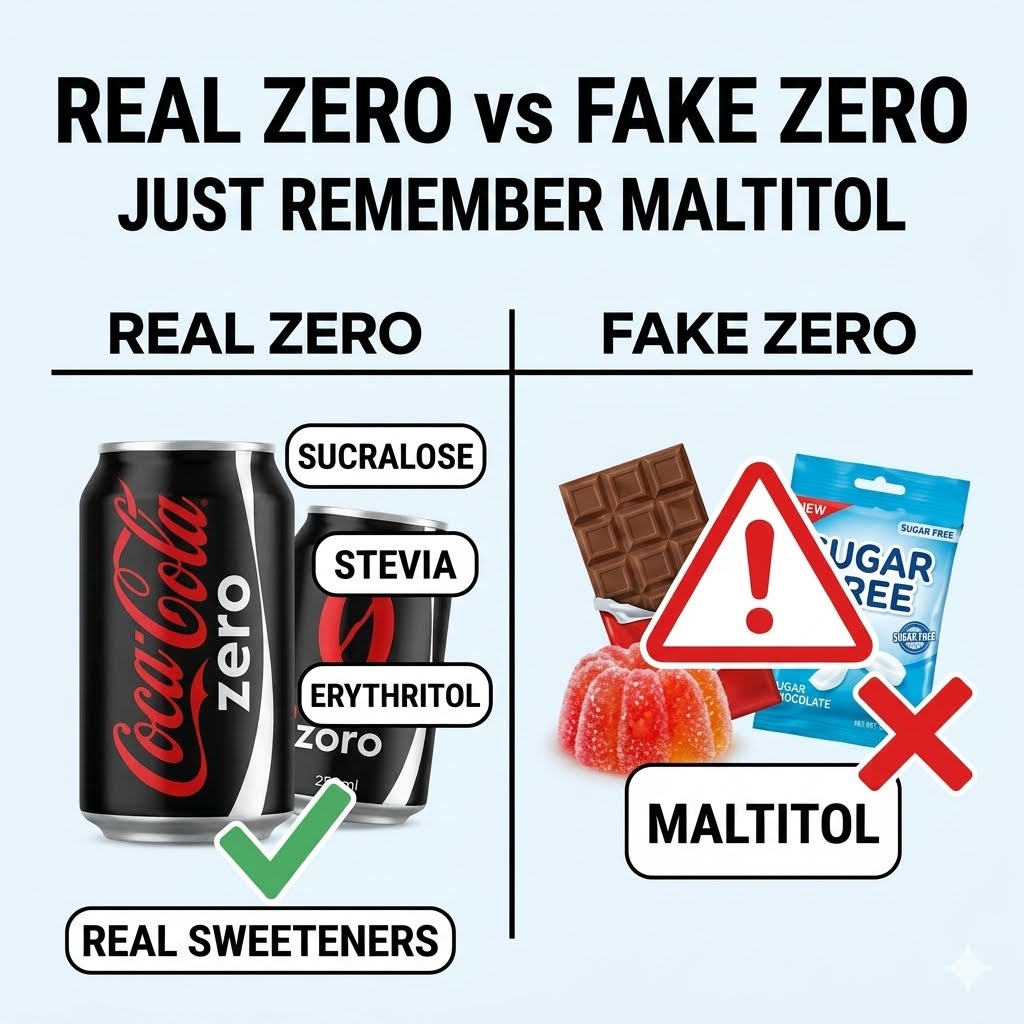
These days, it's actually harder to find products without the word "zero" on them than products that have it.
Zero cola, zero soda, zero iced tea, sugar-free chocolate, sugar-free candy, sugar-free jelly—the market is full of products that promise sweetness without the guilt.
As a physician, I often hear questions like these:
"Doctor, do zero-calorie drinks really not cause weight gain?"
"If a chocolate is sugar-free, can I eat as much as I want?"
"Why does a product have calories if the sugar content is listed as 0 grams?"
Today, I'd like to talk about something many people misunderstand: the difference between "real zero" and "fake zero."
The First Thing You Need to Know
0g of sugar does NOT mean 0 calories.
Many people assume these two statements mean the same thing, but nutritionally speaking, they are completely different concepts.
Let's take olive oil as an example.
Olive oil contains virtually no sugar.
Yet it is very high in calories.
On the other hand, a can of zero cola contains almost no sugar and almost no calories.
In other words:
- Sugar-free does not automatically mean low-calorie.
- Low-calorie does not automatically mean sugar-free.
Understanding this distinction can completely change the way you evaluate food and beverages, especially if you're trying to lose weight.
The Most Misleading Word: "Sugar-Free"
When people see the words "sugar-free," they often think:
"No sugar? Great. It probably won't make me gain weight."
Unfortunately, that's not always true.
"Sugar-free" simply means that traditional sugar (sucrose) has not been added.
It does not mean the product contains no calories.
Many sugar-free chocolates, candies, and gummies still contain a significant amount of calories.
In some cases, the calorie difference between a sugar-free chocolate and a regular chocolate bar is surprisingly small.
That's why, if you're watching your weight, it's important to look beyond the front label and check the nutrition facts panel.
Why Is Zero Cola Considered a "Real Zero"?
Most zero-calorie soft drinks use sweeteners instead of sugar.
Common examples include:
- Sucralose
- Acesulfame Potassium (Ace-K)
- Stevia
- Saccharin
- Erythritol
These sweeteners are incredibly potent.
A tiny amount can provide the same sweetness as several teaspoons of sugar.
In addition, most of them are either not metabolized for energy or are used in such small quantities that their calorie contribution is negligible.
As a result, the actual calorie content is essentially zero.
Technically speaking, substances such as sucralose do contain chemical energy.
However, the human body absorbs very little of it, and the amount used in beverages is extremely small.
For practical purposes, the calorie impact is close to zero.
This is why drinking a can of zero cola is unlikely to contribute meaningfully to weight gain.
Then Why Do Some People Talk About "Fake Zero" Products?
This is where maltitol comes into the conversation.
Maltitol is a type of sugar alcohol.
Compared with regular sugar, it causes a smaller rise in blood glucose and is absorbed more slowly.
However, slower absorption does not mean no absorption.
A portion of maltitol is still absorbed by the body and used as energy.
In other words:
It's better than sugar—but it's not truly zero.
For this reason, people who closely monitor carbohydrate intake, such as those following ketogenic or low-carb diets, often refer to maltitol-containing products as "fake zero" products.
Maltitol is commonly found in:
- Sugar-free chocolate
- Sugar-free candy
- Sugar-free gummies
- Sugar-free snacks
Many of these products proudly advertise "0g sugar" on the package, yet still contain a substantial number of calories.
How Can Something With 0g Sugar Still Cause Weight Gain?
When reading nutrition labels, many consumers focus only on sugar content.
However, there are three important numbers that should always be reviewed together:
- Sugar
- Total carbohydrates
- Calories
For example, a product may contain:
- Sugar: 0g
- Carbohydrates: 25g
- Calories: 180 kcal
That is not a low-calorie snack.
The sugar content may be zero, but the body is still receiving energy.
At the end of the day, weight gain is primarily influenced by total calorie intake.
Sugar is only one piece of the equation.
Can You Drink Unlimited Amounts of Zero-Calorie Beverages?
Current research suggests that moderate consumption of zero-calorie beverages is generally safe for healthy adults.
In fact, replacing sugary soft drinks with zero-calorie alternatives is often a better choice for weight management.
However, there is one important caveat.
Zero-calorie drinks are not magic.
Some people think:
"I had a zero cola today, so I can treat myself to extra pizza, fried chicken, or dessert."
If overall calorie intake increases, weight gain can still occur.
Zero-calorie beverages can be helpful tools, but they are not substitutes for healthy eating habits.
The Most Important Thing Is Not the Word "Zero"
Food manufacturers naturally highlight the most attractive marketing terms:
- Zero
- Sugar-Free
- 0g Sugar
But the information that truly matters is found on the nutrition label.
Whenever you pick up a product, take a moment to check:
- Total calories
- Total carbohydrates
- Type of sweetener used
If the product primarily contains sweeteners such as sucralose, acesulfame potassium, stevia, or erythritol, it is generally much closer to a true zero-calorie product.
If maltitol is listed among the primary ingredients, it is worth taking a closer look before assuming the product is "free."
A Doctor's Takeaway

Not all "zero" products are created equal.
Sugar-free and calorie-free are not the same thing.
Most zero-calorie beverages are very close to what consumers think of as a "real zero."
However, many sugar-free snacks contain maltitol and may provide significantly more calories than people expect.
When it comes to weight management, the most important habit is not trusting marketing claims—it's learning to read nutrition labels.
And if there is only one thing you remember from this article, let it be this:
The Most Important Takeaway
If a product contains maltitol, don't automatically assume it is truly zero just because it says "sugar-free."
Before purchasing a product, take a quick look at the ingredient list.
If you see maltitol or maltitol syrup, pause and check the nutrition facts more carefully.
Good health often starts with small habits—and reading the label is one of them.


