Dr. Sly Fox Column · Laser Hair Removal
Why Is GentleMax Hair Removal So Cheap?
The Real Question Patients Should Ask
Device names matter. But the name “GentleMax” alone does not automatically guarantee the quality of laser hair removal.
Written by: Bo Won Lee, M.D. · Representative Doctor, Springday Clinic Sinchon-Hongdae
Clinical perspective: Instead of factory-style turnover, this article focuses on skin type, hair thickness and density, treatment density, cooling, parameter judgment, and follow-up care.
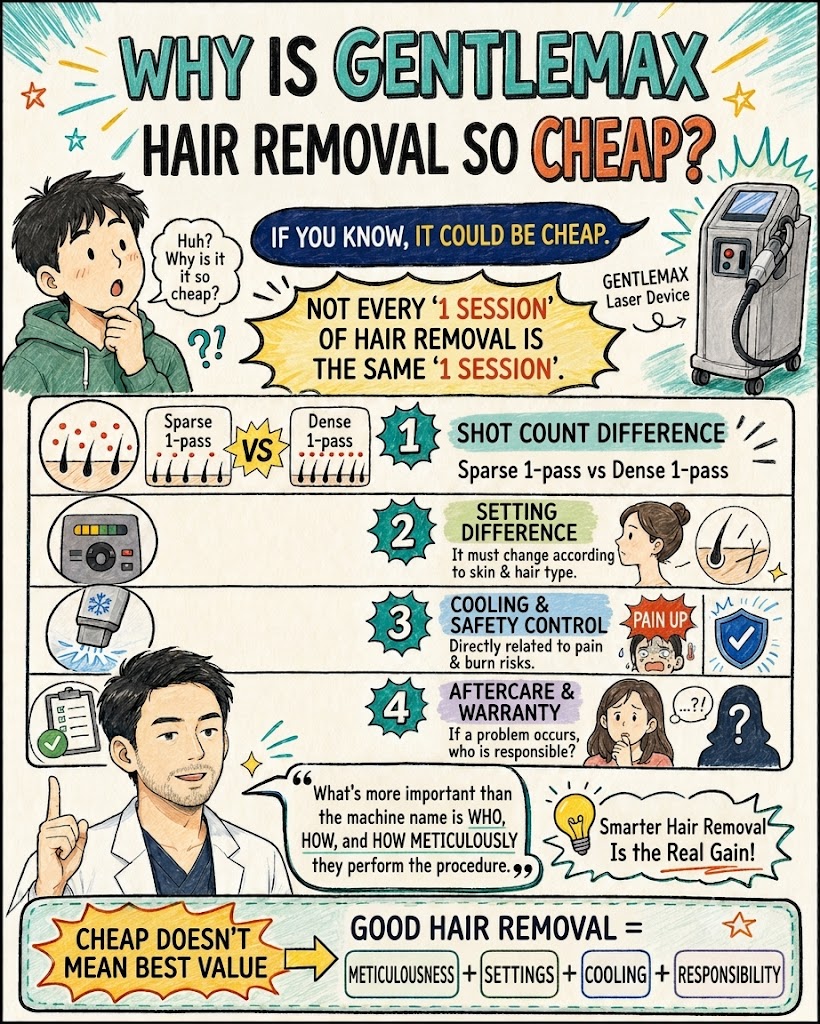
This article is not intended to refer to any specific clinic or medical institution. It was written to help patients considering laser hair removal look beyond the device name and consider treatment density, settings, cooling, consumable management, and follow-up responsibility.
What this article covers
- What to check when GentleMax hair removal looks unusually cheap
- The trap of sparse one-pass laser hair removal
- Shot count, pass density, and parameter differences hidden inside “one session”
- The true cost: time, skin irritation, travel, and repeated visits
- Why treatment density and medical responsibility matter more than the device name
When patients compare laser hair removal prices, they often think:
“Wait, this is GentleMax. Why is it so cheap?”
“GentleMax Pro Plus at this price? Is that even possible?”
“Unlimited laser hair removal? Isn’t this an amazing deal?”
“If the device is so expensive, why is the treatment price so low?”
But after seeing aesthetic procedures for many years, one thing becomes clear: when a price is extremely low, there is usually a reason.
This does not mean every low-cost hair removal treatment is bad. It also does not mean every expensive treatment is excellent. And it certainly does not mean GentleMax is a bad device.
But one thing is clear.
Not every “one session” of hair removal is the same.
Not every GentleMax hair removal treatment is the same.
A famous device name does not automatically guarantee treatment quality.
Laser hair removal may look simple from the outside.
Lie down. Get lasered. Done.
That may be how it looks to patients. But the actual procedure is not that simple.
Results can vary greatly depending on how densely the treatment area is covered, how the energy is set, how the pulse duration is chosen, whether cooling is adequate, whether settings are adjusted according to skin type and hair thickness, and whether the next session is modified based on the previous skin response.
The problem is that patients usually cannot see these differences immediately. So they tend to focus on what is easiest to see.
Device name
GentleMax, GentleMax Pro, GentleMax Pro Plus
Promotion price
Single-session price, packages, limited-time plans
Unlimited plans
Patients should check whether it only looks cheap
The names all sound good. But the real issue comes next.
The real core question
Who is using that device, how are they using it, and how carefully is the area being treated?
That is the real core of laser hair removal.
Sparse One-Pass Hair Removal Can Be a Real Problem
In hair removal consultations, the term “one session” is used all the time.
Full-face hair removal, upper-lip hair removal, chin hair removal, underarm hair removal, arm hair removal, leg hair removal.
But the number of laser shots included in that “one session” can vary significantly from clinic to clinic.
An important concept here is the pass.
A one-pass treatment means covering the treatment area once. For example, if we are treating the full face, one pass means going over the whole face once.
But are all one-pass treatments the same?
Absolutely not.
Sparse one pass
It may look as if the entire area was treated, but there can be many untreated gaps. It finishes quickly and looks cheap, but the result may be underwhelming.
Careful one pass
The operator tries to cover the hair-bearing area without leaving unnecessary gaps. It may take longer, but treatment density can change the quality of the result.
Some treatments are truly sparse. The spacing between laser spots is wide. It may look as if the whole face was treated, but in reality many areas may have been skipped.
Other treatments are much denser. The goal is to minimize unnecessary gaps between laser spots.
Of course, excessive overlap is not good either, because too much overlap may increase the risk of burns. But a sparse one-pass treatment that merely gives the appearance of treatment is completely different from a carefully spaced, dense one-pass treatment.
What price comparison can miss
Even if two clinics both advertise “one session of full-face hair removal,” the actual shot count and treatment density can be very different.
At one clinic, one full-face session may mean only the bare minimum. At another clinic, one full-face session may feel closer to 1.5 or even 2 sessions compared with a sparse treatment elsewhere.
That is why price alone is not enough for comparison.
For example
If one session costs 30,000 KRW and another costs 70,000 KRW, the 30,000 KRW option is not automatically cheaper in a meaningful sense.
If the cheaper session is sparse and the more expensive session is much denser and more carefully performed, the latter may actually be the more honest price.
A patient may think, “I had five sessions with GentleMax, so why is the result not good?”
But the problem may not be GentleMax itself. The problem may be how casually or sparsely the treatment was performed.
Laser hair removal works when appropriate energy reaches the hair-bearing area. What happens if the laser simply skips over much of that area?
The hairs that were hit may respond. The hairs that were not hit remain.
From the patient’s point of view, it becomes: “I definitely had hair removal, so why is the hair still patchy?”
That is the trap of sparse one-pass laser hair removal.
Not Every Hair Removal Session Is the Same
Hair removal price lists usually say things like:
Upper lip · 1 session
Chin · 1 session
Underarms · 1 session
Lower legs · 1 session
Brazilian · 1 session
But inside the treatment room, far more differences can occur.
Shot count
How densely the area is covered
Pass density
Whether difficult areas are treated more carefully
Settings
Energy, pulse duration, cooling, repetition rate
First, shot count differs.
Even for the same area, the number of shots changes depending on how densely the area is treated.
Second, pass density differs.
Some clinics finish with a single sparse pass. Others pay more attention to dense, thick hair areas, especially male beard hair, which is much more difficult.
Third, settings differ.
Energy, pulse duration, cooling, repetition rate, and spacing between shots can all differ.
Fourth, the operator’s concentration matters.
This is more important than many patients realize. Hair removal may look repetitive, but carefulness can greatly affect the result.
Male beard hair removal is especially difficult. The hair is thick, dense, painful to treat, and the skin reaction can be stronger.
This is not an area where one should think, “The device is good, so a rough treatment is enough.”
What matters in the end
Treatment density matters more than the device name.
Medical judgment matters as much as treatment density.
And above all, the honesty of the clinic matters.
“Can’t I Just Get It Twice?” Your Time Also Costs Money
Some patients may say:
“If one session is sparse, can’t I just get it twice?”
I find that argument a little strange.
Of course, laser hair removal normally requires multiple sessions. Hair growth cycles mean it cannot be completed in a single visit.
But that is not what we are talking about here.
Necessary sessions and careless sessions are not the same.
Receiving the sessions that are naturally required is completely different from needing extra visits because each session was performed too sparsely.
If each session is too sparse, the patient may need more visits in the long run.
More visits do not simply mean more money.
- Your skin receives additional irritation.
- You experience pain again.
- You need to make another appointment.
- You spend more time traveling to the clinic.
- You may have to use your evening, weekend, or lunch break again.
- Transportation, parking, and fatigue are also real costs.
There is a reason people say time is money.
If a low price leads to insufficient shot count, lower density, and ultimately more visits, is it really cheap?
If the per-session price is low but the result is weak, and you end up spending more time, more transportation cost, and receiving more skin irritation, then it may not be “cheap hair removal.” It may simply be hair removal designed to look cheap.
One session is not just a number.
The key is how much treatment density and responsible parameter setting are contained in that one session.
Laser Hair Removal Is Not Always as Simple as It Looks
Laser hair removal looks simple from the outside.
Lie down. Get lasered. Done.
That is why many people think hair removal is an easy and simple procedure.
But in reality, it is not that simple.
Results vary depending on how densely the area is treated, how the energy is set, how pulse duration is chosen, whether cooling is adequate, and whether settings are adjusted according to skin type, hair thickness, and hair color.
GentleMax-type laser hair removal is generally not a gel-applied sliding treatment. That is why the operator’s hand, eye, spacing sense, treatment density, and parameter judgment become even more important.
It may look similar from the outside, but the inside can be very different.
To the patient, it may seem like the same few minutes of laser treatment. But in reality, one clinic may have treated the area carefully, while another may have passed over it sparsely.
Some clinics adjust settings while observing the skin response. Others may quickly run through the treatment using fixed parameters.
Patients may not notice the difference on the day of treatment. But after several weeks and several sessions, the difference appears in the result.
A G80 Driven by a Racer vs. a Mercedes Driven by a Beginner
Let’s use a car analogy.
A Mercedes is a good car. A Genesis G80 is also a good car.
But imagine you are sitting in the passenger seat.
A G80 driven by a professional racer
The car matters, but the driver understands the car and controls it well.
A Mercedes driven by a beginner
The brand looks impressive, but if the driver lacks judgment and skill, the ride may not feel safe.
Which one would you choose?
I would choose the G80 driven by a professional racer.
Because the car matters, but in the end, a person drives it.
Laser devices are the same.
GentleMax is a good device. It has been widely used in many clinics for a long time and is well known in the laser hair removal market.
A device is a tool.
A machine is still just a tool in someone’s hands. How that tool is used is the real skill.
A 300-Won Pencil in an Artist’s Hand vs. a 3,000-Won Pen in a Student’s Hand
Drawing is similar.
Imagine a professional artist drawing with a cheap 300-won pencil. Then imagine a middle school student drawing with a 3,000-won pen.
What will the result be?
Does using a pen that is ten times more expensive automatically create a drawing that is ten times better? Ten times more artistic?
Not at all.
A tool is only a tool.
Who uses it, what they do with it, and how they use it are what matter.
Lasers are the same.
GentleMax is a good device. But the four syllables of the brand name do not automatically guarantee the result.
A good device can produce excellent results when used properly. But if a good device is used sparsely, mechanically, and in a factory-like manner, the result can be disappointing.
Conversely, even a domestic laser device can produce good results when the clinician understands its characteristics, evaluates the patient’s skin and hair properly, and performs the treatment carefully and safely.
Remember this.
A device that costs ten times more does not automatically create results that are ten times better.
A tool is only a tool. Results ultimately come from judgment and hands.
Laser Hair Removal Requires More Medical Judgment Than Many People Think
There are more parameters to judge in laser hair removal than many patients realize.
There is the energy setting, often casually called “power.” More precisely, it is not simply about one number; the clinician must understand how energy is delivered to the skin depending on the device and treatment conditions.
Skin type
Lighter skin, darker skin, tanning history
Hair condition
Thickness, color, density, area-specific differences
Previous response
Pain, redness, pigmentation, response to prior sessions
Settings should vary according to skin type, hair thickness, hair color, treatment area, pain level, and previous treatment response.
Pulse duration is also important. It refers to the time during which laser energy is delivered in each shot. Too short or too long can both create problems.
Cooling is important as well. Cooling is not just for reducing pain. It helps protect the epidermis, reduce the risk of burns, and improve treatment safety.
Shot spacing is also important.
If the spacing is too wide, the effect decreases. If there is too much overlap, the risk of side effects can increase.
A patient with light skin and thick hair should not necessarily be treated the same way as someone with darker skin and finer hair.
Even within the same patient, the upper lip, chin, cheeks, neck, and sideburn areas can have different hair densities and skin responses.
A good device is only the starting point.
Using a good device is the starting point. Using that device properly is a completely different matter.
Are Patients Too Focused on the Name “GentleMax”?
It is natural for patients to check device names.
Ultherapy or Shurink, Thermage or Density, Pico or toning, GentleMax or a domestic hair removal laser. Device names are important information.
I am not saying devices do not matter.
But when the device name becomes everything in medical aesthetics, strange things happen.
Clinics put the device name at the front. Patients choose clinics based only on the device name. Meanwhile, actual treatment quality gets pushed behind price competition.
“GentleMax hair removal special price!”
“Unlimited GentleMax!”
“GentleMax period pass!”
“Biggest GentleMax discount ever!”
But the most important questions are often missing.
- How densely is the area treated?
- Who performs the treatment?
- Who decides the settings?
- Are settings adjusted by skin type?
- How are pain and burn risks managed?
- Is cooling properly managed?
- Are dense male beard areas treated in the same way as easy areas?
- Is it a sparse one-pass treatment or a careful one-pass treatment?
Comparing GentleMax prices without these questions is only half of the picture.
The same device name does not mean the same treatment. Just as a Mercedes does not guarantee good driving, GentleMax does not guarantee good hair removal.
If the Price Is Too Low, Something Usually Has to Be Reduced
When hair removal prices are extremely low, clinics also have to do the math.
Laser devices are not free. There are purchase or lease costs, maintenance costs, consumable costs, staff costs, and treatment-room turnover to consider.
Laser hair removal also takes more time as the treatment area becomes larger.
If the price is extremely low, something may have to be reduced.
Easy things to reduce
Time, shot count, explanation, aftercare, and consumable management can all be reduced.
Things that should not be reduced
Skin evaluation, parameter judgment, cooling, treatment density, and side-effect response should not be reduced.
The easiest thing to reduce is time. Finish quickly.
Next is shot count. Treat sparsely.
Next is explanation. Skip detailed evaluation and move fast.
Next is aftercare. Reduce the system for managing problems when they occur.
Next are consumables. There may be pressure to save on consumable costs.
“Why is GentleMax hair removal so cheap?”
The answer may be simpler than expected. Patients should at least consider whether fewer shots, faster turnover, or cost-saving somewhere behind the scenes is involved.
Of course, not all low-cost treatments are like this. Some clinics may run promotions at a loss. Each clinic can have a different strategy.
But patients should ask questions.
- Why is this price possible?
- How densely is the area treated?
- Are settings adjusted to my skin and hair?
- Are shot count and pass density sufficient for each area?
- Are cooling and consumables managed properly?
- Who takes responsibility if a problem occurs?
If a clinic becomes uncomfortable with these questions, I personally think that is more strange.
Extremely Low Prices Can Also Mean Saving on People
To lower prices dramatically, something has to be reduced.
Time is reduced. Shot count is reduced. Explanation is reduced. Aftercare is reduced. Consumables are reduced. Sometimes, people are reduced too.
In the industry, stories like this are sometimes heard.
A clinic hires a part-time doctor only for hair removal, runs treatments quickly, and when a patient returns with a burn or side effect, the doctor who performed the treatment is no longer there.
Patients may think the doctor only needs to be present at the time of treatment. I do not think so.
Laser hair removal is not only about the treatment day.
If the skin reaction is too strong, if blisters develop, if pigmentation occurs, or if pain and inflammation appear, someone must take responsibility and manage the situation.
“That doctor is not here today.”
“That doctor only came in on that day.”
“Another doctor will see you instead.”
How frustrating would that be from the patient’s perspective?
The easier a procedure looks, the more important the system becomes.
The idea that hair removal is simple enough for anyone to do casually is, in my view, the risky part.
“Do Not Change the Energy Setting”? What Does That Even Mean?
There are even more surprising stories.
In the industry, there have been stories of signs placed near hair removal devices for employed doctors, with the message “Do not change the energy setting.”
When I first heard this, I honestly found it absurd.
If such an operating policy actually exists, patients can make their own judgment.
Energy settings in laser hair removal are not just numbers.
Settings may need to change according to skin type, hair thickness, hair density, treatment area, pain sensitivity, previous response, pigmentation risk, and tanning status.
When the patient changes, settings may need to change. Even in the same patient, settings may need to be adjusted as the hair becomes thinner over multiple sessions.
But what if changing the energy setting is not allowed?
Then what is the clinician supposed to judge? Why examine the skin? Why check hair thickness? Why ask about previous treatment response?
That starts to look less like a medical procedure and more like a fixed-value factory operation.
The device name may be GentleMax. But if the operating system is that rigid, patients have the right to ask questions.
Are they using a good device?
Or are they borrowing the name of a good device for marketing?
Should Anyone Use GentleMax Pro Plus While Refilling Used Cooling Gas Canisters Arbitrarily?
This is a sensitive topic.
Within the industry, there have been stories about certain devices being operated in unofficial ways to save on cooling gas, consumables, or maintenance costs.
Why do such stories arise in the first place?
GentleMax-type devices have strong name value. Patients recognize the name. It works for marketing. The word “GentleMax” itself attracts attention.
So clinics may want to use the name.
But simply owning the device is not the end of the story.
Devices require maintenance. Consumables should be managed through proper procedures. Cooling systems that protect the skin are not just optional accessories.
Cooling is directly related to the safety of hair removal.
If cooling is unstable, pain may increase. Epidermal protection may be insufficient. The same energy can create different skin reactions. Burns, blisters, and post-inflammatory pigmentation may become more likely.
There have even been industry rumors that some clinics arbitrarily refill used cooling gas canisters.
The mere fact that such rumors circulate is, frankly, disappointing.
Why would such stories even arise?
Because genuine cooling gas is expensive?
Because consumable costs feel wasteful?
Because the clinic wants the GentleMax name but not the maintenance cost?
If cooling gas were actually used through unofficial arbitrary refilling, that would not be a simple cost-saving issue.
It could raise concerns in terms of medical device management and safety management. More importantly, unstable cooling quality can be directly related to patient safety.
If cooling spray is inconsistent, skin protection may vary. Even at the same energy level, the risk of epidermal injury can change. Burns, blisters, and pigmentation can be affected.
Is it really worth going that far just to use the GentleMax name?
It may be better to use a domestic laser device properly, understand the device, set parameters responsibly, manage consumables through proper procedures, and perform careful, safe, dense treatment.
Patients do not need device-name showmanship.
They need proper device management, stable cooling, medical judgment, careful coverage, and responsibility when problems occur.
Authenticity, Proper Dose, and Honesty Matter in Hair Removal Too
In aesthetic medicine, people often talk about authenticity, proper dose, and honesty.
Authentic Botox. Authentic fillers. Authentic skin boosters. Proper dosing. Honest treatment.
I believe the same idea applies to laser hair removal.
Hair removal should also be honest.
- First, do not sell only the device name.
If the clinic advertises GentleMax but performs sparse treatment, it is hard to call that honest. - Second, adjust settings to the patient.
Applying the same settings to everyone like a factory process is not good hair removal. - Third, treat the necessary areas sufficiently.
If shot count is reduced too much to meet a price point, the result will likely suffer. - Fourth, manage devices and consumables properly.
Cooling, lenses, handpieces, and device maintenance are related to treatment safety. - Fifth, be honest about limitations.
White hairs, very fine hairs, low-pigment hairs, and high-risk skin types require realistic expectations.
Patients come for hair removal, not to admire a device name.
Be Careful with Unlimited and Period-Pass Hair Removal Plans
Unlimited hair removal can sound attractive to patients.
Unlimited sessions within a certain period. Low price. Famous device name.
But there are still things to check.
- Are enough shots performed carefully every time?
- Is the interval between visits appropriate?
- Are settings adjusted after observing the skin response?
- Does the approach change as the hair becomes thinner?
- Or is each session rushed like a factory process?
Hair growth cycles make repeated sessions necessary.
But the need for repeated sessions does not mean each session can be careless.
In fact, each session needs to be done properly for cumulative results to improve.
If a patient buys 10 sessions because the price is cheap, but every session is sparse and the final result is weak, was it really cheap?
On the other hand, even if the per-session cost is slightly higher, careful coverage, skin-response-based adjustment, and avoiding missed areas may be more reasonable in terms of final outcome.
What matters more than the word “unlimited”
Patients should distinguish genuinely affordable hair removal from hair removal that only looks cheap.
Good Hair Removal Clinics Reveal Themselves in the Treatment Process, Not Just the Price List
When choosing a clinic, patients may want to ask questions like these:
- Who performs the hair removal?
- Does a doctor review the settings?
- Are energy and pulse duration adjusted by skin type?
- How are dense male beard areas treated?
- Are hair-dense areas treated more carefully?
- How is cooling managed?
- How are burn and pigmentation risks explained?
- Are settings adjusted in later sessions based on previous response?
- If a problem occurs, can the same clinic take responsibility?
A clinic that can answer these questions properly is more likely to have the basics in place.
On the other hand, be careful if the clinic only repeats the device name and price.
“It’s GentleMax.”
“It’s cheap.”
“It’s a promotion.”
“It’s unlimited.”
“It’s cheaper if you pay today.”
If those are the only explanations, and there is no explanation about density or safety, patients should think again.
Laser hair removal is not just a beauty treatment. It is a medical procedure that delivers energy into the skin.
Burns, blisters, pigmentation, folliculitis, pain, and paradoxical hypertrichosis can occur. That is why price alone should not determine the decision.
Results Matter More Than the Device Name
GentleMax is a good device. But the name GentleMax does not solve everything.
A domestic laser device can produce good results when used properly. An imported device can produce poor results if used carelessly.
Good device + poor operation
The device name looks good, but if density and settings are insufficient, the result can be disappointing.
Good judgment + careful treatment
When the device is understood and used according to the patient’s condition, better satisfaction can be expected.
Of course, the best scenario is using a good device properly.
But “using a good device properly” is different from simply displaying a good device name.
Patients should look at the clinic’s attitude toward the device, not just the device name itself.
- Is the treatment careful?
- Is it honest?
- Does it prioritize safety?
- Does it approach patients individually?
- Does price competition sacrifice treatment density?
- Are devices and consumables managed properly?
- Is there someone responsible if a problem occurs?
This is the real quality of laser hair removal.
So Does Cheap GentleMax Hair Removal Always Mean Bad Treatment?
No.
Cheap does not always mean bad. Expensive does not always mean good.
But if it is too cheap, patients should ask questions.
- Why is it so cheap?
- Where are costs being reduced?
- Is time being reduced?
- Is shot count being reduced?
- Is explanation being reduced?
- Is maintenance cost being reduced?
- Are consumables being reduced?
- Are people being reduced?
- Or is the clinic truly efficient while maintaining quality?
A clinic should be able to answer these questions.
Patients should not make decisions based only on a machine name.
This is especially true for procedures like laser hair removal, which require multiple sessions, may cause side effects, and produce cumulative differences in results.
Hair removal should be evaluated by cumulative outcome, not only by the price list.
If a cheap start leads to weak results and more visits, patients may end up spending more time and money.
Getting it done properly from the beginning may be more economical in the long run.
What Matters More Than the Name GentleMax
I do not think it is wrong for patients to check device names. In fact, it is good to be interested and informed.
But patients should not stop there.
Whether the device is GentleMax matters, but there are more important questions.
- How carefully is the area treated?
- Are settings adjusted to skin and hair condition?
- Are cooling and safety managed properly?
- Are consumables managed properly?
- Does a doctor take responsibility for judgment?
- Is treatment density sacrificed because of price competition?
- Is there a responsible system if problems occur?
Laser hair removal is not performed by the machine alone.
The machine is a tool. The standards of the person using that tool create the result.
A G80 driven by a racer versus a Mercedes driven by a beginner. A 300-won pencil in an artist’s hand versus a 3,000-won pen in a student’s hand.
What would you choose?
I would look at skill over name value. I would look at treatment density over brand. I would look at honesty over price.
At the very least, I would avoid this kind of hair removal.
Sparse one-pass hair removal. Hair removal that only pushes the device name. Hair removal with questionable consumable management. Hair removal wrapped in the word “unlimited” but performed carelessly. Factory-style hair removal that does not evaluate skin condition. Hair removal where responsibility is unclear if a problem occurs.
Not every session is the same.
Cheap does not always mean a good deal. GentleMax does not automatically mean premium hair removal. A famous device does not automatically create good results.
Good hair removal comes from carefulness, settings, cooling, honesty, and responsibility.
Do not be fooled by a device name. Do not be attracted only by the number on the price list.
Laser energy is being delivered into your skin. You are entrusting your body to a medical procedure.
Who you choose to sit beside, or whose passenger seat you choose to enter, is ultimately your decision.
Frequently Asked Questions
Q1. Should I avoid cheap GentleMax hair removal completely?
No. Cheap does not automatically mean bad. However, if the price is extremely low, patients should check whether time, shot count, treatment density, parameter adjustment, aftercare, or consumable management is being reduced.
Q2. Can one session of hair removal really differ between clinics?
Yes. Even for the same area, treatment density, shot count, pass design, settings, cooling, and operator carefulness can all affect the result.
Q3. Are unlimited hair removal plans a good choice?
The word “unlimited” is less important than how carefully each session is performed. Visit intervals, skin response, session-by-session setting adjustment, and actual treatment density should be checked.
Q4. Is GentleMax better than domestic laser hair removal devices?
It is difficult to judge by device name alone. A good device used properly is excellent, but careless use can lead to disappointing results. Conversely, a domestic laser device can perform well when settings are appropriate and the treatment is careful.
Q5. What should I ask before choosing a hair removal clinic?
Ask who performs the treatment, whether a doctor checks the settings, whether energy and pulse duration are adjusted by skin and hair condition, how cooling and aftercare are managed, and who takes responsibility if a problem occurs.
Springday Clinic Sinchon-Hongdae values careful laser hair removal based on skin type and hair condition, rather than relying only on device names. We believe important areas should not be missed, and treatment density, safety, and responsible judgment matter.
Laser hair removal may look simple, but it should not be performed casually. What matters more than the price is the actual treatment density and safety delivered to your skin.


