DOCTOR COLUMN · BOTULINUM TOXIN
Why Botox Can Make Your Facial Expression Look Strange
If your eyes feel heavy, your smile looks stiff, or your face seems less expressive after Botox, it does not always mean that Botox itself was wrong for you.
In many cases, the problem comes from treating wrinkles alone without fully evaluating eyebrow position, eyelid heaviness, facial muscle balance, asymmetry, and previous aesthetic procedures.
Written from the clinical perspective of Bo Won Lee, M.D., Medical Director of Springday Clinic Sinchon, Seoul
POINT 01
Facial muscles should be assessed before wrinkles
Botox is not simply a wrinkle-erasing injection. It is a treatment that temporarily modulates muscle movement.
POINT 02
People who use their forehead to open their eyes need special caution
Forehead lines may not be just wrinkles. In some patients, they are signs of compensatory forehead movement used to keep the eyes open.
POINT 03
Natural-looking Botox is not about freezing every movement
Even if wrinkles improve, the result may look unnatural if the face becomes too stiff. A natural result requires evaluating individual facial anatomy and the expression the patient wants to maintain.
Why can Botox make the face look strange?
“I look angry after Botox.” “My eyes feel heavy.” “The wrinkles improved, but my expression looks awkward.” These are concerns that patients may bring up in the consultation room.
Botox is often perceived as a quick and simple treatment. However, it directly affects the muscles that create facial expression. Therefore, the treatment plan should consider facial expression muscles, eyebrow position, eyelid heaviness, asymmetry, and previous aesthetic procedures.
In short, people who look strange after Botox often do not have a “Botox-incompatible face.” More commonly, the treatment focused only on wrinkles without assessing how the whole face moves.
In one sentence
Botox should be planned based on the role of the muscle causing the wrinkle, not just the location of the wrinkle itself.
Common patterns of an unnatural look after Botox
The exact pattern differs from person to person, but several clinical patterns are commonly seen when Botox makes the face look awkward. The following descriptions are general explanations, not fixed rules that apply to every individual.
※ These are general explanations. The actual cause and possibility of correction depend on the treatment area, product used, dose, timing after injection, and individual facial anatomy.
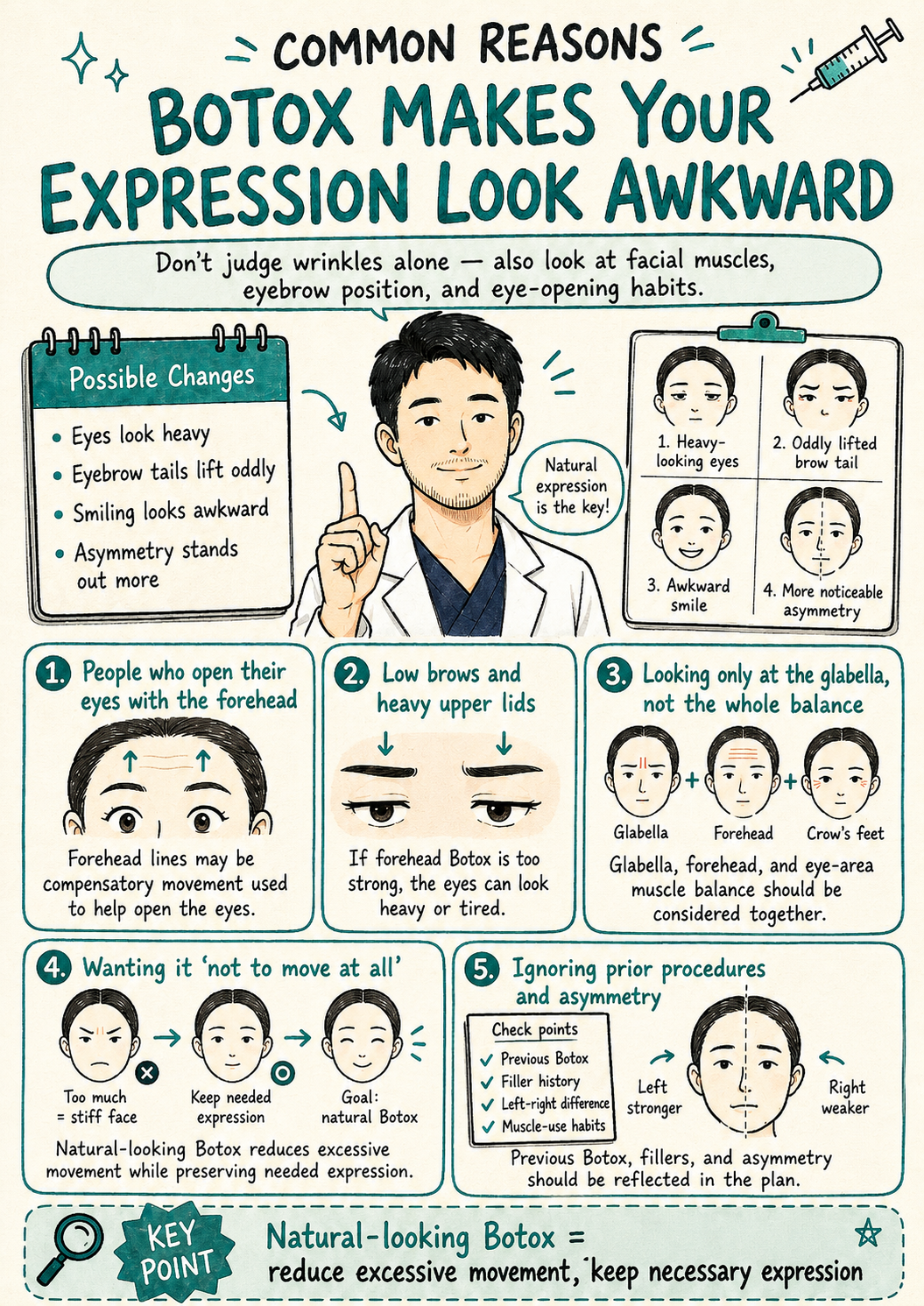
Common trait 1: People who open their eyes with their forehead
Patients who say, “My eyes feel heavy,” “My eyes look smaller,” or “My face looks tired after Botox” often have a habit of using the frontalis muscle to open their eyes.
If the eyelids are naturally heavy, the eyebrows are low, the upper eyelid skin is lax, or there is a tendency toward eyelid ptosis, the person may unconsciously lift the forehead to keep the eyes open. In this case, forehead wrinkles may represent compensatory movement for visual comfort, not simply aging lines.
If strong forehead Botox is applied in this situation, the wrinkles may soften, but the compensatory lifting function may also decrease. This is one reason why the forehead can look smoother while the overall expression becomes heavier or more tired.
Common trait 2: Low eyebrows or heavy upper eyelids
People with low eyebrows or heavy upper eyelids may be more likely to feel that their expression has become heavier after forehead Botox. This is especially true when the lateral eyebrow is already low or the distance between the eye and eyebrow is short.
On the other hand, if the central forehead is weakened more than the lateral forehead, the outer brow may appear relatively elevated. Patients may describe this as “my eyebrows look strange,” “I look sharp,” or “I look surprised.”
Why this matters
Forehead Botox should not be planned based only on the number of wrinkles. Eyebrow position and eye-opening habits should be assessed first.
Common trait 3: Strong frown lines without evaluating the surrounding balance
Glabella Botox is often associated with high satisfaction. However, patients with strong frowning muscles still need careful evaluation of the surrounding muscles and eyebrow position.
The glabellar muscles pull the eyebrows inward and downward. Weakening this movement may soften the expression, but it can also change the balance of the brow. In people with complex interactions between the forehead, orbicularis oculi, and glabellar muscles, simply injecting fixed points with the same dose may not create a natural-looking result.
Common trait 4: Wanting the wrinkles to stop moving completely
Some patients request, “Please make it not move at all.” In certain cases, such as strong habitual expressions or specific professional needs, reducing movement significantly may be appropriate. However, stronger freezing is not always better for everyone.
A natural facial expression does not mean that there are no wrinkles at all. It means that excessive folding is reduced while enough movement remains for normal expression. In patients with skin laxity, eyelid heaviness, or midface volume change, overly strong Botox may make the face look stiff rather than refreshed.
In one sentence
Natural-looking Botox is not about eliminating muscle movement; it is about reducing excessive movement while preserving the movements that should remain.
Common trait 5: Previous aesthetic procedures were not shared or considered
Many people receive Botox repeatedly. The issue is that residual effects from previous Botox, fillers, thread lifting, lifting lasers, eyelid surgery, brow lifting, and jaw muscle habits can all influence the current facial expression.
At Springday Clinic Sinchon, Seoul, we check the patient’s previous procedure history, the timing of the most recent Botox treatment, past uncomfortable reactions, desired impression, and expressions the patient wants to avoid. This is important not only for first-time Botox patients, but also for patients who have received repeated treatments at different clinics.
Checklist before your Botox consultation
Check the following before your consultation
- You tend to lift your forehead to open your eyes comfortably.
- You have been told that your eyebrows are low or your upper eyelids look heavy.
- You previously felt that your eyes became heavy or smaller after forehead Botox.
- Your eyebrow shape looked strange after glabella Botox.
- Your smile looked awkward because the eye area did not move naturally.
- You received Botox at another clinic within the past 3 to 4 months.
- You recently had fillers, thread lifting, eyelid surgery, or lifting laser treatments.
- A natural expression is more important to you than completely removing every wrinkle.
Bo Won Lee, M.D., Medical Director of Springday Clinic Sinchon, approaches Botox not as a treatment that simply removes wrinkles, but as a procedure that adjusts excessive facial muscle activity while preserving necessary expression. For patients looking for Botox in Seoul, especially around Sinchon, Hongdae, Ewha, and Mapo, the priority is not just the dose, but careful evaluation of facial structure and expression patterns.
It may not be that Botox is wrong for you — the plan may have been wrong
If your expression looked strange after Botox, it does not necessarily mean that Botox itself is unsuitable for you. Of course, Botox should be avoided or approached with caution in patients with hypersensitivity to botulinum toxin, infection at the injection site, certain neuromuscular disorders, pregnancy, or breastfeeding.
However, in many cases, the issue is not that “Botox does not suit my face,” but that “the Botox design did not suit my face.” Even with the same product and dose, the result can vary depending on which muscle is treated, how deep the injection is placed, how wide the treatment range is, and how much movement is intentionally preserved.
How we evaluate Botox at Springday Clinic
We do not evaluate only the resting face. We also observe how the patient opens the eyes, frowns, smiles, and moves different facial areas. Treatment area, dose, skin condition, previous procedure history, and possible side effects should all be considered to achieve a more natural result.
FAQ
References and official sources
- FDA. BOTOX Cosmetic Prescribing Information. Revised 10/2024.
- DailyMed. BOTOX Cosmetic label.
- Biello A, et al. Botulinum Toxin Treatment of the Upper Face. StatPearls/NCBI Bookshelf.
- Carruthers J, et al. Consensus recommendations on the use of botulinum toxin type A in facial aesthetics. Plast Reconstr Surg. 2004. PMID: 15507786.
- Sundaram H, et al. Global Aesthetics Consensus: Botulinum Toxin Type A. Plast Reconstr Surg. 2016. DOI: 10.1097/01.prs.0000475758.63709.23.
- Nestor MS, et al. Botulinum toxin-induced blepharoptosis. Journal of Cosmetic Dermatology. 2021. PMID: 34378298. DOI: 10.1111/jocd.14361.
- Zargaran D, et al. Complications of Cosmetic Botulinum Toxin A Injections to the Upper Face. Aesthetic Surgery Journal. 2022. PMID: 35178552.
Botox may look simple, but it can change your facial expression
More important than price or trends is deciding which muscles should be softened and which movements should remain. If you are considering Botox in Seoul, especially near Sinchon, Hongdae, Ewha, or Mapo, a detailed consultation can help determine a plan that better matches your facial structure and expression pattern.
#Botox Side Effects, #Natural Botox, #Forehead Botox, #Glabella Botox, #Botox Facial Expression, #Heavy Eyes After Botox, #Eyebrow Ptosis, #Botox Asymmetry, #Botox in Seoul, #Springday Clinic Sinchon


