MEDICAL COLUMN · FILLER CONSULTATION
Why Fillers Can Look Overdone: It’s Not Just About Too Much Volume
An unnatural look after filler treatment is not simply caused by injecting “too much.”
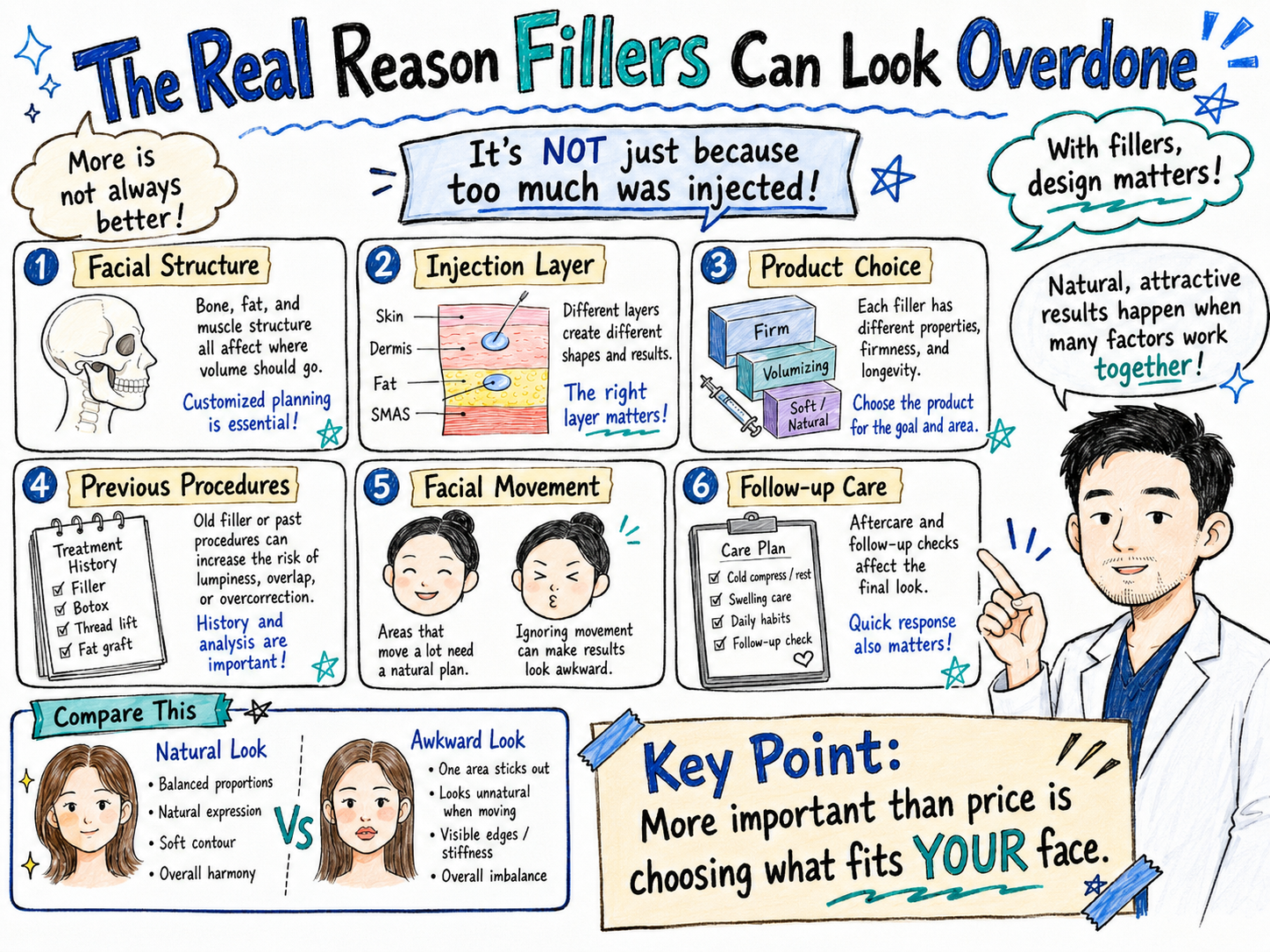
Facial structure, injection layer, product choice, previous procedures, facial movement, and follow-up planning all matter when aiming for a natural-looking result.
Written from the clinical perspective of Bo Won Lee, M.D., Representative Director of Springday Clinic Sinchon
POINT 01
“Overdone filler face” is not a medical diagnosis.
However, when patients use this expression, they are often describing concerns such as unnatural volume, a heavy-looking face, a stiff expression, or a result that does not match their original facial features.
POINT 02
Planning matters more than volume alone.
Even the same 1 cc of filler can be too much or too little depending on facial structure, skin thickness, facial movement, and previous procedure history.
POINT 03
Follow-up care is part of the treatment.
Filler treatment may be quick, but it is still a medical procedure. Bruising, swelling, inflammation, vascular issues, and other warning signs should be properly distinguished and addressed.
What Do Patients Mean by an “Overdone Filler Look”?
During filler consultations, I often hear patients say things like, “I want to look better, but I do not want to look overdone,” or “I am worried about looking unnatural in real life even if the photos look fine.”
The phrase “overdone filler look” is not a formal medical diagnosis. Still, it is a meaningful expression in the consultation room. In most cases, patients are worried about unnatural volume, an awkward change in facial impression, a stiff or heavy-looking expression, or a facial contour that does not fit their original features.
Some patients in the Seoul aesthetic market, including those searching around Sinchon, Hongdae, Ewha, or Mapo, may first compare filler prices or promotional volumes. However, filler treatment is not simply about filling empty spaces with gel. It is a medical procedure that requires evaluation of facial proportions, movement, skin thickness, vascular anatomy, and previous procedures.
In one sentence: an overdone filler look is not just about having too much filler; it is more often about volume being placed in a way that does not match the patient’s facial structure.
Seven Reasons Fillers Can Look Unnatural
1. Treating only the visible area, not the true cause
Patients often point to the area that looks hollow or wrinkled first. If the nasolabial fold looks deep, they may think of nasolabial fold filler. If the lips look thin, they may think of lip filler. If the chin looks short, they may think of chin filler. However, the most visible area is not always the true cause.
For example, a deep-looking nasolabial fold may be caused by actual volume loss in that fold, but it may also be related to midface support, cheek descent, or perioral movement. If filler is placed only into the fold without evaluating the overall structure, the mouth area may end up looking thick or heavy instead of naturally improved.
2. Looking at local volume instead of overall facial balance
Natural-looking filler treatment is closer to facial balance correction than isolated area filling. The cheeks, temples, chin, lips, nasolabial folds, and under-eye areas do not exist separately. They all work together to create the overall facial impression.
If someone already has sufficient anterior cheek volume, adding more cheek filler may not make the face look younger. It may instead make the central face look puffy or widened. On the other hand, for someone with a short chin and weak lower-face balance, a small amount of chin support may help the overall face look more refined.
In one sentence: natural filler treatment is not about filling more; it is about adding only what is needed in a way that looks less artificial.
3. Injecting into the wrong layer
The layer where filler is placed matters. Depending on whether filler is placed in a superficial layer, fat layer, or deeper plane near the bone, the visible shape and tactile feel may differ.
Some areas require superficial, delicate refinement, while others require deeper structural support. If a filler that should be placed deeply is placed too superficially, it may look lumpy or visible through the skin. If a firm product is placed in a thin, delicate area, the result may look heavy or stiff.
The under-eye area, lips, nose area, and glabella require extra caution due to skin thickness and vascular anatomy. The U.S. FDA also notes that accidental injection of dermal filler into blood vessels can lead to serious complications.
4. Choosing a product that does not fit the purpose
Not all fillers behave the same way. Even among hyaluronic acid fillers, products differ in elasticity, cohesiveness, particle feel, longevity, and spreading behavior. Some products are better suited for structural support, while others are more appropriate for soft blending in thin or mobile areas.
For a highly mobile and delicate area such as the lips, a filler that is too firm may feel or look unnatural during speech or smiling. Conversely, for areas that need projection or structural support, such as the chin, a very soft product may not maintain the intended contour for long.
5. Ignoring previous fillers, thread lifting, or fat grafting history
A face that has never received filler and a face that has received multiple procedures should not be approached in the same way. Even if a patient feels that old filler has disappeared, some product may remain, or tissue changes such as fibrosis or recurrent swelling may have developed.
Previous fat grafting, thread lifting, lifting lasers, botulinum toxin, and contouring injections may also affect facial volume and movement. In many aesthetic clinic consultations, including patients who have visited several clinics around Sinchon or Hongdae, it is important to trace what was done, when it was done, and why it was done as much as possible.
6. Not checking facial expressions and movement
Filler should not only look acceptable when the face is still. It should also look reasonably natural when the patient smiles, speaks, purses the lips, turns the head, or changes facial expression. The lips, nasolabial folds, anterior cheeks, under-eye area, and chin can all look different during movement.
If a treatment plan is based only on a front-facing still photo, important details may be missed. In practice, it is helpful to evaluate the face from the front, 45-degree angle, side view, smiling expression, neutral expression, and sometimes from below.
7. Having no clear follow-up or complication response plan
Filler treatment may be completed quickly, but it is still a medical procedure. Bruising, swelling, tenderness, lumpiness, inflammation, nodules, Tyndall effect, and vascular issues can occur. Many reactions are temporary and manageable, but some require prompt assessment.
Why this matters
One advantage of hyaluronic acid filler is that hyaluronidase may be used when reduction or dissolution is needed. However, this does not mean every situation can be solved easily. Non-hyaluronic acid fillers, old filler, mixed products, inflammatory nodules, and vascular complications may require more complex clinical judgment.
What Should a Natural-Looking Filler Consultation Evaluate?
The most important question in a filler consultation is not “How many cc should we inject?” The more important question is, “Why does this area look hollow or aged?” Even the same nasolabial fold can have different causes, such as skin laxity, midface volume loss, perioral movement, or deeper facial structure.
※ This table is for educational comparison only. Actual treatment decisions may vary depending on the individual patient’s condition.
Bo Won Lee, M.D., Representative Director of Springday Clinic Sinchon, approaches filler treatment with the principle that “more” is not always better. The goal is not simply to create a dramatic immediate change, but to plan a direction that still looks natural over time.
How we look at filler consultation
At Springday Clinic Sinchon, filler consultation is not approached simply as “which area and how many cc.”
From a physician-led consultation perspective, we evaluate individual facial structure, skin condition, previous procedure history, possible complications, and follow-up response planning. For patients coming from areas such as Ewha or Mapo, it is important to focus on their own current facial condition rather than relying only on promotional photos or before-and-after images.
Who May Be a Good Candidate for Filler, and Who Should Be More Cautious?
In one sentence: natural filler consultation is not about choosing from a price list; it is about distinguishing what should be improved from what should be avoided.
Pre-Filler Consultation Checklist
Questions to review before filler treatment
- Do you know the product name, date, area, and volume of any previous filler treatment?
- Have you ever had filler dissolved?
- Have you experienced inflammation, nodules, recurrent swelling, or pain after filler?
- Is your goal wrinkle reduction, facial balance, or overall impression improvement?
- Can you allow time for bruising and swelling to settle?
- Do you have an important event soon?
- Have you had fat grafting, thread lifting, contouring injections, or lifting laser treatments?
- Are you taking anticoagulants, aspirin, or supplements that may need to be discussed?
- Are you choosing only based on the lowest price?
Warning Signs After Filler and Follow-Up Response
Bruising, swelling, and mild tenderness can occur after filler treatment. However, not every discomfort should be dismissed as ordinary swelling.
If the treated area or surrounding skin becomes unusually pale, develops a net-like discoloration, becomes severely painful, shows rapid color change, or if any visual symptoms occur, the patient should contact the treating clinic immediately and be evaluated. Vascular events are uncommon, but when they occur, timely response is important.
Consultation point
When deciding on filler treatment, it is important to consider not only whether a clinic can create an attractive result, but also whether there is a clear plan for what to do if a problem occurs. Product name, injection area, expected volume, recovery period, dissolving options, and return-visit criteria should be discussed in advance.
FAQ
References and Official Sources
- U.S. Food and Drug Administration. Dermal Fillers (Soft Tissue Fillers).
- U.S. Food and Drug Administration. Dermal Filler Do’s and Don’ts for Wrinkles, Lips and More. 2023.
- Signorini M, Liew S, Sundaram H, et al. Plastic and Reconstructive Surgery. 2016;137(6):961e-971e. DOI: 10.1097/PRS.0000000000002184.
- Beleznay K, Carruthers JDA, Humphrey S, Jones D. Dermatologic Surgery. 2015;41(10):1097-1117. DOI: 10.1097/DSS.0000000000000486.
- Heydenrych I, Kapoor KM, De Boulle K, et al. Clinical, Cosmetic and Investigational Dermatology. 2018;11:603-611. DOI: 10.2147/CCID.S180904.
In aesthetic filler treatment, some decisions rely on expert consensus, clinical experience, retrospective data, and case-based guidance rather than large randomized trials. Therefore, the level of evidence for detailed aesthetic design and “natural-looking” judgment is limited.
Start by Asking Whether Filler Is Truly Needed
Filler treatment can help soften and refine facial impressions when it is appropriate, but it is not the answer to every hollow area or wrinkle. A consultation should evaluate facial structure, skin condition, previous procedures, and possible risks before deciding on the most suitable direction.
dermal fillers, hyaluronic acid filler, overfilled face, unnatural filler look, filler complications, filler consultation, facial anatomy filler, filler safety, filler migration, aesthetic medicine


