Ultherapy, Shurink, LinearZ, VRO, and CoolSonic:
A Physician’s Honest Perspective After Using Them All

A Note Before We Begin
There is often a significant gap between how a medical professional views a treatment and how a patient perceives it.
Patients are not expected to possess the same level of medical knowledge, technical understanding, or clinical experience as physicians. This information asymmetry naturally creates differences in perception regarding aesthetic treatments.
Even among skincare professionals who have worked in dermatology clinics for years, I have found that individual knowledge and understanding can vary tremendously.
This article will be published as a two-part series. While it may be a lengthy read, I believe that patients interested in lifting treatments will gain a much clearer understanding of how these procedures actually work—and why understanding your treatment before undergoing it matters.
The Real Story Behind HIFU Lifting:
Comparing Ultherapy, Shurink, LinearZ, and CoolSonic
Hello, I am Dr. Bowon Lee, Medical Director of Spring Day Clinic Sinchon.
One of the lifting devices patients ask about most frequently these days is CoolSonic.
Common questions include:
"Is it similar to Ultherapy?"
"How is it different from Shurink?"
"If it hurts less, does that mean it's less effective?"
Whenever I hear these questions, I find them somewhat amusing because they all ultimately lead to the same question:
"Is this treatment actually worth getting?"
Today, I would like to discuss CoolSonic from a physician’s perspective.
Rather than focusing on marketing phrases such as "comfortable" or "cooling technology," I want to explain what HIFU technology actually is, why Ultherapy continues to be considered the benchmark, and where newer cooling-assisted HIFU devices such as CoolSonic fit into the overall landscape.
This may not be the type of article device manufacturers would necessarily enjoy reading.
However, I believe these are important points that patients should understand before making treatment decisions.
First, What Exactly Is HIFU?
If you have researched lifting treatments, you've probably encountered a long list of device names:
Ultherapy, Shurink, LinearZ, Liftera, VRO, Doublo, Ultraformer, CoolSonic, and many others.
Although the names differ, most of these devices share the same fundamental technology:
HIFU (High-Intensity Focused Ultrasound).
A simple analogy would be using a magnifying glass to focus sunlight.
Sunlight itself may not feel particularly hot, but when concentrated into a single point, it can generate enough heat to burn paper.
HIFU works in a similar way.
Ultrasound energy is concentrated at a specific depth beneath the skin, creating tiny areas of thermal coagulation known as Thermal Coagulation Points (TCPs).
These focal points can momentarily reach temperatures of approximately 60–70°C (140–158°F).
Following treatment, the body's natural wound-healing response stimulates new collagen production around these microscopic treatment zones.
Many people think of lifting procedures as treatments that simply "pull the skin tighter."
In reality, HIFU is better understood as a treatment that encourages the skin to rebuild and remodel itself.
This is why immediate results are often less important than the gradual improvements that develop over one to three months following treatment.
How Is HIFU Different from Radiofrequency (RF)?
This is another area where patients frequently become confused.
Many patients ask:
"What's the difference between HIFU and Thermage?"
My simplest explanation is:
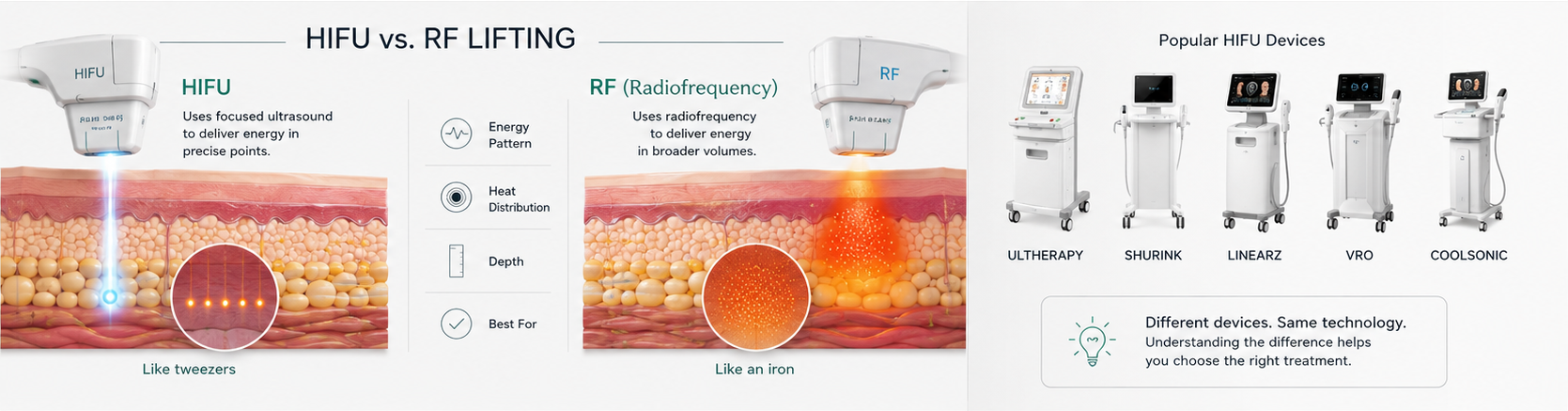
HIFU creates heat in points.
Radiofrequency creates heat in volumes.
HIFU generates highly focused thermal coagulation points at specific depths.
Radiofrequency devices such as Thermage, Density, and Volnewmer create broader zones of thermal heating.
Both technologies ultimately rely on heat generation.
Both create thermal gradients within tissue.
However, their starting mechanisms differ significantly.
HIFU creates concentrated focal points of thermal injury.
Radiofrequency creates broader and more diffuse heating zones.
As a result, the clinical outcomes and treatment characteristics are naturally different.
One analogy I often share with patients is:
HIFU is like a pair of tweezers.
Radiofrequency is like an iron.
Both have value.
They simply serve different purposes.
Why Is Ultherapy Still Considered the Gold Standard?
This is a topic that deserves an honest discussion.
There are legitimate reasons why Ultherapy remains significantly more expensive than many competing devices.
One important factor is energy delivery.
For example, a typical Shurink setting often operates around 0.5 Joules.
Ultherapy commonly operates around 0.9 Joules.
While devices cannot be compared solely based on numerical energy values, the difference is substantial.
Like all medical devices, manufacturing tolerances exist.
Variations of approximately ±20% may occur depending on device design and production standards.
Even with those considerations, it is difficult to deny that Ultherapy has historically been one of the more powerful HIFU systems available.
This is likely one of the reasons why it has consistently demonstrated strong clinical outcomes over the years.
Ultherapy also incorporates MFU-V (Microfocused Ultrasound with Visualization).
In other words, the physician can visualize tissue layers during treatment using real-time ultrasound imaging.
And this is where the discussion becomes a bit more interesting.
A Point That Marketing Departments May Not Appreciate
The ability to see tissue layers during treatment is certainly an advantage.
However, there is something I would like patients to understand.
Being able to visualize tissue is not the same thing as actively monitoring every single treatment shot in real time.
Those are two very different concepts.
And that distinction leads us into the next part of this discussion.
(To be continued in Part 2)
Written by Dr. Bowon Lee
Medical Director, Spring Day Clinic Sinchon
Author of SCI-indexed publications
Degrees in Engineering, Medicine, and Business Administration


