What Went Through My Mind When a Patient Paid $1,500 and Lay Down on the Treatment Bed
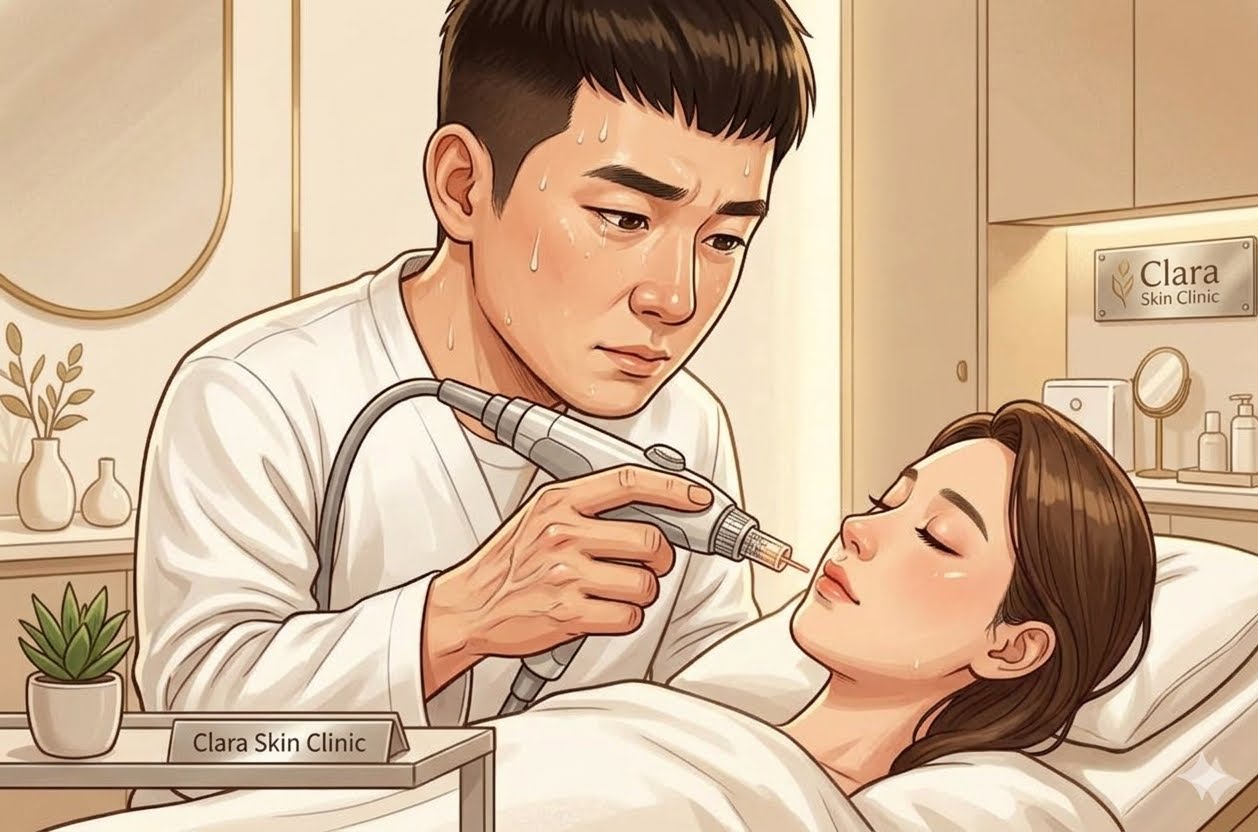
Earlier today, a patient visited our clinic and received a combination of a 10,000-shot CoolSonic lifting treatment along with Botox injections in several areas of the face.
The total cost, including tax, came close to 2 million Korean won.
As I watched the patient quietly lie down on the treatment bed after making a payment that was far from insignificant, I felt a strange heaviness settle in my chest.
While applying the cold gel and preparing the device, countless thoughts raced through my mind in those brief few seconds.
To be honest, I'm not one of those idealistic doctors who constantly talks about sacrifice and noble missions. Nor am I the kind of person people would describe as exceptionally virtuous.
Sometimes I speed through a yellow light when I'm in a hurry. If the crosswalk is inconveniently far away, I've been known to jaywalk. I've even tossed a candy wrapper beside a deserted utility pole without thinking much about it.
In other words, I'm far from being a saint.
I'm an ordinary person—sometimes selfish, sometimes flawed, and often guilty of taking the easy way out, just like everyone else.
And yet, there's something peculiar about me.
For someone who can be surprisingly practical and pragmatic in everyday life, why do I feel so burdened, so apologetic, whenever I recommend a lifting procedure that costs well over a thousand dollars?
The devices we use in our clinic are extraordinarily expensive.
Many cost tens of thousands of dollars. Some of the more advanced systems exceed a hundred thousand dollars with ease.
From a purely business perspective, once you account for equipment costs, consumable supplies, staff salaries, rent, utilities, and the countless expenses required to keep a clinic running, the treatment fee is entirely justified.
In fact, compared to clinics with similar experience, expertise, and treatment philosophies, our pricing is average—or perhaps even slightly below average.
By all logic, I should feel confident in charging what the treatment is worth.
But instead of thinking about profit margins or operational costs, I find myself feeling guilty.
I find myself wondering whether I'm asking too much.
And when I look closely at myself, I can't help but think that perhaps I'm being foolish.
Sometimes I sit alone and try to calculate the true weight of that amount of money.
Two million won.
For most ordinary people, that is not a small sum.
For someone, it may represent half a month's salary.
It may be the reward for weeks of waking up early, squeezing onto crowded buses and trains, enduring workplace stress, carrying family responsibilities, and simply doing their best to keep life moving forward.
Weeks of effort.
Weeks of sacrifice.
Weeks of life.
And then a question inevitably arises:
"Am I really allowed to take away two weeks of someone's hard-earned life in exchange for twenty minutes of treatment?"

Another question follows immediately after:
"How deeply must this person care? How sincere must their desire be to willingly exchange two weeks of their life, their labor, and their earnings, and then trust me completely with their face and body for twenty short minutes?"
Whenever I look at a patient lying quietly on the treatment bed with their eyes closed, I can almost feel the weight of that sincerity.
I imagine the moments they sighed at their reflection in the mirror.
The loneliness they may have felt while watching themselves grow older.
The hesitation they experienced before finally deciding to spend such a significant amount of money on themselves.
All of those emotions seem to pass across their face, even with their eyes closed.
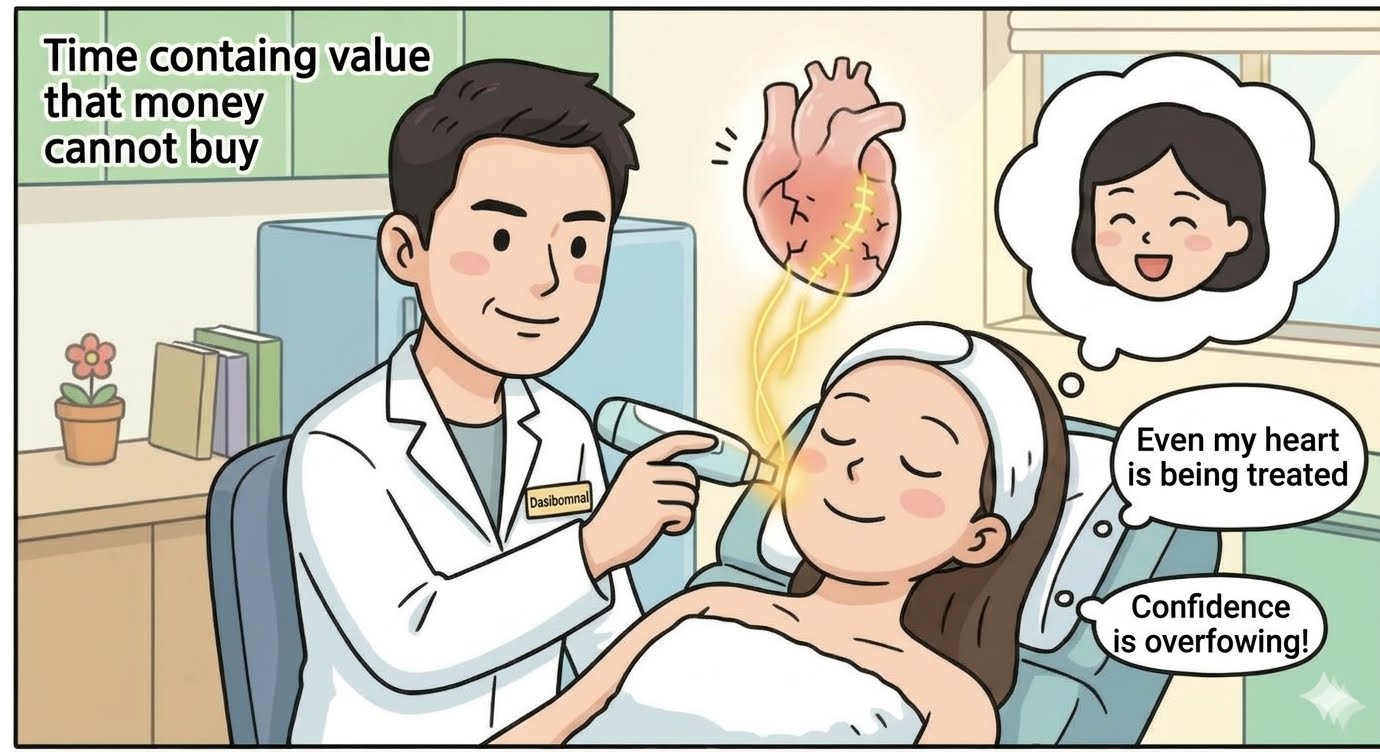
And in that moment, the handpiece in my hand no longer feels like a medical device.
It feels as heavy as a piece of someone's life.
Some people view aesthetic medicine with skepticism.
I've heard comments like, "How is this any different from a beauty salon?"
Television shows and comedians occasionally use cosmetic clinics as easy targets for jokes.
Others dismiss aesthetic medicine as nothing more than a commercial industry, arguing that it has strayed too far from the true purpose of medicine because it doesn't directly save lives.
I disagree.
Of course, I don't work in an emergency room.
I don't stand in an operating room fighting to save someone from death.
I don't place a stethoscope against a patient's chest and listen to the rhythm of their heartbeat.
Instead, I hold a treatment handpiece.
But in many ways, I use that handpiece like my own stethoscope.
Just as an internist listens carefully to subtle changes in breathing and heart sounds to uncover what is happening deep within the body, I place my device against the skin and look beneath what is visible.
I see sagging skin.
I see lost elasticity.
But beyond that, I often sense something deeper.
I see insecurities people never speak aloud.
I see fears about aging.
I see wounds to self-esteem that have accumulated quietly over years.
And because of that, I believe my responsibility carries its own unique weight.
Sometimes I find myself thinking that doctors who perform aesthetic procedures may be something unusual.
Perhaps we are psychiatrists holding syringes.
Or surgeons treating emotional scars.
What we change is not merely a wrinkle.
Not merely a jawline.
Not merely skin elasticity.
What we truly touch is often much deeper.
We help people who have lost confidence feel comfortable in their own skin again.
We help people who have become discouraged by age-related changes walk through the world with renewed self-assurance.
We help restore a sense of dignity that may have quietly faded over time.
In that sense, aesthetic medicine inevitably intersects with mental and emotional well-being.
The work is not simply about improving appearance.
It is about helping repair something within.
To me, medicine is not only the treatment of disease.
It is also the healing of invisible wounds.
The procedure itself may last only twenty minutes.
By the clock, that is a very short period of time.
But during those twenty minutes, I focus every ounce of my attention on honoring the trust my patient has placed in me.
I adjust the angle of the handpiece.
I carefully control the treatment depth.
I concentrate on every detail.
Because I know that what my patient entrusted to me is not merely money.
It is time.
It is effort.
It is hope.
It is a piece of their life.
I may still be the kind of imperfect person who occasionally takes shortcuts in everyday life.
But there is one thing I can never treat lightly.
The sincerity of the people who walk through the doors of my clinic and place their trust in me.
I suspect I will continue feeling guilty every time someone spends a significant amount of money on a procedure.
I will probably continue hesitating.
Continue questioning myself.
And perhaps that is precisely why I continue doing my very best.
Today, as always, I pick up the handpiece once again.
Not hiding behind expensive machines.
Not relying on technology alone.
But carrying the responsibility of someone who has been trusted with another person's hopes, confidence, and emotional well-being.
As long as I never lose this sense of humility—and this strange feeling of guilt—I believe those twenty minutes I spend with a patient can become something meaningful.
Something worthy of the weeks of effort they invested to be there.
And so today, once again, I make the same promise to myself:
To become a doctor who never takes that trust for granted.
This column was personally written by Dr. Bowon Lee, Medical Director of Dasibomnal Clinic Sinchon Branch.
Today, I would like to express my sincere gratitude to every patient who has chosen to visit our clinic among countless options available to them. In particular, this piece was inspired by one patient who remained in my thoughts long after the treatment had ended.
Perhaps you spent a long time looking in the mirror before deciding to seek treatment. Perhaps you hesitated more than once before making an appointment.
That is why I never take lightly the trust, time, and courage that each patient brings through our doors.
Even if you never become a patient at our clinic, I would also like to thank those who simply take the time to read these reflections and share in my thoughts through this blog.
Of course, treatment outcomes matter.
But if someone leaves the clinic feeling a little lighter than when they arrived, if they discover even a small spark of confidence when they look in the mirror, or if they find themselves smiling quietly on the way home, then I believe I have done something worthwhile.
I will continue striving to remain true to my original purpose and to become a doctor who is worthy of the sincerity and trust that every patient places in me.
Dr. Bowon Lee
Medical Director
Dasibomnal Clinic, Sinchon