Dermatology Clinic Promotions in Seoul: When Is an Event Price Actually a Good Deal?
Dermatology Clinic Promotions in Seoul: When Is an Event Price Actually a Good Deal?
The lowest advertised price is not necessarily the lowest total cost—or the best treatment choice.
Written by M.D. Bo Won Lee, Director of Springday Clinic Sinchon, Seoul.
Promotional pricing is extremely common in aesthetic medicine. Patients comparing clinics around Sinchon, Hongdae, Ewha, or Mapo may see dramatically different prices for procedures that appear to have the same name.
Does that mean the lowest price is automatically the smartest choice? No. But it also does not mean a low promotional price is inherently a warning sign.
A well-structured promotion can be genuinely good value. The important question is whether you know exactly what is being provided for that price and whether the treatment itself is appropriate for you.
What is the final amount you will actually pay?
What product, dose, volume, shots, area, or device setting is included?
Who assesses your indication and what happens if a problem occurs?
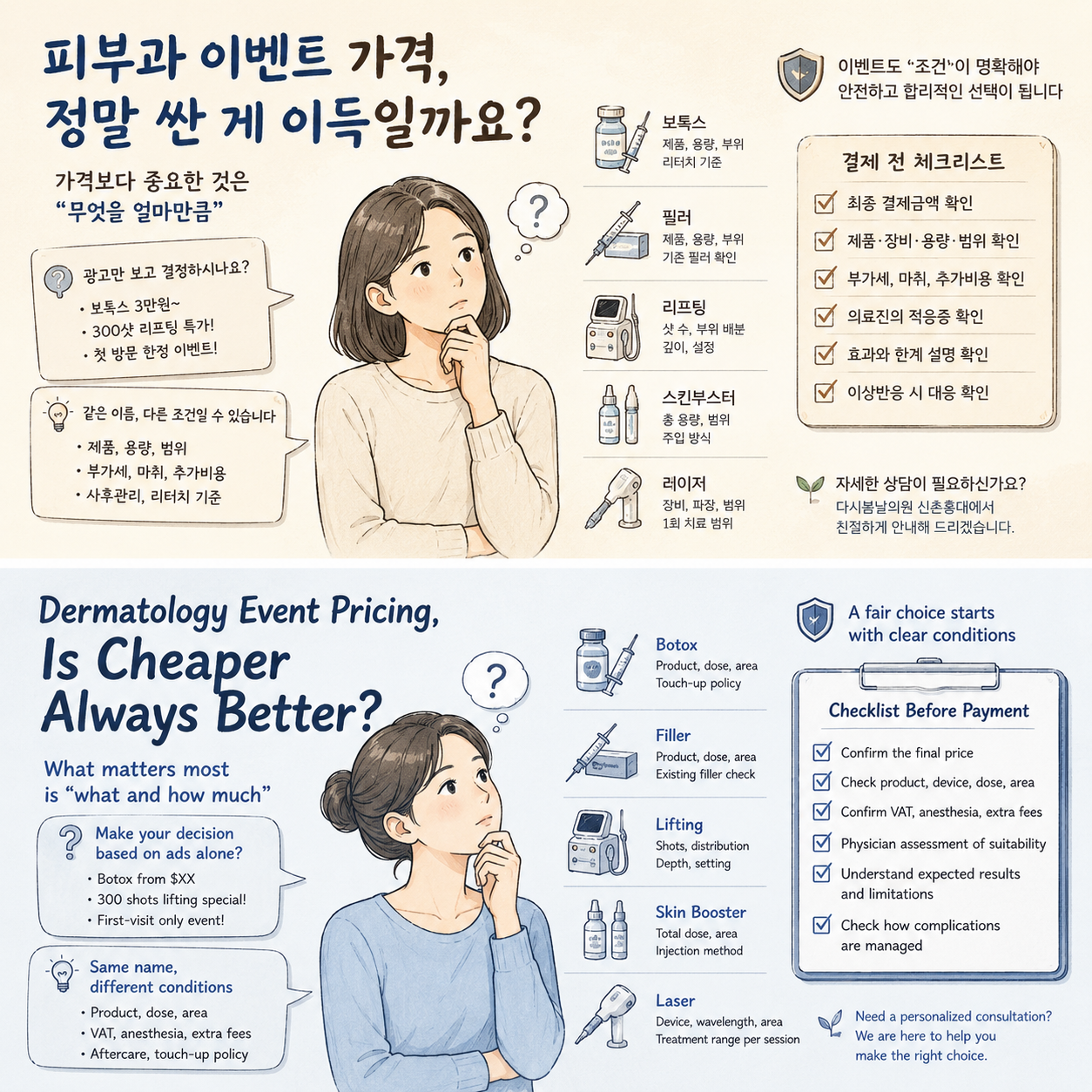
A promotion is not automatically inferior care
Clinics can offer promotional prices for many operational reasons. A treatment may be promoted during a launch period, appointments may be concentrated during specific days, or a clinic may simply use a lower-margin, higher-volume pricing model.
None of these possibilities proves that the treatment is good or bad. It is generally more useful to examine the actual conditions than to guess why one clinic is cheaper than another.
Similarly, a higher price does not guarantee a better aesthetic result. In cosmetic medicine, outcomes depend on much more than the product or device name.
The most important question: what exactly is included?
Two advertisements may both say “jaw Botox,” yet the actual treatment plans may differ. Muscle size, facial asymmetry, previous injections, dose, and injection pattern can all affect the plan.
Two clinics may both advertise 300 shots of an ultrasound lifting treatment, but the distribution of those shots, targeted depths, treatment areas, and patient anatomy may not be identical.
A filler advertisement may list “1 cc,” but safe and appropriate treatment also requires assessment of previous filler, facial anatomy, treatment goals, and the selected injection area.
The treatment name is therefore only the beginning of the comparison.
Advertised price versus final price
Before booking, ask whether the displayed price is the final amount for the treatment you plan to receive.
Depending on the service, taxes, anesthesia, additional medication or volume, disposable tips or cartridges, expanded treatment areas, aftercare, or touch-up policies may be handled separately. This does not mean that every clinic charges these items separately. Many clinics offer all-inclusive pricing.
“If I receive this exact treatment today, what is the total amount I will pay, and what does that price include?”
Under current Korean law, medical institutions must disclose applicable non-covered medical fees in a manner patients can readily access, and they may not collect more than the amount they have disclosed. Medical institutions with websites are also required to make applicable non-covered fee information available online under the relevant enforcement rules.
Korean medical advertising law also prohibits advertising discounts or exemptions for non-covered medical fees in a manner likely to deceive or mislead consumers. This is one reason transparency about the actual conditions matters more than the size of the discount itself.
What to check for different treatments
| Treatment | Check before comparing prices |
|---|---|
| Botulinum toxin | Product, treatment area, planned dose, asymmetry assessment, touch-up policy |
| Dermal filler | Product, total volume, target area, additional-volume pricing, follow-up plan |
| Skin booster | Exact product, total volume, injection method, treatment area, anesthesia |
| Energy-based lifting | Exact device, shots or tips, treatment area, depth and treatment planning |
| Laser treatment | Device or wavelength, full-face versus targeted treatment, number of sessions, aftercare |
| Packages | Number of sessions, validity period, modification and refund conditions |
Why a medical assessment still matters during a promotion
Promotional pricing should not replace clinical decision-making.
A patient may request nasolabial-fold filler, for example, while the visible fold may also be influenced by midface volume, facial anatomy, soft-tissue descent, or dynamic movement. A patient requesting masseter Botox may have facial width that is influenced more by skeletal structure or fat than by muscle size.
These distinctions matter because the treatment a patient asks for is not always the treatment most likely to address the actual concern.
Recent literature in aesthetic medicine emphasizes expectation management, informed consent, and clear patient-clinician communication. Results may vary, and realistic treatment goals should be discussed before a procedure rather than after payment.
A low price matters less if the treatment is wrong for you
For simple, familiar treatments that a patient has received successfully before, promotional pricing may be especially practical when the product, dose, area, and follow-up conditions are clear.
More caution is reasonable when the procedure is new to you, expensive, intended to alter facial shape, or associated with previous adverse reactions. In such situations, a medical assessment generally deserves more weight than the promotional discount.
Aftercare is part of the value
Minimally invasive cosmetic procedures can still cause adverse events. Common temporary reactions may include swelling, bruising, redness, tenderness, or pain, while some procedures can produce less common complications requiring prompt medical evaluation.
Published medical literature on complications of minimally invasive cosmetic procedures emphasizes timely recognition and management when complications occur.
Rather than looking for a clinic that claims complications never happen, ask what happens if an unexpected problem occurs.
A practical value test
A promotion is easier to evaluate when the final price, exact treatment, product or device, dose or shot count, treatment area, medical assessment, and aftercare policy are all clearly explained.
Be more cautious when the price is presented only as “starting from,” the actual dose or area is unclear, multiple additional options appear only after arrival, or there is strong pressure to pay immediately before a meaningful medical consultation.
How I approach promotional treatments at Springday Clinic Sinchon
Price is a legitimate and important consideration for patients. My approach, however, is to determine whether the procedure makes sense before deciding whether the promotional price makes sense.
That means looking at facial structure, soft-tissue distribution, skin characteristics, muscle movement, asymmetry, previous aesthetic procedures, prior adverse reactions, and the patient's actual goal.
A more expensive procedure is not automatically the better procedure. The more appropriate procedure is the better starting point.
A promotional treatment can therefore be a reasonable option when the indication is appropriate and its conditions are transparent.
Pre-payment checklist
☐ I know the exact product or device.
☐ I know the treatment area.
☐ I know the planned volume, dose, shots, or relevant treatment conditions.
☐ I know whether tax is included where applicable.
☐ I know whether anesthesia or disposables cost extra.
☐ I know the cost of additional volume if needed.
☐ A clinician has assessed whether the treatment is appropriate.
☐ Expected benefits and limitations have both been explained.
☐ I know how to contact the clinic if an unexpected reaction occurs.
☐ For a package, I understand validity, modification, and refund conditions.
FAQ
References
Republic of Korea Medical Service Act, Article 45, effective April 7, 2026.
Enforcement Rule of the Medical Service Act, Article 42-2, effective June 12, 2026.
Republic of Korea Medical Service Act, Article 56, effective April 7, 2026.
Enforcement Decree of the Value-Added Tax Act, Article 35, effective April 1, 2026.
Friedman O. Expectation management and patient-surgeon communication in aesthetic surgery: A narrative review of current challenges and communication strategies. Patient Educ Couns. 2026;146:109511. PMID: 41653542.
Complications of minimally invasive cosmetic procedures: prevention and management. 2012. PMID: 23060707. PMCID: PMC3461789.
Germani M, et al. Unveiling Patient Expectations: Insights From a Cross-Sectional Study on Facial Aesthetic Treatments. Dermatol Surg. 2025. PMID: 39584694.
At Springday Clinic Sinchon, consultation can begin with your concern, previous treatments, and desired change so that appropriate options and their limitations can be discussed before treatment.