Why a Cheap Botox or Filler Treatment Can Sometimes Look Unnatural — and Why Price Is Not the Real Issue
Why a Cheap Botox or Filler Treatment Can Sometimes Look Unnatural — and Why Price Is Not the Real Issue
The quality of an aesthetic injection cannot be judged by its price tag alone.
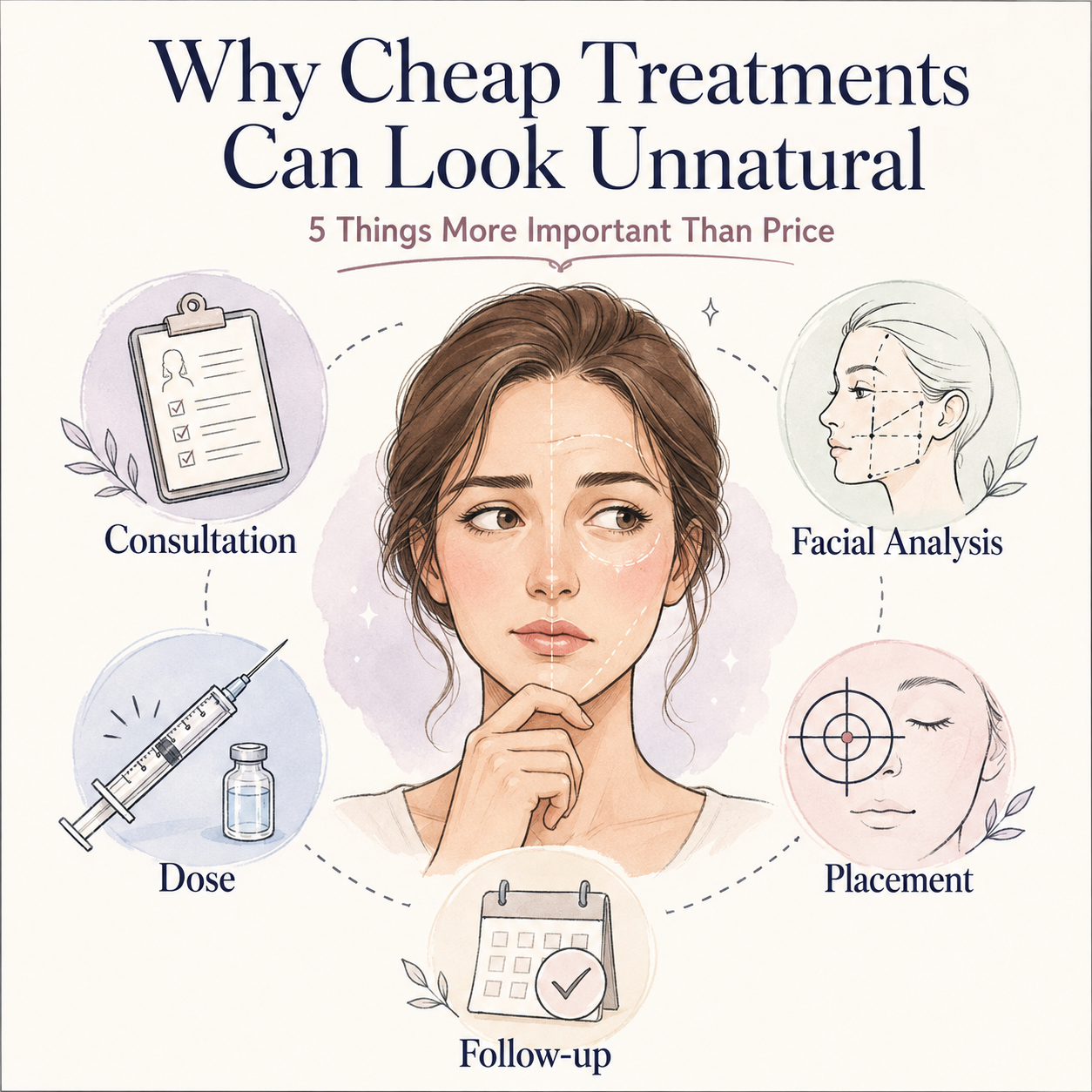
A very inexpensive Botox or filler treatment is not automatically a bad treatment. Likewise, a premium price does not guarantee a natural or complication-free result.
The more useful question is what happens between the consultation and the end of follow-up.
Was your facial anatomy, asymmetry, movement and previous treatment history evaluated?
Were the treatment area, dose, volume and distribution chosen for your individual face?
Is there a clear pathway if the result is unexpected or a complication is suspected?
Low price itself is not a medical risk factor
Clinics can offer lower prices for many legitimate reasons, including purchasing arrangements, promotional strategies or operational efficiency. There is no reliable evidence that a low price by itself predicts a poor cosmetic outcome.
The opposite assumption is equally problematic. Paying more does not automatically mean that the treatment plan is more appropriate for your face.
What matters clinically is whether essential parts of assessment, treatment planning, injection technique and post-treatment management are preserved.
The same product does not mean the same treatment
A face is dynamic. Muscle activity changes when a person smiles, raises the eyebrows, talks or squints. Baseline asymmetry is common. Bone structure, fat distribution, skin thickness and previous procedures also vary considerably between patients.
Modern consensus recommendations for aesthetic botulinum toxin treatment emphasize both static and dynamic facial assessment, documentation of pre-existing asymmetry and treatment planning based on the patient's anatomy and goals.
Dermal filler treatment is similarly individualized. The U.S. FDA notes that successful filler outcomes depend in part on underlying tissue structure as well as the volume and type of filler used.
1. Inadequate facial assessment
A consultation should do more than identify the area a patient points to. The clinician needs to determine why that area looks the way it does.
A visible nasolabial fold, for example, does not automatically mean that the fold itself should simply be filled. A wide lower face does not automatically mean that masseter botulinum toxin is the appropriate solution. Anatomy, muscle activity, volume distribution and tissue laxity can contribute in different proportions.
This does not mean that every consultation must be long. There is no universal evidence-based minimum consultation duration for aesthetic injections. What matters is whether the necessary assessment has actually been completed.
2. Dose is only meaningful when combined with distribution
Undertreatment can lead to an inadequate response, but using a smaller amount is not inherently wrong. Conservative treatment may be desirable in many facial areas.
With fillers, one syringe placed in a single location is not equivalent to the same volume strategically distributed across several structural points.
With botulinum toxin, different muscles and indications require different injection patterns. The official prescribing information for onabotulinumtoxinA, for example, specifies distinct injection sites and doses for different approved cosmetic indications.
The better question is therefore not simply, “How many units or milliliters am I getting?” but also, “Why is that amount being placed there?”
3. Treating the visible problem instead of its cause
Patients naturally describe what they see: a hollow, a fold, a broad jaw, a drooping corner of the mouth or an uneven eyebrow. The structure responsible for that appearance may not be located exactly where the problem is visible.
This is one reason facial aesthetic treatment requires an anatomic rather than purely product-based approach.
For fillers, this is also a safety issue. The FDA advises clinicians to understand the anatomy around the injection site and the location of blood vessels. Unintentional intravascular filler injection can rarely result in severe complications including tissue necrosis, visual impairment or stroke.
4. High patient volume is not automatically poor medicine
It would be inaccurate to say that a busy or high-volume clinic necessarily produces worse outcomes. A well-organized clinic may treat many patients while maintaining appropriate assessment, documentation and safety procedures.
There is also insufficient evidence to claim a direct numerical relationship between clinic turnover and complication rates in aesthetic injections.
The more relevant question is whether efficiency causes essential clinical steps to disappear.
5. The treatment does not end when the injection ends
Bruising, swelling and temporary asymmetry can occur after aesthetic injections. Other problems may require clinical reassessment. Dermal fillers also carry uncommon but potentially serious risks such as vascular occlusion.
For this reason, complication recognition and a clear management or referral pathway are important parts of an injectable practice.
A practical question before treatment is: “Who should I contact if something does not look or feel right afterward?”
When a lower-cost treatment may be perfectly reasonable
A lower price can be a meaningful advantage when the indication is clear, the product and treatment scope are transparent, the patient has been properly assessed, and an appropriate follow-up system is available.
Patients who have previously received the same treatment and have a well-documented, predictable response may also be easier to manage efficiently than first-time patients requiring a comprehensive facial plan.
Price efficiency and medical quality are not inherently incompatible.
Situations where price alone becomes a poor comparison tool
A more useful comparison
Price
Units or milliliters
Promotional discount
Dynamic movement
Baseline asymmetry
Previous treatment history
Dose distribution
Expected limitations
Complication management
Pre-treatment checklist
□ Do I understand what is causing the appearance I want to change?
□ Has my baseline asymmetry been assessed?
□ Have I disclosed previous fillers, toxins and lifting procedures?
□ Do I know the product and approximate treatment scope?
□ Do I understand why this dose or volume was selected?
□ Have realistic limitations been discussed?
□ Do I know what to do if I develop an unexpected reaction?
FAQ
References
1. U.S. Food and Drug Administration. Dermal Fillers (Soft Tissue Fillers).
2. BOTOX Cosmetic (onabotulinumtoxinA) Prescribing Information. Revised October 2024.
3. Ascher B, et al. International Consensus Recommendations on the Aesthetic Usage of Ready-to-Use AbobotulinumtoxinA. Aesthetic Surgery Journal. 2024;44(2):192-202. doi:10.1093/asj/sjad222.
4. Goodman GJ, Liew S, Callan P, Hart S. Facial aesthetic injections in clinical practice: Pretreatment and posttreatment consensus recommendations to minimise adverse outcomes. Australas J Dermatol. 2020;61:217-225. doi:10.1111/ajd.13273.
5. Urdiales-Gálvez F, et al. Preventing the Complications Associated with the Use of Dermal Fillers in Facial Aesthetic Procedures. Aesthetic Plast Surg. 2017;41:667-677. doi:10.1007/s00266-017-0798-y.