Can a Higher-Powered Korean Monopolar RF Device Outperform Thermage FLX?
EVIDENCE-BASED AESTHETIC MEDICINE
Can a Higher-Powered Korean Monopolar RF Device Outperform Thermage FLX?
Why wattage, treatment level, and pain intensity cannot determine clinical superiority.
Written by M.D. Bo Won Lee, Director of Springday Clinic Sinchon, Seoul.
Three-line overview
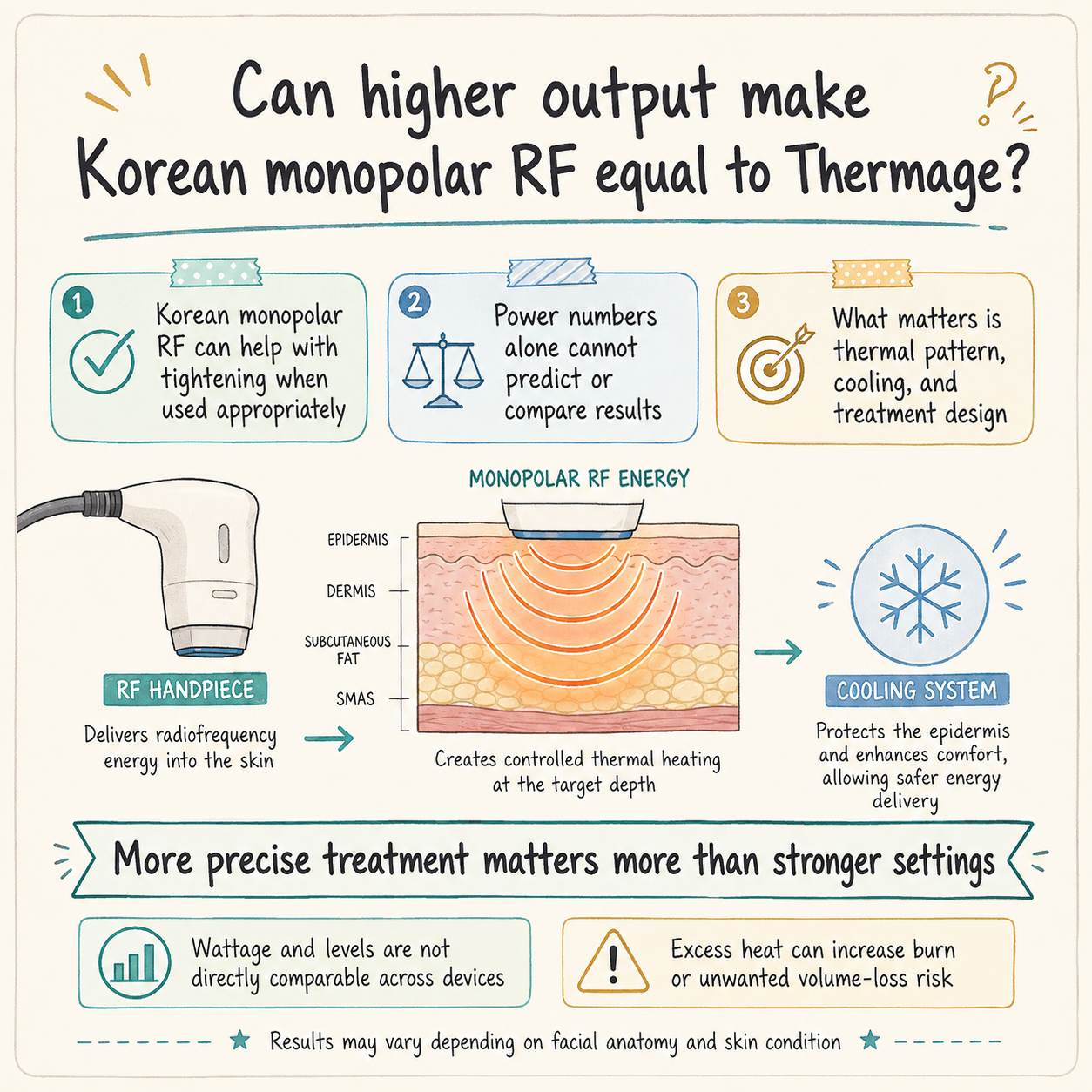
Korean monopolar radiofrequency devices may produce clinically meaningful skin tightening when used appropriately.
A higher displayed wattage or treatment level does not make one platform equivalent to Thermage FLX.
Clinical outcomes depend on delivered thermal dose, electrode geometry, pulse design, cooling, impedance control, treatment distribution, and patient anatomy.
Key takeaway
A Korean monopolar RF platform may achieve results that are comparable for selected patients and endpoints. However, current evidence does not support the conclusion that raising its output automatically makes it equal or superior to Thermage FLX.
Generator output, energy at the tip, energy density, pulse duration, and tissue temperature are different measurements.
Tip size, waveform, cooling, contact sensing, and impedance algorithms vary among devices.
Excessive focal heat may cause burns, contour irregularity, or unwanted fat loss.
The first question should not be, “Which device has the highest power?”
Patients comparing Thermage FLX with Korean devices frequently focus on maximum wattage, treatment level, or pain. These numbers are easy to understand, but they are poor substitutes for delivered tissue dose.
Monopolar radiofrequency uses an active electrode and a return pad to pass RF current through tissue. Electrical resistance generates heat. When heat is delivered within a suitable spatial and temporal range, it may produce immediate collagen contraction and delayed extracellular matrix remodeling.
The biological response is therefore related to the temperature-time profile within tissue—not simply to the maximum power specification of the generator.
The relevant question is whether the device creates a sufficiently uniform and safe thermal field in the intended tissue layer.
“Korean Thermage” is a marketing shorthand, not a device category
The term is commonly used for Korean-manufactured noninvasive monopolar RF systems. However, these devices do not share an identical treatment tip, cooling method, pulse structure, contact algorithm, or clinical protocol.
Thermage FLX is also more than a 6.78-MHz RF generator. It is an integrated platform consisting of a console, handpiece, proprietary treatment tips, return pad, coupling medium, cooling, vibration, and energy-delivery controls.
Two devices may operate at the same nominal frequency while producing different thermal profiles. Frequency alone does not establish equivalence.
Why displayed wattage cannot be compared directly
A displayed power value may represent maximum generator capacity, peak output, average output, or a manufacturer-specific internal setting. The publicly displayed number may not represent the energy ultimately deposited within a square centimeter of tissue.
Clinical heating is influenced by:
- Pulse duration and waveform
- Active electrode surface area
- Tip-edge energy distribution
- Skin-tip coupling and pressure
- Tissue impedance and hydration
- Epidermal cooling before, during, and after RF delivery
- Number of passes and pulse overlap
- Heat dissipation through blood flow and surrounding tissue
Consequently, 300 W on one platform cannot be assumed to equal 300 W on another. Treatment level 4 on one device is not equivalent to level 4 on a different device.
Does increasing energy improve the outcome?
Within the same device and treatment geometry, increasing energy may increase tissue heating up to a point. This does not mean that clinical benefit rises linearly with every increase.
A prospective multicenter eyelid study reported no clear correlation between the amount of RF energy applied and the clinical outcome. Earlier treatment evolution also moved away from extremely high single-pass energy toward tolerable multi-pass protocols guided by clinical endpoints.
These findings do not prove that energy is irrelevant. They show that energy must be interpreted together with coverage, repetition, anatomy, cooling, and tissue response.
Can a Korean device achieve comparable results?
It is possible in selected settings. A randomized split-face study in 22 Asian women compared a continuous water-cooled monopolar RF system with a conventional cryogen spray-cooled monopolar RF system. Over an eight-week follow-up, both sides demonstrated broadly comparable improvements in lifting, wrinkles, and volume-related measurements, while the continuous water-cooled treatment was reported as less painful.
This is clinically relevant evidence that an alternative platform may perform similarly for certain short-term endpoints. It does not establish universal equivalence between all Korean devices and Thermage FLX.
The limitations include the small sample, short follow-up, specific device and protocol, and selected outcome measures. Current evidence does not support a definitive device hierarchy.
What actually determines treatment quality?
Tip contact and geometry
The cheek, temple, mandibular border, and periorbital region have different contours. A large electrode may cover broad areas efficiently but may not contact sharply curved surfaces uniformly. Poor contact may create inconsistent energy delivery.
Cooling architecture
Cooling protects the epidermis and influences where heat accumulates. Cryogen spray cooling and continuous contact water cooling use different thermal strategies. Neither mechanism can be declared universally superior without considering the complete treatment protocol.
Impedance and feedback
Skin impedance varies with anatomy, hydration, pressure, and temperature. Real-time or repeated impedance assessment may support consistent delivery, but the presence of an algorithm alone does not prove superior clinical efficacy.
Shot placement and overlap
Six hundred pulses distributed across the entire face are not equivalent to six hundred pulses concentrated on the lower face. Immediate repetitive overlap may also produce a different thermal burden from spaced multi-pass treatment.
Patient anatomy
Skin thickness, facial fat compartments, skeletal projection, ligamentous support, and previous fillers or biostimulatory injections affect the risk-benefit balance. A protocol suitable for a heavy lower face may be inappropriate for a thin face with temporal and midface hollowing.
When higher energy may become harmful
Controlled thermal injury is the therapeutic mechanism, but uncontrolled or excessively concentrated heat may become an adverse event.
Unexpected focal pain, excessive heat, blanching, or poor tip contact
Erythema, edema, tenderness, blistering, or a partial-thickness burn
Pigment alteration, contour depression, fat loss, sensory symptoms, or scarring
Results may vary. Severe complications are not expected in routine treatment, but they are possible when thermal delivery becomes excessive, uneven, or poorly monitored.
Who may be a reasonable candidate?
Potentially suitable
- Mild to moderate skin laxity
- Fine lines and reduced firmness
- Preference for gradual, nonsurgical improvement
- Limited tolerance for prolonged downtime
- Realistic expectations of modest change
Requires caution or alternatives
- Severe tissue descent
- Marked temporal, infraorbital, or midface hollowing
- Complex history of fillers, threads, or biostimulants
- Active inflammation or an open wound in the treatment area
- Implanted electrical devices
Thermage FLX versus Korean monopolar RF platforms
Thermage FLX
Potential strengths
- Long clinical history
- Relatively mature literature base
- Integrated proprietary tip, cooling, and feedback platform
Limitations
- Outcome still depends on operator planning
- Higher cost in many markets
- Not the ideal treatment for every cause of facial aging
Korean monopolar RF
Potential strengths
- Multiple cooling and tip designs
- Options designed to improve comfort and workflow
- Potentially flexible cost and repeat-treatment planning
Limitations
- Evidence quality varies substantially by device
- Limited long-term head-to-head data
- Maximum wattage cannot establish superiority
Checklist before treatment
□ Has the clinician identified whether laxity, fat, muscle, gland, or skeletal structure is the main concern?
□ Are hollow areas separated from areas that require tightening?
□ Have previous fillers, threads, biostimulators, and energy treatments been reviewed?
□ Is there a clear reason for the selected power, pulse count, and treatment distribution?
□ Are limitations and potential adverse events discussed?
□ Is there a plan for assessment and management if an unexpected reaction occurs?
□ Is the clinician willing to discuss alternatives rather than insisting on one device?
Our clinical perspective at Springday Clinic Sinchon
We consider the cause of facial aging before selecting the device.
Treatment zones and protection zones are separated.
A patient may need tightening along the jawline while requiring conservative treatment over the temples and anterior cheeks.
Protocol matters more than the headline wattage.
Tip selection, contact, cooling, pulse distribution, and overlap are planned according to tissue characteristics.
Expectations are defined realistically.
Noninvasive monopolar RF may improve firmness and mild laxity, but it cannot reproduce surgical repositioning in severe tissue descent.
Frequently asked questions
References
- U.S. Food and Drug Administration. Thermage FLX System, 510(k) K170758. 2017.
- Austin GK, Struble SL, Quatela VC. Lasers Surg Med. 2022;54(1):27-45. DOI: 10.1002/lsm.23506. PMID: 34923652.
- Fitzpatrick R, Geronemus R, Goldberg D, et al. Lasers Surg Med. 2003;33(4):232-242. DOI: 10.1002/lsm.10225. PMID: 14571447.
- Biesman BS, Baker SS, Carruthers J, et al. Lasers Surg Med. 2006;38(10):890-898. DOI: 10.1002/lsm.20452. PMID: 17163476.
- Dover JS, Zelickson B, et al. Dermatol Surg. 2007;33(8):900-907. DOI: 10.1111/j.1524-4725.2007.33191.x. PMID: 17661932.
- Roh H, Lee YI, Lee SG, et al. Ann Dermatol. 2025;37(6):397-407. DOI: 10.5021/ad.25.166. PMID: 41331720.
- Yang HJ, Choi SY, Jung JM, et al. J Dermatolog Treat. 2025;36(1):2469633. DOI: 10.1080/09546634.2025.2469633. PMID: 40068225.
- de Felipe I, Ruiz Del Cueto S, Pérez E, Redondo P. J Cosmet Dermatol. 2007;6(3):163-166. DOI: 10.1111/j.1473-2165.2007.00322.x. PMID: 17760693.
Final note
The displayed power of an RF device is not a clinical ranking score. A well-designed Korean monopolar RF treatment may be a reasonable option, while a poorly planned treatment with any platform may underperform or create unnecessary risk. Current evidence does not support a definitive conclusion that higher output makes a Korean device universally equal or superior to Thermage FLX.
monopolar RF, Thermage FLX, Korean RF device, radiofrequency skin tightening, RF power settings, facial rejuvenation, collagen remodeling, RF cooling, impedance feedback, RF treatment safety