Radiofrequency vs. Ultrasound Lifting: Which Treatment Fits Your Face?
A CLINICAL GUIDE TO NONSURGICAL LIFTING
Radiofrequency vs. Ultrasound Lifting: Which Treatment Fits Your Face?
Radiofrequency and focused ultrasound both generate heat, but they do not distribute that heat in the same way. The right choice depends on skin laxity, fat distribution, facial anatomy, and the direction of tissue descent.
Written by M.D. Bo Won Lee, Director of Springday Clinic Sinchon, Seoul.
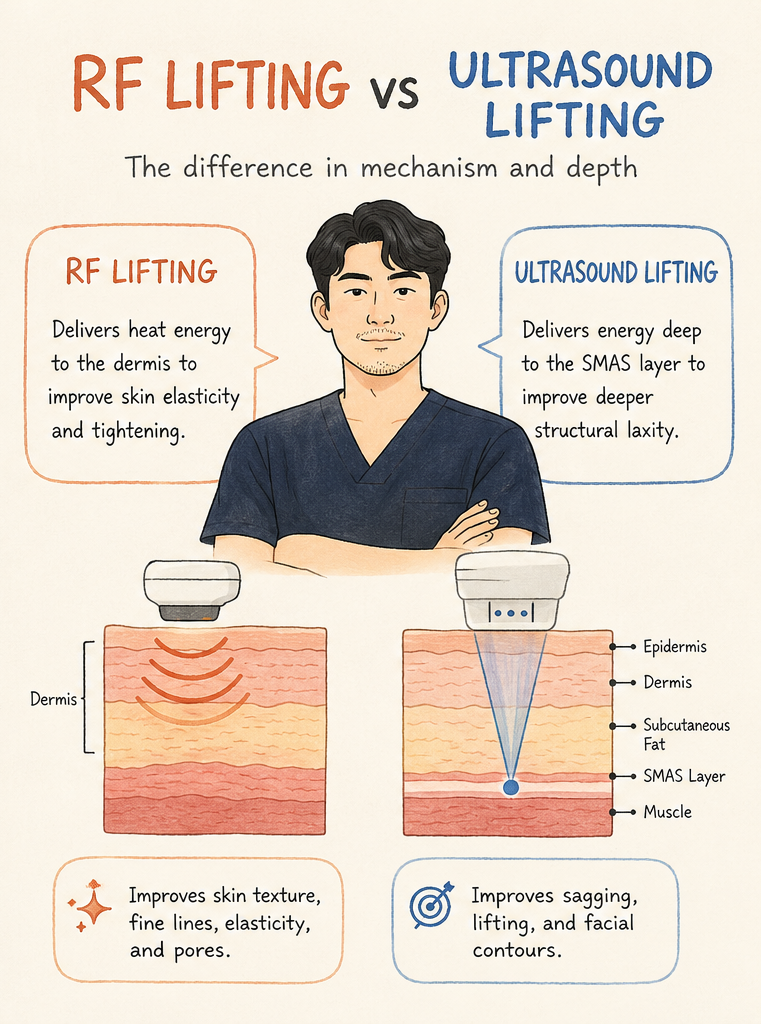
Radiofrequency produces heat through electrical resistance and is generally used for broad tissue tightening.
Focused ultrasound creates discrete thermal coagulation points at predetermined depths.
The device name alone does not determine the outcome. Treatment depth, energy distribution, anatomy, and technique all matter.
RF
Broad volumetric heating
Often selected when diffuse skin laxity and overall firmness are major concerns.
FOCUSED ULTRASOUND
Discrete focal treatment zones
Often selected when the jawline, submental region, or neck requires directional lifting.
PLANNING
Treat and preserve
A good plan defines which areas need tightening and which areas must retain volume.
Patients often ask whether radiofrequency is “weaker” than ultrasound, or whether ultrasound is automatically better because it can target deeper tissue.
This is not the most useful way to compare the two technologies.
They are not simply stronger and weaker versions of the same treatment. They create heat through different physical mechanisms and distribute that heat differently within tissue.
Radiofrequency is generally suited to broad tissue tightening, while focused ultrasound is suited to placing small thermal zones at selected depths and along selected vectors.
How radiofrequency tightening works
Radiofrequency devices deliver alternating electrical current through tissue. Tissue resistance converts part of that electrical energy into heat.
In a noninvasive monopolar system, current travels from the treatment electrode through the patient toward a return electrode. The resulting thermal pattern is influenced by the treatment tip, tissue impedance, contact quality, cooling, power, and repetition.
Unlike focused ultrasound, monopolar RF does not usually create a single row of sharply defined focal points. It produces a broader volume of heating.
RF may be considered when:
- The skin feels diffusely loose rather than displaced in one direction.
- Fine wrinkles and crepey texture are prominent.
- The cheeks, eye area, and jawline require general tightening.
- The patient wants broad improvement rather than treatment of a single vector.
Radiofrequency is not one uniform category. Monopolar, bipolar, multipolar, and microneedle RF systems have different electrical pathways and clinical applications. This article mainly addresses noninvasive monopolar RF.
How focused ultrasound lifting works
Focused ultrasound directs acoustic energy toward a predetermined focal depth. At the focus, acoustic energy is converted into heat and creates a small thermal coagulation zone.
Multiple focal zones can be arranged along treatment lines. Depending on the device and transducer, treatment may involve the deep dermis, subdermal connective tissue, or tissue near the superficial musculoaponeurotic system.
Microfocused ultrasound with visualization adds real-time ultrasound imaging, allowing the clinician to assess tissue layers and contact before delivering treatment.
Focused ultrasound may be considered when:
- The jawline has descended.
- Submental or neck laxity is a major concern.
- The brow region requires lifting.
- Different facial zones require different treatment depths.
- A clear lifting vector can be identified.
Is RF for skin and ultrasound for the SMAS?
That explanation is convenient, but it is anatomically oversimplified.
Focused ultrasound can be delivered to the deep dermis as well as deeper connective tissue. Radiofrequency heating may extend beyond the dermis depending on the electrode design, electrical pathway, and tissue properties.
A labeled focal depth also does not mean that the same anatomical structure exists at exactly that depth in every part of every face.
Avoid these absolute assumptions:
RF only treats the dermis.
Ultrasound only treats the SMAS.
A 4.5-mm setting always corresponds to the same fascial layer.
RF and focused ultrasound compared
Radiofrequency
Energy: Alternating electrical current
Thermal pattern: Relatively broad tissue heating
Common goal: Diffuse tightening and firmness
Sensation: Heat or burning discomfort
Potential adverse effects: Erythema, edema, tenderness, burns, and uncommon contour changes
Focused ultrasound
Energy: Focused acoustic energy
Thermal pattern: Discrete focal coagulation zones
Common goal: Depth-specific and directional lifting
Sensation: Deep tingling, aching, or sharp discomfort
Potential adverse effects: Erythema, edema, tenderness, bruising, sensory symptoms, and uncommon burns
Which patients may favor radiofrequency?
The skin appears generally loose rather than displaced along one dominant vector.
Fine wrinkles and thin, folded skin are more noticeable than deep tissue descent.
The cheeks, eye area, and jawline require a more global approach.
A thin face does not make RF automatically safe. Excessive energy accumulation may still affect deeper soft tissue. Conservative planning is important when facial volume is limited.
Which patients may favor focused ultrasound?
The lower face has moved downward and the outer contour has become less defined.
The principal concern is tissue laxity beneath the chin or along the neck.
Different areas require different focal depths and treatment vectors.
Patients with severe laxity may not obtain a surgical degree of correction from a noninvasive energy device. The expected magnitude of change should be discussed before treatment.
Does ultrasound cause facial fat loss?
Not every focused ultrasound treatment is designed to reduce facial fat.
The effect on subcutaneous tissue depends on the device, focal depth, energy, line placement, and tissue thickness. A patient with limited facial fat may require avoidance of volume-critical zones or lower energy density in selected areas.
It is equally inaccurate to claim that RF can never affect facial volume. Both energy categories can influence subcutaneous tissue when heat reaches that layer.
For a lean face, the plan should identify:
- Areas where fat volume must be preserved
- Areas where tissue is heavy or displaced
- Prominent bony landmarks
- Previous filler, biostimulator, thread, or fat-grafting sites
- Any history of hollowing after an energy-based treatment
Should RF and ultrasound be combined?
Combination treatment can be reasonable when two distinct problems are present. Focused ultrasound may address directional descent, while RF may address diffuse skin laxity.
However, combining two devices does not automatically double the result. If both treatments deposit heat in the same zone without a clear reason, the main effect may be more pain, swelling, and tissue stress.
- Confirm that each device has a separate treatment target.
- Avoid unnecessary thermal overlap.
- Consider facial fat volume and previous procedures.
- Decide whether same-day or staged treatment is more appropriate.
- Review the specific device instructions and contraindications.
There is no universal evidence-based rule that defines one optimal sequence or interval for every RF and ultrasound device.
Pain, recovery, and adverse effects
RF discomfort is commonly described as heat or burning. Focused ultrasound discomfort is more often described as deep tingling, aching, or sharp sensations near bone.
Both treatments may cause temporary redness, swelling, and tenderness. Ultrasound studies have also reported bruising and transient sensory symptoms. Burns and contour changes are uncommon but clinically relevant risks.
Pain and adverse-event rates cannot be directly compared across devices because treatment protocols, energy levels, and reporting methods differ substantially.
Practical pre-treatment checklist
□ Is the main concern skin texture, diffuse laxity, or downward tissue displacement?
□ Was the face assessed in an upright position?
□ Were skin thickness and fat distribution assessed by facial zone?
□ Were volume-preservation areas identified?
□ Were previous fillers, threads, biostimulators, and energy treatments reviewed?
□ Were treatment depth, coverage, and energy strategy explained?
□ Were limitations and potential adverse effects discussed?
□ Is there a clear follow-up plan if an unexpected symptom develops?
How we approach treatment planning
We separate laxity from volume deficiency
A hollow cheek may require volume support rather than stronger tightening.
We assess the face upright
Gravity changes facial shape. Treatment vectors should be planned before the patient lies down.
We evaluate each facial zone separately
The anterior cheek, lateral cheek, jawline, and submental region do not have the same thickness or anatomy.
We review previous procedures
Fillers, collagen-stimulating injections, threads, fat grafting, and previous energy treatments can affect the plan.
We aim for a meaningful but proportionate change
The objective is not minimal treatment disguised as subtlety, nor excessive energy that increases tissue risk.
Frequently Asked Questions
References
1. Contini M, et al. A Systematic Review of the Efficacy of Microfocused Ultrasound for Facial Skin Tightening. Int J Environ Res Public Health. 2023;20(2):1522. DOI: 10.3390/ijerph20021522. PMID: 36674277.
2. Amiri M, et al. Microfocused Ultrasound With Visualization Effectiveness and Safety: A Systematic Review and Meta-Analysis. Aesthetic Surgery Journal. 2025. DOI: 10.1093/asj/sjae228. PMID: 39540440.
3. Carruthers J, Fabi S, Weiss R. Monopolar Radiofrequency for Skin Tightening. Dermatol Surg. 2014;40 Suppl 12:S168-S173. DOI: 10.1097/DSS.0000000000000232. PMID: 25417570.
4. Shin JM, et al. Efficacy and Safety of Monopolar Radiofrequency for Tightening the Skin of Aged Faces. Cosmetics. 2024;11(3):71. DOI: 10.3390/cosmetics11030071.
5. Kerscher M, et al. Skin Physiology and Safety of Microfocused Ultrasound With Visualization. Clin Cosmet Investig Dermatol. 2019;12:71-79. DOI: 10.2147/CCID.S188586.
6. U.S. Food and Drug Administration. Thermage FLX System, 510(k) K170758.
7. U.S. Food and Drug Administration. Ulthera System PRIME, 510(k) K233996.
Choose the treatment target before choosing the device.
At Springday Clinic Sinchon, treatment planning considers facial anatomy, skin thickness, fat distribution, previous procedures, and areas where volume should be preserved.
#RadiofrequencyLifting #UltrasoundLifting #RFvsHIFU #SkinTightening #FacialLifting #Ultherapy #Thermage #SeoulSkinClinic #SinchonSkinClinic #SpringdayClinicSinchon