Why Does Melasma Come Back After Laser Treatment? Understanding Relapse and Long-Term Control
CLINICAL GUIDE TO MELASMA
Why Does Melasma Come Back After Laser Treatment?
Laser treatment may lighten existing pigment, but it does not necessarily remove the biological and environmental factors that allow melasma to return.
Written by M.D. Bo Won Lee, Director of Springday Clinic Sinchon, Seoul.
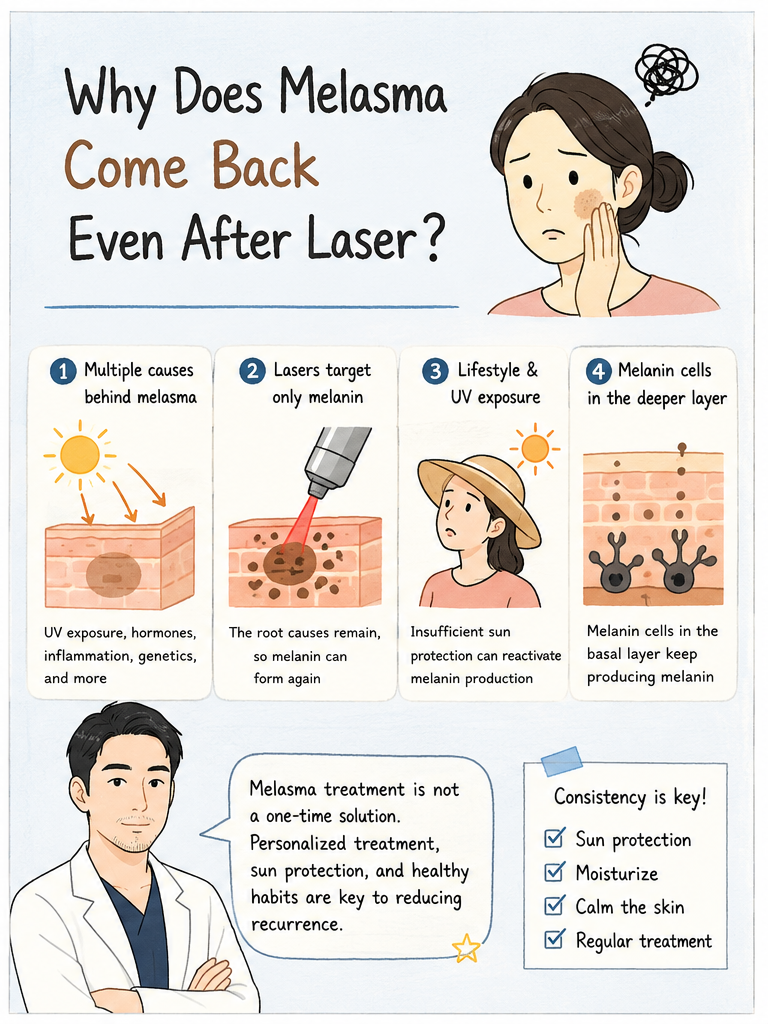
Three-point overview
1. Melasma is a chronic, relapsing pigmentary disorder rather than a single deposit of pigment that can always be permanently removed.
2. Lasers can reduce visible melanin, but ultraviolet radiation, visible light, hormonal influences, inflammation, and altered skin signaling may remain.
3. Sustainable control usually requires accurate diagnosis, photoprotection, appropriate skin care, maintenance treatment, and carefully selected procedures.
Laser treatment may reduce melanin that is already present in the skin.
Melanogenic signaling may remain active even when the skin initially appears clearer.
Long-term control matters as much as the initial procedure.
A common scenario is easy to recognize. A patient completes a course of laser toning, sees a noticeable reduction in facial pigmentation, and feels that treatment has worked. Several months later, the patches over the cheeks or forehead gradually become visible again.
This does not automatically mean that the previous treatment was ineffective. It may mean that the laser reduced existing pigment without eliminating the conditions that stimulate new pigment production.
THE CENTRAL POINT
Treating visible melanin is not the same as permanently switching off the tendency to produce melanin.
Melasma is more than excess surface pigment
Melanin is responsible for the visible brown or gray-brown appearance of melasma. However, histological studies indicate that melasma skin may also show abnormalities involving the epidermal barrier, basement membrane zone, upper dermis, mast cells, blood vessels, and photoaging-related structures.
These findings do not mean that every patient has the same pathology or that every abnormality has the same clinical importance. They do support a broader view of melasma as a disorder involving epidermal-dermal interactions rather than pigment alone.
Removing pigment is like drying a wet floor. If water continues to leak from above, the floor becomes wet again. Laser treatment may remove some of the visible “water,” while light exposure, inflammation, hormonal influences, and altered skin signaling allow pigmentation to return.
What laser treatment can and cannot do
What lasers may help with
- Reducing melanin that is already present
- Improving selected epidermal pigment
- Supporting treatment of resistant melasma
- Targeting different pigment components when properly selected
What lasers do not automatically remove
- Ultraviolet and visible-light exposure
- Genetic susceptibility
- Hormonal influences
- Skin-barrier dysfunction or ongoing irritation
- The lifelong ability of melanocytes to produce pigment
Six reasons melasma may return
1. Light exposure resumes after treatment
Ultraviolet radiation stimulates melanogenesis, but visible light may also contribute to persistent pigmentation, particularly in individuals with more reactive or darker phototypes. Randomized studies have found benefits from photoprotection that addresses short-wavelength visible light in addition to ultraviolet radiation.
2. Melanocytes are still present
Low-fluence laser toning is not intended to eliminate all melanocytes. Pigment may decrease while the cells capable of producing new melanin remain. When they are stimulated again, pigmentation can gradually return.
3. The dermal microenvironment does not change overnight
Basement-membrane alterations, mast-cell activity, vascular changes, and photoaging-related features have been reported in melasma skin. Reducing pigment does not necessarily normalize all of these features after one procedure.
4. The procedure itself may generate inflammation
Excessive fluence, short treatment intervals, and high cumulative energy can irritate the skin. Inflammation may trigger post-inflammatory hyperpigmentation or rebound darkening, particularly in pigment-reactive skin.
5. Hormonal and environmental triggers continue
Pregnancy, hormonal medications, genetic susceptibility, seasonal sun exposure, outdoor activities, and irritating skin-care routines may affect the clinical course. These factors do not affect every patient in the same way.
6. The pigmentation may not be melasma alone
Solar lentigines, freckles, post-inflammatory hyperpigmentation, acquired dermal melanocytosis, and treatment-related hypo- or hyperpigmentation may coexist with melasma. Each component may require a different treatment strategy.
Does stronger treatment produce longer-lasting results?
Not necessarily. A stronger endpoint may create faster visible lightening, but excessive inflammation can worsen melasma or cause post-inflammatory hyperpigmentation.
The opposite assumption is also unsafe. A low-fluence treatment is not automatically harmless when it is repeated too frequently or indefinitely. High cumulative exposure has been associated with mottled hypopigmentation after laser toning.
- Redness or burning persists after treatment
- The skin becomes unusually dry and reactive
- Small white macules begin to appear
- Pigmentation becomes more irregular after each session
- Multiple procedures have been performed at short intervals
Initial correction and maintenance are different phases
Initial correction
- Confirm the diagnosis
- Stabilize irritation and barrier dysfunction
- Use appropriate topical therapy
- Select laser or light treatment when indicated
- Establish consistent photoprotection
Maintenance
- Continue realistic daily photoprotection
- Avoid unnecessary irritation
- Use individualized pigment-control products
- Recognize early relapse or adverse effects
- Use procedures intermittently rather than automatically
Who may be considered for laser treatment?
Laser may be considered when
- The diagnosis is reasonably clear
- Photoprotection and topical treatment are insufficient
- The skin is not actively inflamed or severely irritated
- The patient understands the need for maintenance
Treatment may need to be delayed when
- Active dermatitis or persistent burning is present
- Recent tanning or intense sun exposure has occurred
- Mottled hypopigmentation is developing
- Previous procedures caused rebound darkening
- The diagnosis remains uncertain
What I assess in clinical practice
At Springday Clinic Sinchon, treatment planning begins with determining whether the visible pigmentation is entirely melasma or a mixture of melasma and other lesions.
- The distribution and type of pigmentation
- Current erythema, dryness, irritation, and barrier status
- Previous lasers and the skin's response to them
- Outdoor exposure, driving, travel, and sunscreen use
- Whether the treatment goal is realistic and sustainable
Choosing when not to treat can be as important as choosing the laser itself.
Practical checklist for reducing relapse
□ Has the diagnosis been confirmed rather than assuming every brown patch is melasma?
□ Does photoprotection address UVA, UVB, and relevant visible-light exposure?
□ Are hats, shade, and reapplication used during prolonged outdoor exposure?
□ Has persistent redness or burning developed after treatment?
□ Are treatment intervals allowing adequate recovery?
□ Have small white macules or patchy light areas appeared?
□ Are multiple irritating active ingredients being used together?
□ Have pregnancy, hormonal medication, and other medicines been disclosed?
□ Is there a maintenance plan after initial improvement?
Frequently asked questions
References
- Sarkar R, et al. Delphi consensus on melasma management by international experts and Pigmentary Disorders Society. J Eur Acad Dermatol Venereol. 2026;40(4):680-692. doi:10.1111/jdv.70066. PMID:40996222.
- Chehrara M, et al. The efficacy of laser therapy in melasma treatment: a systematic review and meta-analysis. J Cosmet Dermatol. 2025;24(12):e70602. doi:10.1111/jocd.70602. PMID:41378674.
- Lee YS, et al. The low-fluence Q-switched Nd:YAG laser treatment for melasma: a systematic review. Medicina. 2022;58(7):936. doi:10.3390/medicina58070936. PMID:35888655.
- Gao YL, et al. Melanocyte activation and skin barrier disruption induced in melasma patients after 1064 nm Nd:YAG laser treatment. Lasers Med Sci. 2019;34(4):767-771. doi:10.1007/s10103-018-2658-7. PMID:30302596.
- Espósito ACC, et al. Exploratory study of epidermis, basement membrane zone, upper dermis alterations and Wnt pathway activation in melasma. Ann Dermatol. 2020;32(2):101-108. doi:10.5021/ad.2020.32.2.101. PMID:33911720.
- Boukari F, et al. Prevention of melasma relapses with sunscreen combining protection against UV and short wavelengths of visible light. J Am Acad Dermatol. 2015;72(1):189-190.e1. doi:10.1016/j.jaad.2014.08.023. PMID:25443629.
- Castanedo-Cazares JP, et al. Near-visible light and UV photoprotection in the treatment of melasma. Photodermatol Photoimmunol Photomed. 2014;30(1):35-42. doi:10.1111/phpp.12086. PMID:24313385.
Melasma management should focus on reducing visible pigmentation while minimizing inflammation and slowing relapse. Results may vary, and treatment should be adjusted to skin type, previous procedures, current barrier status, and daily light exposure.
SPRINGDAY CLINIC SINCHON · SEOUL
Recurrent pigmentation should be reassessed before automatically repeating the same laser procedure.
An individualized evaluation can help distinguish ordinary relapse from irritation, post-inflammatory hyperpigmentation, mixed pigmentary disorders, or laser-related hypopigmentation.
#Melasma #MelasmaTreatment #MelasmaRecurrence #LaserToning #MelasmaLaser #Hyperpigmentation #VisibleLightProtection #TintedSunscreen #SeoulSkinClinic #SpringdayClinicSinchon