How to Choose the Right Aesthetic Doctor: 10 Signs That Matter Beyond Degrees, Experience, and Instagram Fame
A PHYSICIAN’S PERSPECTIVE ON MEDICAL AESTHETICS
How to Choose the Right Aesthetic Doctor:
10 Signs That Matter Beyond Degrees, Experience, and Instagram Fame
Degrees, specialist training, experience, technology, and price all matter.
But none of them can fully explain how a doctor will actually treat you.
Written by M.D. Bo Won Lee, Director of Springday Clinic Sinchon, Seoul.
This article does not argue that doctors from a particular school, specialty, or training path are automatically superior. Its purpose is to explain why patients should look beyond the visible résumé and consider how a doctor’s education, curiosity, judgment, concentration, honesty, and responsibility appear in actual clinical practice.
1. Education, specialist training, and years of experience are meaningful, but no single credential proves a doctor’s overall ability.
2. A sophisticated device cannot decide whether a treatment is appropriate, necessary, or safe for a particular patient.
3. Technical skill matters, but so do curiosity, clinical attention, honesty, and responsibility after treatment.
EDUCATIONAL BACKGROUND
Look beyond the name of the school and ask what kind of thinking and problem-solving training the doctor received.
CURRENT LEARNING
A diploma describes the past. It does not tell you whether the doctor is still studying, questioning, and improving today.
CARE AND RESPONSIBILITY
Having the ability to perform a treatment is different from using that ability fully and carefully for the patient in front of you.
What This Article Covers
- Why education matters, but cannot prove clinical ability by itself
- How my engineering education at KAIST influences my medical thinking
- Why doctors with the same medical degree may have very different educational backgrounds
- Why continued learning matters more than a diploma alone
- Why I returned to study a PTT protocol I had already used for years
- What a patient’s two million Korean won should mean to a doctor
- The difference between technical skill, care, kindness, and sincerity
- Ten practical signs patients can look for
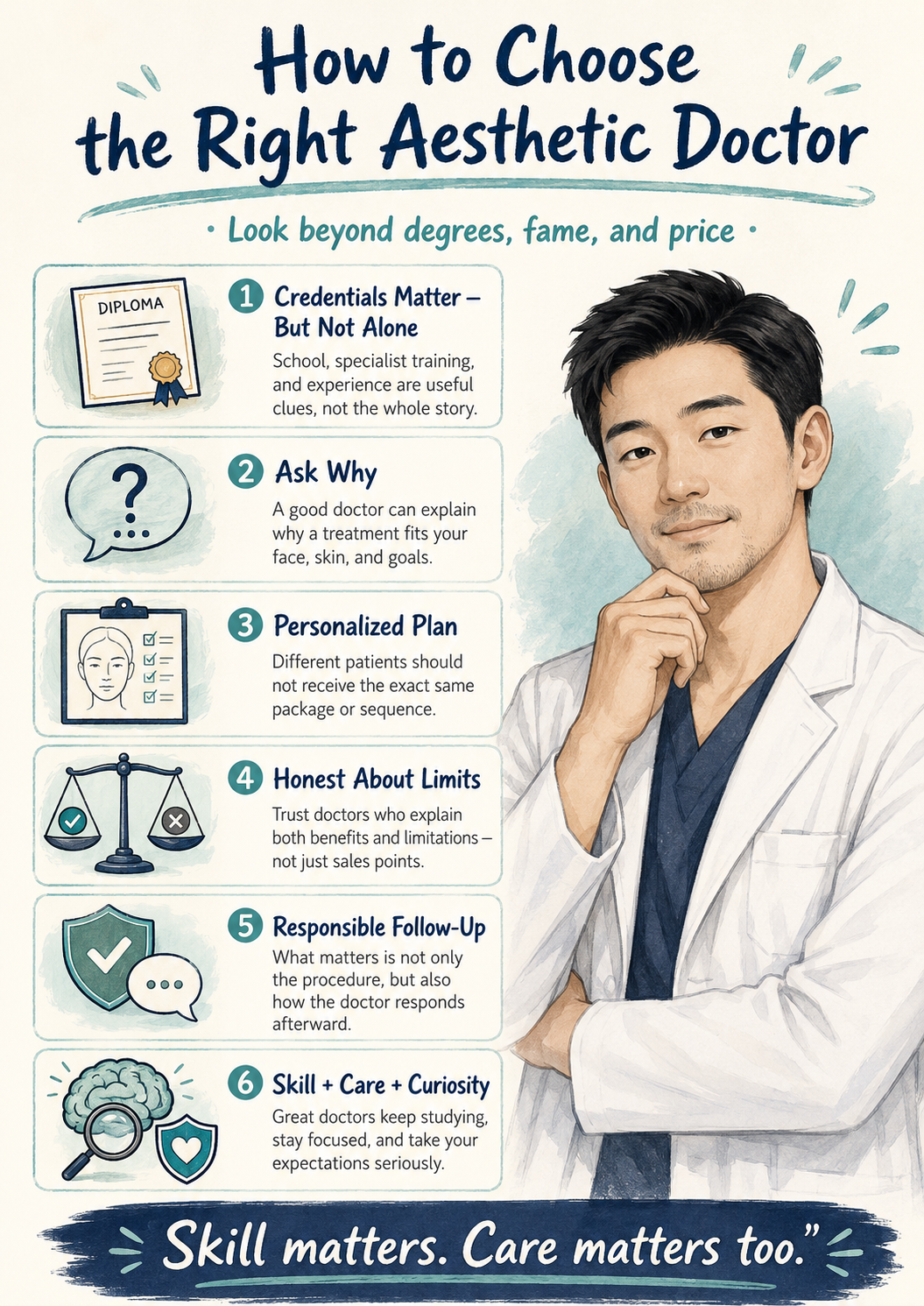
Patients searching for an aesthetic clinic can compare an enormous amount of information.
They can check which university a doctor attended, whether the doctor completed specialist training, how many years the doctor has practiced, how many procedures the clinic claims to have performed, which devices are available, how many online reviews have been posted, how many followers the doctor has, and how low or high the treatment price may be.
These details are easy to compare because they can be presented as names, numbers, badges, photographs, and price lists.
The more important questions are often much harder to see.
How does this doctor examine a face? Why does the doctor recommend one treatment but not another? Does the doctor remain attentive during a procedure that has already become routine? What happens if the result is different from what both the doctor and the patient expected? Will the doctor review the decision, explain the uncertainty, and respond responsibly?
Two clinics may use the same device, the same genuine treatment tip, and the same number of shots. The experience and result can still be different. A device does not make the diagnosis, choose the treatment area, set the priorities, interpret unexpected reactions, or decide when not to proceed.
Education Is Not Everything, but It Is Not Meaningless
I do not believe patients should judge a doctor solely by academic background.
Graduating from a highly regarded university does not guarantee excellent clinical judgment or procedural skill. The ability to pass difficult examinations and complete demanding academic courses overlaps with clinical competence in some ways, but they are not the same ability.
A doctor with an impressive academic history may stop learning. Another doctor without a famous school name may spend years studying one field intensely and develop outstanding expertise.
However, I also disagree with the idea that everything a person studied before obtaining a medical license becomes irrelevant the moment the license is issued.
Patients should not judge a doctor by education alone, but they should not treat education as meaningless either.
Doctors may hold the same medical license while approaching problems in very different ways. The depth of their previous studies, the habits they developed while analyzing difficult questions, and the way they learned to evaluate new information can all influence clinical thinking.
Academic background is not a certificate proving current clinical ability. It is one clue among many that may show what kind of intellectual training a doctor has received.
The more important question is not simply where a doctor studied. It is whether that education is still being used in present-day diagnosis, explanation, treatment planning, and problem-solving.
Does Everything Studied Before Medical School Simply Disappear?
Once someone becomes a doctor, the public résumé usually begins with medical school, graduate medical education, specialist training, hospital appointments, and years of practice.
That is understandable. What a doctor learned and experienced after entering medicine is highly relevant to patient care.
Still, I do not think we should completely erase what a person studied before becoming a physician.
Someone trained in mathematics and engineering may instinctively separate a complicated problem into variables. Someone with a laboratory science background may read research design differently. Someone trained in psychology or the humanities may bring another set of strengths to communication and interpretation.
These differences do not create a simple hierarchy. One undergraduate major does not make a doctor superior in every aspect of medicine.
Different forms of education can provide different intellectual tools. When those tools are actively used in present-day medical practice, education before medical school remains relevant.
From Engineering at KAIST to Medicine
I studied engineering at KAIST before entering a graduate-entry medical program and becoming a physician.
I do not want to hide that background or pretend that it has no meaning. At the same time, I am not claiming that graduating from KAIST makes me better than another doctor.
At KAIST, I repeatedly trained in mathematics, physics, experimentation, design, and structured problem-solving. The emphasis was not only on memorizing a result. We were expected to ask why a result occurred, which variables affected it, and what would change if the conditions changed.
That habit has remained with me in medical aesthetics.
When I evaluate an aesthetic device, I do not want to stop at the device name or the manufacturer’s headline claims. I want to understand what form of energy is delivered, where it is delivered, how changing the settings may affect tissue, what the expected benefits are, and where the limitations begin.
However, an engineering degree does not automatically create a skilled procedural doctor.
A KAIST diploma does not guarantee anatomical knowledge, manual precision, aesthetic judgment, complication management, or good communication.
A doctor without an engineering background can study device physics and tissue response deeply after becoming a physician and become exceptionally capable. Over time, continued medical study and clinical reflection may become more important than the undergraduate major itself.
The Same Medical Degree Can Hide Very Different Starting Points
Graduates of Korea’s former graduate-entry medical school system are often grouped together under one simple label: “graduate medical school doctors.”
In reality, their academic backgrounds before medical school could be very different.
Under that system, applicants from non-science undergraduate majors could apply if they completed the required prerequisite science courses specified by each medical school.
Depending on the school’s admissions rules, eligible prerequisite credits could sometimes be obtained through regular university courses, seasonal courses at another institution, part-time enrollment, or Korea’s Academic Credit Bank System.
What I am not saying
- I am not saying that every graduate-entry medical student followed this route.
- I am not saying that doctors who completed prerequisites through another pathway are inferior.
- I am not judging another doctor’s personality or current clinical ability.
- I am only saying that different types and depths of prior education should not be treated as identical.
Completing several required science courses and spending several undergraduate years studying engineering, mathematics, physics, experimentation, design, and problem-solving are not the same educational experience.
The difference in educational depth does not automatically mean that one person is a better physician. But it is still a real difference in training.
To be honest, I sometimes feel slightly frustrated that a doctor’s public résumé often begins only after medical school, while the years of demanding study before medicine become almost invisible.
That feeling is not about putting down doctors who followed a different route. It is simply an acknowledgment that the education I received before medicine continues to influence the way I think, question, and analyze today.
Where Engineering Thinking Helps in Medical Aesthetics
Medical aesthetics is not simply a field of manual technique.
Lasers, radiofrequency, ultrasound, microwaves, light, heat, and cooling can all be used to deliver energy to the skin and deeper tissues.
Devices differ in how energy is delivered, how deeply it reaches, how heat spreads, which tissue is targeted, and how the skin surface is protected. Even with the same device, the result may change depending on settings, treatment technique, skin thickness, fat distribution, facial structure, and previous procedures.
An engineering background helps me interpret settings as more than numbers to memorize. It encourages me to ask what each setting changes and why that change may matter.
The advantage of engineering is not knowing more complicated terminology. It is developing the habit of asking, “Which condition caused this difference?”
When a patient experiences less improvement than expected, it may be easy to end the explanation with the phrase “individual variation.”
Individual variation is real, but it should not always be the end of the analysis. Was the original diagnosis appropriate? Was the device suitable for the problem? Were the treatment depth and area appropriate? Was the tissue condition different from what was expected? Were expectations explained accurately?
The human body cannot be calculated like a machine. Engineering thinking does not provide every answer. For me, its value is that it makes it harder to stop thinking when the answer is not immediately obvious.
A Diploma Matters Less Than Whether the Doctor Still Studies
A strong education can be a valuable starting point, but it cannot guarantee the quality of a doctor’s work forever.
Over time, what matters more is whether the doctor continues to study, reviews outcomes, notices patterns, and questions familiar routines.
Medical aesthetic technology continues to change. New devices and materials appear. The limitations of older treatments become clearer. Repeated clinical experience reveals subtle differences that may not have been visible at the beginning.
Familiarity, however, can make it easy to stop studying.
Once a doctor knows how to perform a procedure and the clinic operates smoothly with an established protocol, it may seem unnecessary to ask deeper questions.
Repetition is necessary for technical fluency, but repetition and improvement are not the same thing.
Experience is not simply the number of years that have passed. What matters is what the doctor noticed, questioned, and changed during those years.
Repeating the same treatment ten thousand times is not necessarily the same as comparing ten thousand outcomes, identifying why some were better than others, and modifying future decisions accordingly.
The Difference Between Doing the Job and Genuinely Enjoying the Field
Doctors are professionals, and medicine is also a livelihood. I earn income through patient care and operate a medical clinic.
Earning money does not mean a doctor lacks sincerity. Physicians should be compensated fairly for their expertise, and a clinic needs financial stability to maintain staff, equipment, safety systems, and follow-up care.
The problem is not earning money.
The problem is learning only what is necessary to maintain the job, repeating a clinic protocol without understanding why, assuming that a familiar treatment no longer requires study, and viewing every new treatment primarily as another product to sell.
A doctor who genuinely likes the field often studies without being told to do so.
There may be no examination, lecture, or presentation scheduled. The doctor still looks for information, questions long-established routines, considers the possibility that a previous belief may be wrong, and treats an unexpected patient response as a clue rather than an inconvenience.
A person who learns only enough to maintain a profession and a person who continues reading after work because the subject remains interesting will not remain at the same level forever.
One factor that shapes a doctor’s long-term ability is whether the field is still interesting after the clinic closes.
A doctor who stops asking questions after becoming familiar with a procedure and a doctor who begins asking more precise questions because of that familiarity may look similar today. Over time, they may become very different.
Curiosity alone is not enough. Enthusiasm without medical fundamentals, evidence, clinical experience, or restraint can be dangerous. Curiosity must remain connected to anatomy, safety, evidence, judgment, and respect for uncertainty.
Why I Recently Revisited a PTT Treatment I Had Already Used for Years
PTT treatment was not newly introduced at our clinic. We had already been performing it for years, and I had already read several books on the subject.
I did not return to the topic because I lacked the basic concept or had only just learned how the treatment was performed.
The questions appeared because I already had experience.
How might different devices and settings change the outcome? Is the commonly accepted method truly the best approach in every situation? Could the same treatment be performed more effectively or safely?
This was not an effort to create another treatment menu or sell something new.
I wanted to understand more precisely a treatment I was already performing. Even after reading several books, some practical questions were not clearly answered, so I continued asking, comparing, and reviewing.
Studying longer does not necessarily reduce the number of questions. Understanding a subject more deeply often creates questions that textbooks do not answer.
The same principle applies to botulinum toxin injections, fillers, lasers, and lifting procedures. Familiarity can become expertise, but it can also become inertia if the doctor stops examining the result.
Choose a Doctor Who Understands the Weight of Two Million Korean Won
Most aesthetic treatments in Korea are paid directly by the patient rather than covered by national health insurance.
Imagine a patient paying two million Korean won and lying down on the treatment bed.
To a clinic, the payment may appear as one transaction or one line in daily revenue. To the patient, the same amount may carry an entirely different meaning.
For some people, it may be close to a month’s income. For many, it may represent more than two weeks of work. It may be money that could otherwise have gone toward savings, travel, family expenses, or another important need.
When a patient pays two million Korean won and lies on the treatment bed, I do not believe the doctor should see that amount only as clinic revenue.
The doctor should think about why the patient decided that a procedure lasting several minutes or several dozen minutes was worth that amount of money.
A patient is not paying only for the minutes during which the device is active.
- The judgment required to choose an appropriate treatment
- The honesty required not to recommend an unnecessary treatment
- The time spent examining the patient before the procedure
- The concentration and precision used during treatment
- The study and experience accumulated before that day
- The effort to reduce complications and help the patient tolerate discomfort
- Follow-up care when a problem occurs
- The responsibility to investigate an unexpected or disappointing result
This does not mean that an expensive procedure must produce a dramatic result.
Cost and outcome are not perfectly proportional. Paying more does not make a medically impossible result possible. No physician can guarantee every outcome.
Human tissue varies. Recovery varies. Even an appropriate treatment performed carefully may produce less improvement than hoped, and an unexpected reaction may occasionally occur.
Not being able to guarantee a result is entirely different from treating the patient’s money and expectations lightly. A doctor cannot promise perfection, but still has a responsibility to think carefully, remain focused, and make the patient’s decision meaningful.
Equal Skill Does Not Always Mean Equal Care
Two doctors may appear technically similar.
Both may understand anatomy, operate the same device competently, and have performed a similar number of procedures.
The density of the actual medical care may still be different.
ATTENTION TO DETAIL
Does the doctor look at the face one more time and compare the current condition with previous photographs?
JUDGMENT DURING TREATMENT
Does the doctor pause and reassess when the tissue responds differently from what was expected?
RESPECT FOR TIME
Does the doctor rush the current patient simply because another patient is waiting?
I would not describe these differences as kindness alone. They reflect the density of care, professional attention, and responsibility.
Skill means having the ability to perform a treatment properly. Care means choosing to use that ability fully for the patient in front of you.
The ability to produce a good result and the willingness to apply that ability attentively to one individual patient are related, but they are not identical.
Kindness and Sincerity Are Not Exactly the Same
Polite communication and respectful service are important. Patients should be treated with basic dignity in every medical setting.
However, a gentle tone alone does not prove that a doctor is sincere.
Sincerity often becomes clearer when a doctor must say something the patient may not want to hear.
- Not recommending an expensive procedure that is unnecessary
- Explaining honestly when the likely benefit is limited
- Refusing a procedure that is unsafe or inappropriate
- Respecting the patient’s budget and establishing priorities
- Admitting when a problem is outside the doctor’s or clinic’s ability
- Not blaming the patient automatically when the outcome is disappointing
- Remaining available and responsive when a complication occurs
Sincerity is not merely an emotional quality. It appears in actions: not selling what is unnecessary, refusing what is unsafe, and not disappearing when a problem occurs.
Specialist Training, Experience, and Procedure Counts Need Interpretation
Specialist training is meaningful. It indicates that a doctor completed a structured program of education and clinical experience in a defined medical field.
Years of experience and a high volume of procedures are also relevant. A doctor who has encountered a wide variety of situations may recognize unusual responses more quickly and respond more calmly when problems occur.
It would be inaccurate to say that these factors do not matter. They simply require interpretation.
SPECIALIST TRAINING
Important educational information, but doctors with the same qualification may still have different interests and aesthetic procedure experience.
YEARS OF EXPERIENCE
Shows the length of time, but not necessarily how intensely the doctor studied, reflected, or improved during that time.
PROCEDURE COUNT
Suggests the amount of repetition, but not how carefully each patient was assessed or how thoroughly each outcome was reviewed.
Experience becomes knowledge when repetition is combined with reflection and correction. A doctor without specialist certification should not automatically be assumed to be incapable, just as a credential alone should not be treated as proof of complete competence.
Look Beyond the Device and Evaluate the Person Using It
High-quality devices, genuine treatment tips, and appropriate consumables matter. Devices differ in performance, energy delivery, cooling, and safety systems.
A device, however, cannot decide whether a patient needs the treatment.
- Which area needs more treatment?
- Which area should be avoided?
- How should the settings change with skin thickness and fat distribution?
- Which device should be used first when several options are available?
- Where should the doctor stop when balancing benefit and risk?
- Would it be better not to perform the procedure at all?
A good device is a good tool. It cannot replace diagnosis, planning, restraint, attention, or responsibility. Patients should ask not only “Which device does the clinic own?” but also “Who is using it, and how is that person thinking?”
10 Practical Signs Patients Can Look For
Patients cannot fully verify how much a doctor studies or how sincerely the doctor reflects after work. Still, several indirect signs can be observed during consultation, treatment planning, and follow-up.
1. Can the doctor connect education to present-day practice?
Look beyond the name of the university. Ask what the doctor studied and how that training influences diagnosis, explanation, device selection, and problem-solving.
2. Can the doctor explain why a treatment is being recommended?
“It is famous” or “It is currently discounted” is not enough. The doctor should explain why the treatment fits the patient’s present condition and what it is intended to improve.
3. Does the plan change from patient to patient?
Facial structure, skin thickness, fat distribution, previous procedures, priorities, and budget can all change the treatment plan.
4. Can the doctor discourage an unnecessary procedure?
If the likely benefit is small or the risk outweighs the potential improvement, a doctor should be able to recommend doing less or doing nothing.
5. Does the doctor explain limitations as well as benefits?
A balanced explanation should cover what may improve, what is unlikely to change, how many treatments may be needed, and why individual results vary.
6. Are complications and follow-up care explained clearly?
Patients should know how to contact the clinic, which symptoms require prompt evaluation, and what the clinic can realistically do if a problem occurs.
7. Does the doctor answer in the doctor’s own words?
Listen for reasoning that responds to the specific question rather than a memorized manufacturer slogan. A doctor who admits uncertainty and checks the facts may be more trustworthy than someone who answers everything immediately and confidently.
8. Does the doctor respect the patient’s budget?
A useful consultation should help the patient prioritize what matters now, what can wait, and what may not be worth paying for.
9. Does the doctor remain focused during treatment?
Observe whether the doctor checks tissue response, adjusts the approach by area, and reassesses when something differs from the expected pattern.
10. Does the doctor’s attitude change when the result is disappointing?
The attitude before payment and the attitude after a problem should not be completely different. The first step should be examining the patient, not avoiding the conversation.
These principles may be useful for anyone comparing an aesthetic clinic in Seoul, including Sinchon, Hongdae, Ewha, or Mapo. Prices and device names are easy to compare, but the quality of reasoning and responsibility may matter just as much.
Key Takeaways
- Education, specialist training, and experience are meaningful, but no single credential proves the quality of actual care.
- The number of procedures matters less when results are never reviewed or methods are never revised.
- Even the best technology cannot replace diagnosis, treatment planning, restraint, and responsibility.
- Skill is the ability to perform a treatment correctly; care is the decision to use that ability fully for one patient.
- A result cannot be guaranteed, but a patient’s money, expectations, and trust should never be treated lightly.
Frequently Asked Questions
What Kind of Doctor Should You Ultimately Choose?
This article is not telling patients to choose only doctors from prestigious universities.
It is not claiming that a KAIST graduate is automatically superior. It is not saying that specialist training and experience are meaningless.
It is not arguing that enthusiasm can replace medical knowledge or technical skill. It is not suggesting that an expensive procedure must produce a guaranteed result.
The standard I am proposing is more complex.
Consider what the doctor studied before medicine, what the doctor experienced after becoming a physician, and whether the doctor still enjoys the field enough to continue asking difficult questions.
A good doctor should not be judged only by what is already known. It also matters how curious that doctor remains about what is not yet known.
Patients should also consider how seriously the doctor treats the money, effort, expectations, and trust placed in the procedure.
Skill is the ability to perform a treatment properly.
Care is the decision to use that ability fully for the patient in front of you.
Rather than searching for a doctor who promises perfection, look for someone with sound fundamentals and technical ability who continues to study, can discourage an unnecessary procedure, and does not disappear when the result is different from what was expected. That may be one of the most realistic ways to choose an aesthetic physician.
References
1. Konkuk University School of Medicine. 2018 Graduate-Entry Medical School Admissions Guidelines. Referenced for admissions requirements and recognition of prerequisite science credits.
2. Ericsson KA. Deliberate practice and the acquisition and maintenance of expert performance in medicine and related domains. Academic Medicine. 2004;79(10 Suppl):S70-S81. DOI: 10.1097/00001888-200410001-00022. PMID: 15383395.
3. Mamede S, Schmidt HG. Deliberate reflection and clinical reasoning: Founding ideas and empirical findings. Medical Education. 2023;57(1):76-85. DOI: 10.1111/medu.14863. PMID: 35771936.
No single credential should make the entire decision for you.
Consider education, training, experience, and technology, but also pay attention to how the doctor explains the recommendation, whether unnecessary treatment can be refused, how your budget is respected, and how responsibility is handled after the procedure.
Written by
M.D. Bo Won Lee
Director of Springday Clinic Sinchon, Seoul
#AestheticMedicine #AestheticDoctor #HowToChooseADoctor #MedicalAesthetics #SeoulAestheticClinic #SkinClinicSeoul #Sinchon #Hongdae #BoWonLeeMD #SpringdayClinicSinchon