Can At-Home Beauty Devices Replace In-Clinic Skin Treatments?
EVIDENCE-BASED AESTHETIC MEDICINE
Can At-Home Beauty Devices Replace In-Clinic Skin Treatments?
Home LED masks, radiofrequency devices, microcurrent tools, and IPL systems may provide modest benefits for selected concerns.
However, sharing a technology name with a clinical device does not make the two treatments equivalent.
Written by M.D. Bo Won Lee, Director of Springday Clinic Sinchon, Seoul.
Three-Line Overview
1. At-home devices can support maintenance and produce gradual improvement in selected mild concerns, but they generally do not replace medical assessment or in-clinic procedures.
2. The actual tissue effect depends on wavelength, waveform, energy density, pulse duration, electrode design, contact, treatment depth, and technique—not simply on the words LED, RF, ultrasound, or IPL.
3. The most realistic role of a home device is adjunctive care, prevention, or maintenance rather than correction of significant laxity, scarring, deep wrinkles, or an undiagnosed skin condition.
TAKEAWAY 01
Some devices do work
Clinical studies have reported improvements with selected home LED, RF, and light-based hair-removal devices.
TAKEAWAY 02
Evidence is device-specific
A positive study of one model cannot validate every product using the same technology label.
TAKEAWAY 03
Maintenance is not replacement
Convenient daily care and professionally designed treatment address different clinical needs.
Why This Question Is More Complicated Than It Sounds
The consumer beauty-device market now includes LED masks, handheld radiofrequency devices, microcurrent and electrical muscle-stimulation tools, low-intensity ultrasound devices, cleansing systems, and home IPL hair-removal products.
Because some of these devices use the same general forms of energy as professional equipment, it is reasonable to ask whether buying a high-end home device could eliminate the need for clinic visits.
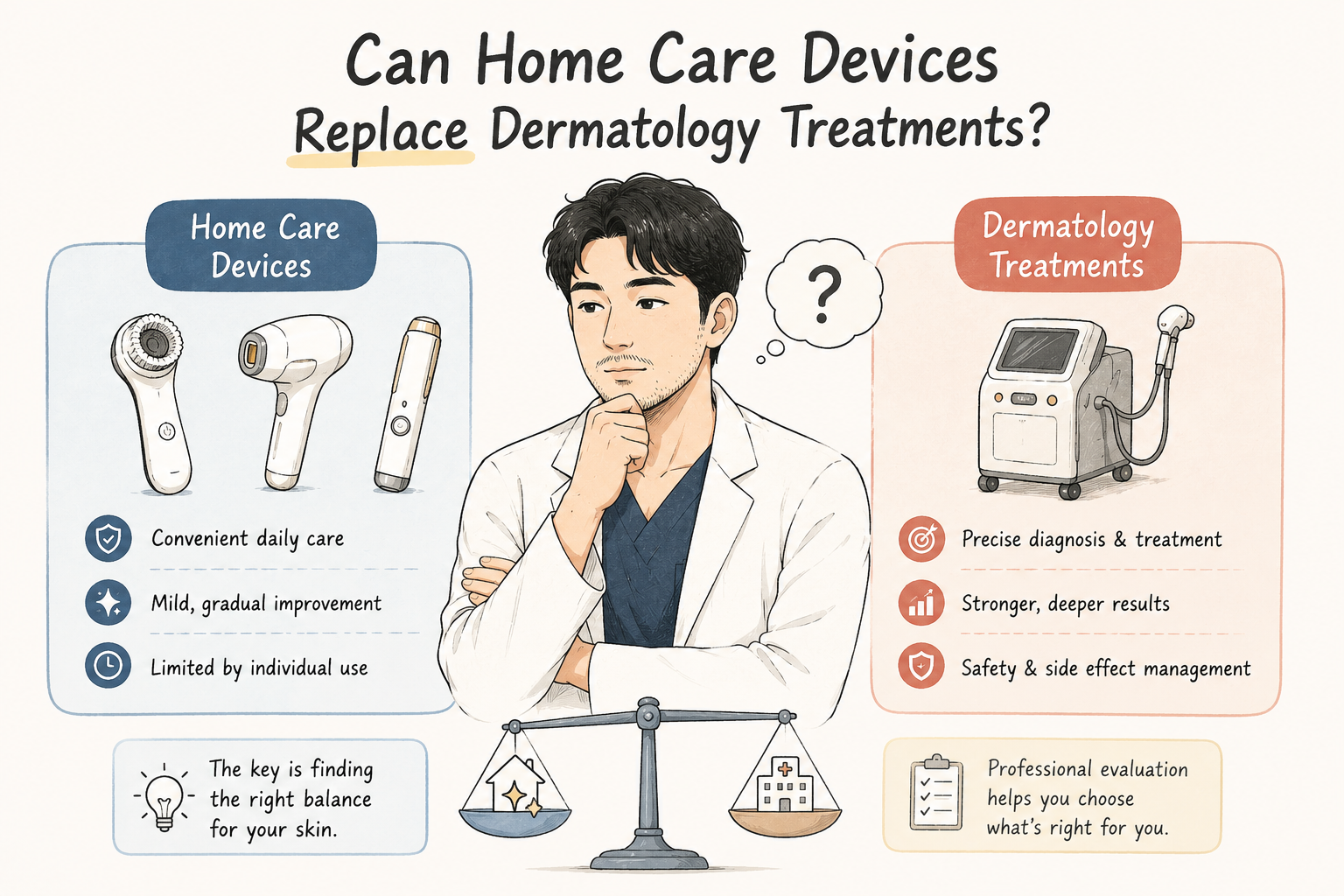
The direct answer is: an at-home device may improve a limited, well-defined concern, but it should not generally be viewed as a substitute for the complete process of medical assessment and procedural treatment.
An in-clinic procedure is not merely the delivery of energy. It includes determining what the skin problem actually is, choosing the appropriate target, adjusting treatment depth and coverage, observing tissue response, and managing complications when necessary.
The key question is not whether home devices “work.” It is which exact device can create which degree of improvement for which indication.
The Same Technology Name Does Not Mean the Same Treatment
Two devices may both be marketed as radiofrequency systems while producing very different tissue responses. The same applies to LED, ultrasound, laser, and IPL technologies.
Energy and waveform
Monopolar, bipolar, and multipolar RF designs do not create identical current paths or heating patterns.
Delivered dose
Power consumption or the number shown on a display does not directly reveal the energy delivered per unit area.
Depth and distribution
A superficial thermal sensation is not equivalent to controlled heating at a clinically selected tissue depth.
Treatment design
Clinical settings can be modified according to facial anatomy, skin thickness, pigmentation risk, and prior procedures.
A home device must be designed for unsupervised, repeated consumer use. This often means that its output, temperature, or treatment range is constrained to reduce the chance of severe injury.
That limitation is not inherently a design failure. It is part of the reason a consumer can use the product repeatedly. The trade-off is that the amount of change produced by a single session may be modest.
Home care is strongest in convenience and repetition. Clinical treatment is strongest in diagnosis, customization, treatment intensity, and medical follow-up.
What Can Different Home Devices Realistically Do?
1. Home LED Masks
Consumer LED systems commonly use blue, red, near-infrared, or combined wavelengths. A 2025 systematic review and meta-analysis found that selected at-home red and blue LED devices could reduce lesions in mild-to-moderate acne.
This does not mean that an LED mask replaces a complete acne-treatment plan. Acne may involve follicular plugging, sebum production, inflammation, hormonal factors, medication effects, and scar risk. Comedonal, nodular, or scarring acne may require topical or systemic medication and appropriately selected procedures.
Red or near-infrared devices have also been studied for fine lines and skin texture. Improvements, when present, tend to be gradual and dependent on wavelength, irradiance, treatment schedule, and adherence.
An LED mask is better understood as an adjunct for mild concerns than as a stand-alone treatment for deep wrinkles, significant laxity, or acne scarring.
2. Home Radiofrequency Devices
Small clinical studies of specific noninvasive home RF devices have reported improvements in fine wrinkles, skin texture, and elasticity measurements.
However, the result of one device cannot be transferred to every handheld RF product. Electrode design, frequency, temperature feedback, coupling method, treatment time, and actual energy output vary considerably.
Consumer RF should also not be assumed to be a miniature version of an in-clinic monopolar or multipolar RF procedure. The clinical systems may use different cooling methods, treatment geometries, energy-delivery protocols, and tissue targets.
More heat or more discomfort is not evidence of better collagen remodeling. Excessive surface heat may increase the risk of irritation or burns without proving that an appropriate therapeutic temperature was achieved at the intended depth.
3. Microcurrent and EMS Devices
Microcurrent and electrical muscle-stimulation devices can produce sensory stimulation or visible muscle contraction. Some users notice a temporary change in facial contour or puffiness immediately after use.
An immediate visual change should not automatically be interpreted as long-term structural lifting. Facial aging involves skin, fat compartments, retaining ligaments, muscles, and bone. Stimulating a muscle does not correct every component of facial laxity.
Long-term independent evidence for microcurrent-based facial rejuvenation remains relatively limited.
4. Home IPL Hair-Removal Devices
Home IPL is one of the better-studied consumer device categories. Repeated use can reduce hair in appropriately selected combinations of skin tone and hair color.
It is still not identical to professional laser hair removal. An aesthetic clinic may select alexandrite, diode, Nd:YAG laser, or medical IPL according to skin tone, hair thickness, anatomical area, and previous treatment response. Clinical devices may also provide different pulse widths, spot sizes, cooling systems, and energy ranges.
Home IPL may require more frequent and prolonged use. White, gray, very light, or very fine hair may respond poorly because there is insufficient melanin to act as a light target.
Tanned skin, tattoos, dark pigmented lesions, and areas excluded by the device instructions should not be treated casually.
5. Ultrasound, Product-Infusion, and Cleansing Tools
The term ultrasound covers a broad range of technologies. A low-intensity consumer device intended to assist skincare application is not equivalent to a focused-ultrasound lifting system used in a clinic.
The frequency, focusing method, energy, focal depth, and treatment objective may all be different.
Galvanic, ion-based, electroporation-style, or cleansing devices may alter product feel, hydration, or cleansing efficiency. However, claims that every active ingredient is delivered deeply into the dermis require product-specific evidence.
Overuse of cleansing brushes or friction-based tools may worsen irritation, rosacea, eczema, or a damaged skin barrier.
6. At-Home Microneedling and RF Microneedling
Devices that penetrate the skin should be separated from ordinary noninvasive home care. Once needles enter living tissue, the risks include bleeding, infection, pigment alteration, scar formation, and aggravation of existing skin disease.
The U.S. FDA states that it has not authorized microneedling medical devices for over-the-counter sale. In its October 2025 safety communication, the FDA also described RF microneedling as a medical procedure that should not be performed at home.
Longer needles do not automatically produce a better result. Greater penetration means closer proximity to blood vessels, nerves, and deeper living tissue.
A product being available online does not establish that medical-style penetration or high-energy tissue treatment is safe for unsupervised home use.
Who May Be a Reasonable Candidate?
A home device may be reasonable when:
- The concern is mild and reasonably well defined.
- Gradual improvement is acceptable.
- The user can follow the protocol consistently.
- The exact device is appropriate for the person's skin tone and condition.
- The goal is maintenance after a professionally selected treatment.
- The user will stop promptly if an adverse reaction develops.
Clinical assessment should come first when:
- A pigmented lesion is changing, bleeding, or repeatedly crusting.
- Acne is painful, nodular, or causing scars.
- Melasma, rosacea, dermatitis, or post-inflammatory pigmentation is active.
- There is substantial laxity, deep wrinkling, or significant scarring.
- Pain, swelling, blistering, or heat persists after a recent procedure.
- A rapid or major structural change is expected.
Home Device vs In-Clinic Treatment
A Practical Buying Checklist
□ Is the target concern clearly defined?
□ Was the exact model—not merely a similar technology—studied?
□ Did the study include a control or sham device?
□ Were objective measurements used in addition to photographs?
□ Were sample size and follow-up duration adequate?
□ Was manufacturer funding or another conflict disclosed?
□ Are contraindications clearly listed?
□ Are eye protection and overheat safeguards provided when relevant?
□ Are there clear instructions for stopping after pain, blistering, or pigment change?
Combining Home Care With Clinical Procedures
Home devices may be useful after the primary problem has been identified and appropriately treated. For example, a low-intensity device may support maintenance after inflammation or barrier dysfunction has been stabilized.
However, more energy is not automatically better. Layering laser, RF, ultrasound, exfoliation, electrical stimulation, and aggressive cleansing within the same period may increase irritation without improving the result.
There is no single universal waiting period for restarting all home devices after all procedures. The timing depends on the procedure, device mechanism, treatment intensity, and skin recovery.
Persistent redness, swelling, pain, crusting, blistering, or heat should be evaluated rather than repeatedly treated with another device.
What We Assess at Springday Clinic Sinchon
- Whether the concern is a cosmetic issue or a skin disease requiring diagnosis.
- Whether the desired change is superficial, inflammatory, pigmentary, or structural.
- Current barrier condition and recent procedure history.
- Whether the patient can realistically follow the required home protocol.
- Whether the expected result matches what the device can plausibly deliver.
Frequently Asked Questions
References
1. Cohen M, Austin E, Masub N, et al. Home-based devices in dermatology: a systematic review of safety and efficacy. Arch Dermatol Res. 2022;314(3):239-246. doi:10.1007/s00403-021-02231-0.
2. Ershadi S, Barbieri JS. At-Home LED Devices for the Treatment of Acne Vulgaris: A Systematic Review and Meta-Analysis. JAMA Dermatol. 2025;161(5):552-555. doi:10.1001/jamadermatol.2025.0019.
3. Bu P, Duan R, Luo J, et al. Development of Home Beauty Devices for Facial Rejuvenation. Clin Cosmet Investig Dermatol. 2024;17:553-563. doi:10.2147/CCID.S449599.
4. Shu X, Wan R, Huo W, et al. Effectiveness of a Radiofrequency Device for Rejuvenation of Aged Skin at Home. Dermatol Ther. 2022;12(4):871-883. doi:10.1007/s13555-022-00697-y.
5. Thaysen-Petersen D, Bjerring P, Dierickx C, et al. A systematic review of light-based home-use devices for hair removal. J Eur Acad Dermatol Venereol. 2012;26(5):545-553. doi:10.1111/j.1468-3083.2011.04353.x.
6. U.S. Food and Drug Administration. Microneedling Devices and Potential Risks with Certain Uses of RF Microneedling. Updated October 15, 2025.
Final Note
A home device should be selected according to a clearly defined concern, product-specific evidence, realistic expectations, and contraindications. Significant laxity, scarring, inflammatory disease, recurrent pigmentation, or an undiagnosed lesion requires a different level of assessment than routine home maintenance.
Maintenance and medical treatment serve different purposes.
At Springday Clinic Sinchon, treatment planning begins by identifying the actual concern, previous procedures, skin condition, and the degree of change a patient reasonably expects.
Written by M.D. Bo Won Lee, Director of Springday Clinic Sinchon, Seoul.
#HomeBeautyDevices #AtHomeSkincare #LEDMask #HomeRadiofrequency #HomeIPL #SkinRejuvenation #AestheticDevices #SeoulSkinClinic #Sinchon #SpringdayClinicSinchon