Why Rejuran Injections Hurt—and How to Make Polynucleotide Treatment More Comfortable
CLINICAL GUIDE TO POLYNUCLEOTIDE INJECTION PAIN
Why Rejuran Injections Hurt—and How to Make Polynucleotide Treatment More Comfortable
Rejuran discomfort is not caused by the needle alone. Repeated punctures, intradermal pressure, product viscosity, treatment area, and anesthetic technique all contribute to the experience.
Written by M.D. Bo Won Lee, Director of Springday Clinic Sinchon, Seoul.
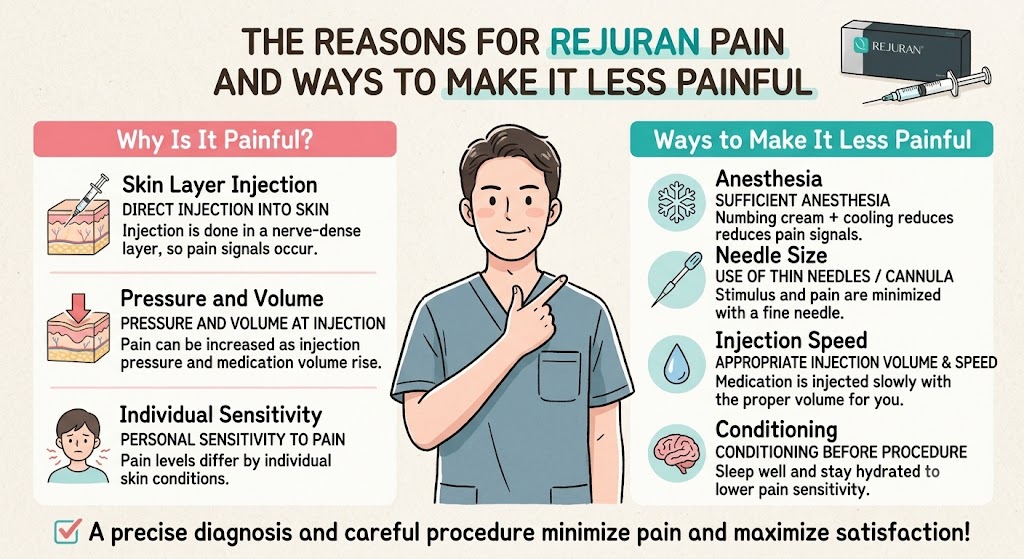
First: repeated superficial injections create cumulative needle pain.
Second: injecting a viscous material into the compact dermis creates pressure and tissue-expansion discomfort.
Third: topical numbing cream reduces surface pain but does not completely remove pressure, touch, or deep aching.
Needle component
Multiple injection points can make otherwise tolerable punctures accumulate into substantial discomfort.
Pressure component
The dermis is a compact tissue layer, so each microdeposit temporarily stretches and displaces tissue.
Anesthetic limitation
A numb skin surface can still register pressure, stretching, movement, and cumulative stimulation.
Why can Rejuran be painful even after numbing cream?
Many patients assume that a painful treatment means the topical anesthetic did not work. That is not always correct. Topical local anesthetics primarily reduce sensation near the surface of the skin. They can make needle penetration more tolerable, but an intradermal polynucleotide procedure creates additional sensations below the surface.
The injected material occupies space inside a relatively compact dermal layer. As each deposit enters the tissue, patients may feel pressure, stretching, burning, tightness, or a spreading ache. Official information for lidocaine-prilocaine cream also notes that pressure and touch may remain even when surface analgesia is achieved.
The practical answer: Rejuran pain is a combination of puncture pain, tissue-pressure pain, and cumulative stimulation.
1. The treatment usually involves many injection points
Polynucleotide treatments are often distributed through multiple small deposits rather than one or two large injections. This helps spread the product across the target area, but it also means that the skin is punctured repeatedly.
Simply reducing the number of punctures is not always a solution. If the same total amount is placed through fewer sites, each deposit may need to be larger, potentially increasing pressure, swelling, and visible papules. Comfortable treatment requires a balance between the number of sites and the volume delivered at each site.
2. Intradermal injection creates tissue pressure
The dermis is not an empty space. It contains collagen fibers, extracellular matrix, vessels, sensory structures, and cells. When a material is deposited into or near this layer, the tissue is temporarily displaced and expanded.
The small raised bumps frequently seen immediately after treatment are a visible result of these microdeposits. The same process can produce a deep, pressurized, or stinging sensation that topical cream cannot fully block.
3. Product properties may affect injection pressure
The manufacturer of Rejuran attributes part of the discomfort of the original formulation to the molecular characteristics and viscosity of polynucleotides. A recent clinical study also described substantial discomfort during conventional intradermal PN injection despite the use of topical lidocaine-prilocaine anesthesia.
This does not prove that polynucleotides chemically irritate nerves or that the ingredient is “too strong.” Current evidence supports a more mechanical explanation involving viscosity, injection force, tissue expansion, and repeated puncture.
4. Pain varies by anatomy and treatment history
A patient's experience may differ between the forehead, cheeks, under-eye area, perioral region, and jawline. Skin thickness, subcutaneous tissue, proximity to bone, sensory innervation, previous procedures, fibrosis, inflammation, and individual pain sensitivity all matter.
There is not enough PN-specific evidence to assign a reliable pain score to each facial zone. An in-person assessment is more useful than a universal pain ranking.
Does Rejuran HB Plus hurt less?
Rejuran HB Plus contains lidocaine, a local anesthetic, along with polynucleotides and hyaluronic acid. The manufacturer reports an average pain reduction of approximately 53 percent compared with the original product in its comparative clinical data.
This number should be interpreted carefully. The available claim is manufacturer-reported, and it does not mean that every patient will experience exactly 53 percent less pain. Needle penetration and tissue pressure may still be felt.
HB Plus should also not be described as an otherwise identical product with anesthetic added. Its formulation includes hyaluronic acid and may differ from the original PN product in composition and clinical emphasis.
Original PN-focused formulation
May require greater reliance on topical or regional anesthesia because lidocaine is not built into the product.
Rejuran HB Plus
Includes lidocaine and hyaluronic acid, potentially improving comfort and hydration, but is not compositionally identical to the original product.
Manual injection, injector device, or needle-free jet?
Manual injection
Manual injection allows the physician to adjust depth, angle, volume, and spacing according to local anatomy. Its disadvantages include a potentially large number of punctures and cumulative discomfort during a broad full-face treatment.
Multi-needle injector
An automated injector can provide relatively standardized depth and dosing. However, several needles may enter the skin simultaneously, and suction pressure may itself feel uncomfortable. Automated treatment is not automatically less painful.
Needle-free jet delivery
A randomized split-face pilot study involving 10 Korean participants compared conventional PN needle injection with a specific needle-free jet system. Both sides received topical lidocaine-prilocaine cream. Mean pain scores were approximately 5.4 out of 10 for manual injection and 2.9 for jet delivery.
The result is encouraging but preliminary. The sample was small, the study evaluated one device, and the manufacturer supported the research. Jet delivery may also create a different depth and distribution pattern from manual injection. It should therefore be viewed as a separate delivery method rather than a painless version of the same procedure.
Seven practical ways to reduce discomfort
- Choose the formulation according to both comfort and treatment goals. A lidocaine-containing option may be reasonable for a pain-sensitive patient, but formulation, target area, hydration needs, and PN treatment objectives should also be considered.
- Use topical anesthetic according to the actual product instructions. Analgesia depends on dose, treated area, contact time, and skin condition. Excessive use over a large area or damaged skin can increase systemic absorption.
- Adjust injection depth and volume by anatomical zone. The forehead, under-eye region, cheeks, and perioral skin should not automatically receive identical deposits.
- Avoid unnecessarily rapid injection. Controlled delivery may reduce abrupt tissue pressure, although PN-specific trials defining an ideal injection speed are not available.
- Consider controlled cooling. Cooling has reduced discomfort in studies of other facial injectable procedures, but excessive or prolonged cold exposure can injure the skin.
- Consider vibration as an adjunct. Studies and a recent meta-analysis of facial injections suggest that vibration can reduce pain perception. Direct Rejuran-specific evidence remains limited.
- Discuss a selective nerve block when appropriate. A regional block may provide stronger analgesia in selected areas, but it requires additional injections and introduces swelling, temporary sensory changes, and local-anesthetic safety considerations.
More pain does not mean better collagen stimulation, better placement, or a stronger treatment response.
Why more numbing cream is not always better
Topical anesthetics are medications, not cosmetic moisturizers. Their absorption is affected by the applied dose, surface area, duration, occlusion, and integrity of the skin.
When topical anesthetics, injected local anesthetics, or lidocaine-containing products are combined, total exposure should be considered. Patients should disclose previous local-anesthetic allergy, unusual reactions, significant liver disease, relevant medications, pregnancy or breastfeeding, and a history of methemoglobinemia or related risk factors.
Patients should not apply an unidentified high-concentration numbing product at home before treatment unless specifically instructed by the treating clinic.
Is sedation the best answer for severe pain anxiety?
Sedation can reduce awareness and procedural distress, but it is not a simple substitute for good injection planning. Sedative medications can affect breathing, oxygenation, blood pressure, alertness, and recovery.
Fasting instructions, physiological monitoring, airway equipment, trained personnel, and post-procedure observation may be required. For a standalone PN treatment, it is usually reasonable to first assess whether formulation choice, appropriate topical anesthesia, cooling, vibration, selective local anesthesia, or a smaller treatment area can provide acceptable comfort.
Sedation should be chosen only after an individualized risk-benefit assessment rather than marketed as a routine comfort upgrade.
What is expected after treatment, and what is not?
Temporary papules, redness, tenderness, swelling, and bruising can occur after intradermal PN injections. A recent systematic review found that reported adverse effects were generally local and transient, but the evidence base consisted of only nine studies involving 219 patients, with low-to-moderate study quality.
The following changes warrant prompt medical assessment:
- Pain that becomes progressively worse rather than improving
- Marked blanching, dusky discoloration, or a mottled pattern
- Rapidly increasing swelling
- Spreading redness, pus, fever, or marked warmth
- Visual disturbance, severe headache, or a neurological symptom
- Generalized hives, breathing difficulty, or swelling of the lips or throat
Who may benefit from a more intensive comfort plan?
Consider additional pain-control planning
- A previous PN session was stopped because of pain
- A broad full-face area is planned
- There is significant needle anxiety or a fainting history
- Topical anesthesia was previously insufficient
- Specific facial zones were disproportionately painful
Reassess before injecting
- Active inflammatory lesions or infection
- Dermatitis, an open wound, or significant barrier damage
- A previous unexplained prolonged swelling or nodule
- A local-anesthetic allergy or serious adverse reaction
- A significant systemic condition or relevant medication
Practical pre-treatment checklist
□ Ask for the exact product and formulation.
□ Confirm whether lidocaine is already included.
□ Ask which topical anesthetic will be used and how it is applied.
□ Report previous local-anesthetic reactions.
□ Ask whether treatment will be manual, automated, or needle-free.
□ Explain whether needle penetration or product pressure was more painful previously.
□ Confirm that active dermatitis or infection is absent.
□ Know how to contact the clinic if symptoms worsen.
Our clinical approach
At Springday Clinic Sinchon, the treatment plan considers the patient's main concern, facial anatomy, skin thickness, previous procedures, prior pain experience, local-anesthetic history, and the expected distribution of the chosen product. The number of syringes alone does not define a well-designed treatment.
Frequently Asked Questions
References
- Lampridou S, Bassett S, Cavallini M, Christopoulos G. The Effectiveness of Polynucleotides in Esthetic Medicine: A Systematic Review. J Cosmet Dermatol. 2025;24:e16721. DOI: 10.1111/jocd.16721.
- Hong JY, Lee YH, Kim HJ, Park KY. Therapeutic Performance of Needle Injection Versus Needle-Free Jet Injector System for Polynucleotide Filler in Skin Rejuvenation. J Cosmet Dermatol. 2025;24:e16595. DOI: 10.1111/jocd.16595.
- Perez SM, Li JN, Vincent N, et al. Efficacy of Vibration Anesthesia in Facial Injections: A Systematic Review and Meta-Analysis. Arch Dermatol Res. 2024;316:706. DOI: 10.1007/s00403-024-03463-6.
- Nestor MS, Ablon GR, Stillman MA. The Use of a Contact Cooling Device to Reduce Pain and Ecchymosis Associated With Dermal Filler Injections. J Clin Aesthet Dermatol. 2010;3(3):29-34.
- DailyMed. Lidocaine and Prilocaine Cream, 2.5%/2.5% Prescribing Information.
- PharmaResearch. REJURAN HB Plus Medical Device Addresses Skin Concerns and Reduces Pain. Manufacturer information, 2024.
A frequently cited 2014 Rejuran clinical trial was retracted in 2016 and was not used as efficacy or safety evidence in this article.
This article provides general medical information and does not determine individual suitability for treatment. Product selection, anesthesia, and injection technique require an in-person assessment and review of the applicable product instructions.
Comfort should be designed—not simply endured.
When considering treatment at a Seoul skin clinic in Sinchon, Hongdae, Ewha, or Mapo, ask how the product, anesthetic plan, injection depth, and follow-up care will be individualized.
#Rejuran #RejuranPain #PolynucleotideInjection #PNSkinBooster #RejuranHBPlus #SkinBooster #InjectionPain #TopicalAnesthesia #SeoulSkinClinic #SpringdayClinicSinchon