Doxycycline, Minocycline, or Sarecycline? - Part 2. How Do Physicians Choose the Right Antibiotic for Acne?
By Dr. Bowon Lee (Dr. Sly Fox)
Spring Day Clinic Sinchon-Hongdae, Seoul, Korea
In Part 1, we discussed why two people with acne may receive completely different prescriptions.
Today, let's answer the next question I hear almost every day.
"Which antibiotic is the best?"
Some patients specifically ask for doxycycline because they've read about it online.
Others request sarecycline simply because it's the newest medication.
The truth is much more interesting.
Experienced physicians rarely ask,
"Which antibiotic is strongest?"
Instead, they ask,
"Which antibiotic is most appropriate for this particular patient?"
That difference is what makes personalized acne treatment so important.
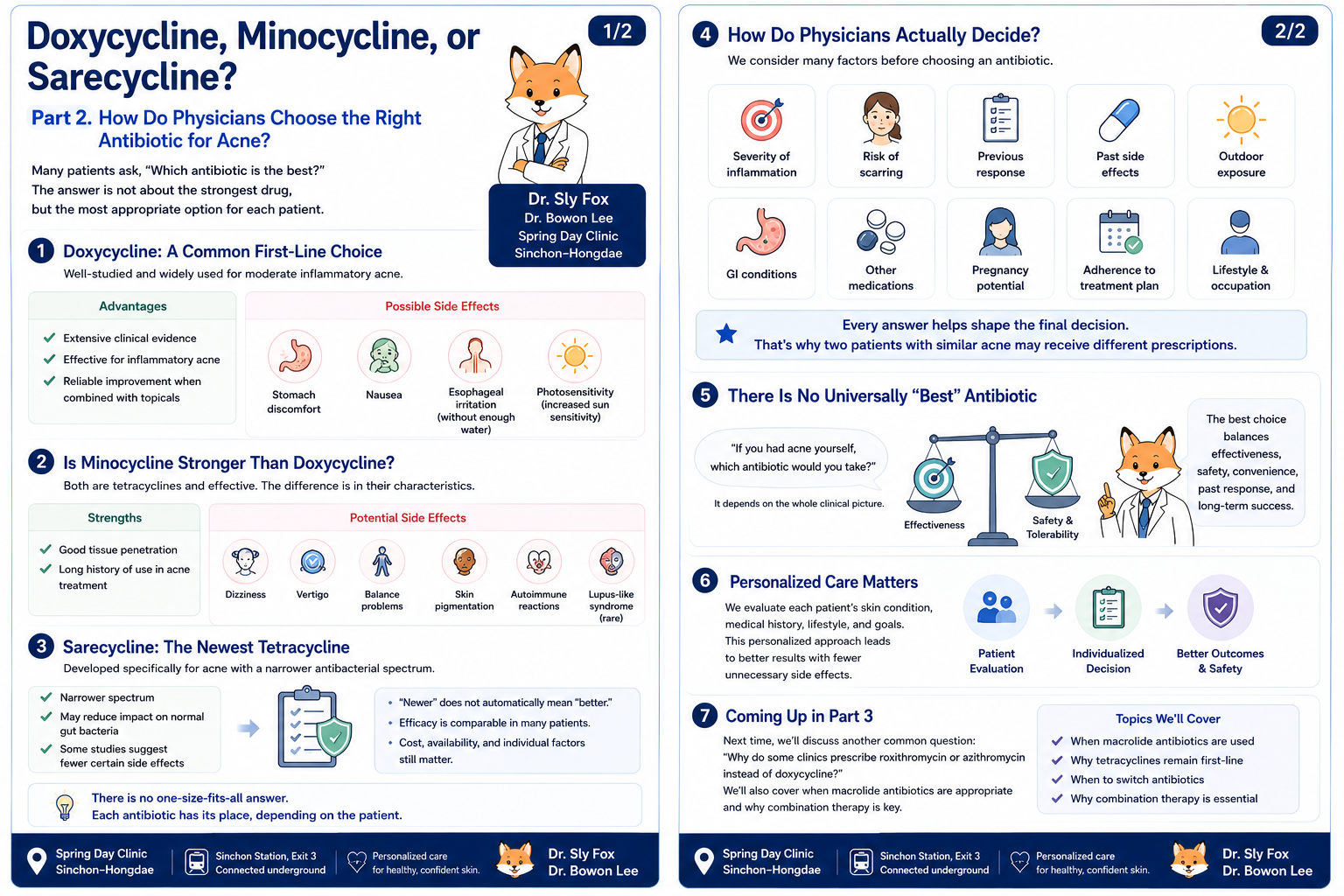
Doxycycline: Still the Most Common First-Line Choice
Among oral antibiotics for inflammatory acne, doxycycline remains one of the most widely prescribed worldwide.
There are several reasons for this.
It has been studied extensively over many years, providing physicians with a large body of clinical evidence regarding both efficacy and safety.
For patients with moderate inflammatory acne, doxycycline often provides reliable improvement when combined with appropriate topical therapy.
However, like every medication, it has limitations.
The most common side effects include:
- Stomach discomfort
- Nausea
- Esophageal irritation if taken without enough water
- Increased sensitivity to sunlight (photosensitivity)
Because of this, physicians often advise patients to drink plenty of water, remain upright for at least 30 minutes after taking the medication, and use sunscreen consistently during treatment.
Is Minocycline Stronger Than Doxycycline?
Many people believe minocycline is simply a "stronger version" of doxycycline.
That isn't really accurate.
Both belong to the tetracycline family and are considered effective treatments for inflammatory acne.
The difference lies less in potency and more in their clinical characteristics.
Minocycline penetrates tissues well and has long been an important option in acne management.
However, it also has a unique side-effect profile.
Some patients experience:
- Dizziness
- Vertigo
- Balance disturbances
Rare but important adverse reactions reported with prolonged use include:
- Skin pigmentation
- Autoimmune reactions
- Drug-induced lupus-like syndrome
These complications are uncommon, but they are one reason physicians prescribe minocycline thoughtfully rather than routinely.
Sarecycline: The Newest Member of the Family
Sarecycline is a newer tetracycline antibiotic developed specifically for acne treatment.
Unlike older tetracyclines, it has a narrower antibacterial spectrum.
Why does that matter?
A narrower spectrum may reduce unnecessary effects on the normal bacteria living in the gastrointestinal tract.
Some studies have also suggested lower rates of certain side effects, although ongoing research continues to evaluate its long-term advantages.
That said, "newer" does not automatically mean "better."
Current evidence suggests that sarecycline offers efficacy comparable to other tetracyclines for many patients, while factors such as cost, availability, and individual patient characteristics still play an important role in treatment selection.
So How Do Physicians Actually Decide?
Choosing an antibiotic involves much more than comparing drug names.
During a consultation, physicians often consider questions like these:
- How severe is the inflammation?
- Is there a high risk of permanent scarring?
- Has the patient previously responded to antibiotics?
- Have there been significant side effects before?
- Does the patient spend long hours outdoors?
- Are there gastrointestinal conditions to consider?
- What other medications are being taken?
- Is pregnancy possible or being planned?
- Will the patient realistically be able to follow the treatment plan?
Every answer helps shape the final decision.
This is why two patients with seemingly similar acne may receive completely different prescriptions.
Medicine is rarely one-size-fits-all.
There Is No Universally "Best" Antibiotic
Patients often ask,
"If you had acne yourself, which antibiotic would you take?"
It's an understandable question—but it's impossible to answer without knowing the individual patient.
The "best" antibiotic depends on the entire clinical picture.
A medication that works perfectly for one patient may not be the ideal choice for another.
Successful acne treatment isn't about following internet rankings or choosing the newest medication.
It's about balancing effectiveness, safety, convenience, previous treatment response, and long-term management.
Personalized Care Matters
At Spring Day Clinic Sinchon-Hongdae, I believe every acne treatment plan should be individualized.
Rather than automatically prescribing the same medication to everyone, I prefer to evaluate each patient's skin condition, medical history, lifestyle, and treatment goals before making a recommendation.
That personalized approach often leads to better outcomes—and fewer unnecessary side effects.
Coming Up in Part 3
In the next article, we'll discuss another question many patients ask:
"Why do some clinics prescribe roxithromycin or azithromycin instead of doxycycline?"
We'll also cover:
- When macrolide antibiotics are appropriate
- Why tetracyclines remain the standard first-line treatment
- When it's reasonable to change antibiotics
- Why combination therapy is more important than antibiotics alone
Dr. Bowon Lee (Dr. Sly Fox)
Spring Day Clinic Sinchon-Hongdae
"The goal isn't to find the newest antibiotic.
It's to find the right treatment strategy for the individual patient."
doxycycline for acne, minocycline acne treatment, sarecycline review, acne antibiotics comparison, inflammatory acne treatment, oral antibiotics for acne, tetracycline antibiotics, acne medication guide, personalized acne treatment, Korean dermatologist