Why Are Acne Antibiotics Different for Everyone? - Part 1. Why Do Different Dermatology Clinics Prescribe Different Antibiotics?
By Dr. Bowon Lee (Dr. Sly Fox)
Spring Day Clinic Sinchon-Hongdae, Seoul, Korea
One of the questions I hear most often in my clinic is surprisingly simple.
"My friend was prescribed doxycycline. Why did I receive a different medication?"
Others ask,
"My previous clinic gave me minocycline. Why did you choose something else?"
Or,
"I read online that sarecycline is the newest antibiotic. Doesn't that mean it's automatically the best?"
These are reasonable questions.
From a patient's perspective, acne is acne. It seems logical that everyone should receive the same treatment.
However, from a physician's perspective, the answer is quite different.
Because two patients may both have acne, yet they rarely have the same disease severity, inflammatory pattern, or treatment needs.
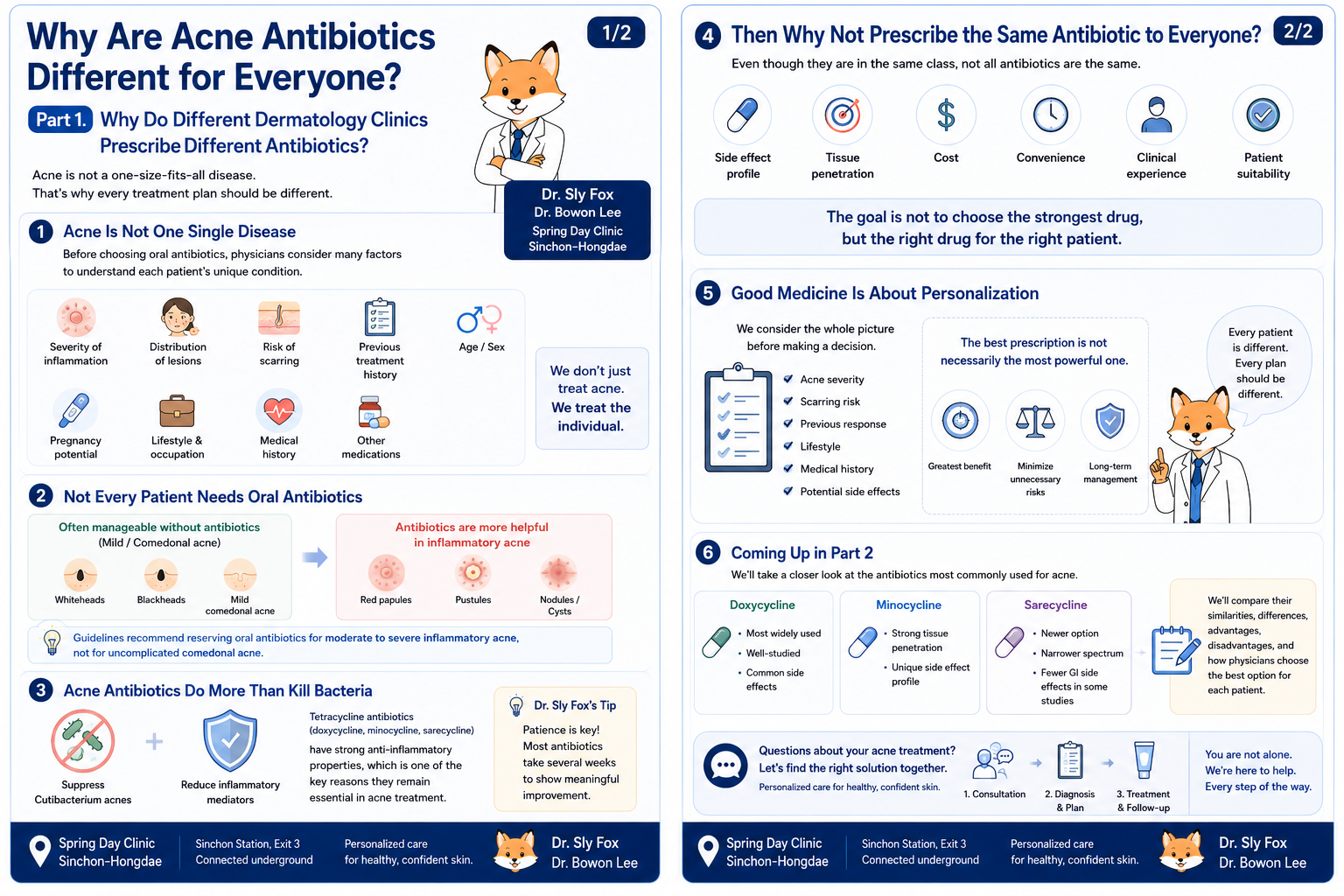
Acne Is Not One Single Disease
Many people think of acne as one condition with one treatment.
In reality, acne exists on a wide spectrum.
Before deciding whether oral antibiotics are appropriate, physicians evaluate numerous factors, including:
- Severity of inflammation
- Distribution of lesions
- Extent of affected skin
- Presence of nodules or cysts
- Risk of permanent scarring
- Previous treatment history
- Age
- Sex
- Pregnancy potential
- Lifestyle and occupation
In other words,
we do not simply treat acne.
We treat the individual sitting in front of us.
This is why two patients of the same age may receive completely different treatment plans.
Not Every Patient Needs Oral Antibiotics
One of the biggest misconceptions is that oral antibiotics are required whenever acne appears.
That simply isn't true.
Patients with predominantly:
- Whiteheads
- Blackheads
- Mild comedonal acne
often improve without systemic antibiotics.
On the other hand, oral antibiotics become much more valuable when acne is clearly inflammatory, such as:
- Painful red papules
- Pustules
- Nodules
- Rapidly progressing inflammatory lesions
Current international acne guidelines recommend reserving oral antibiotics primarily for moderate to severe inflammatory acne, rather than uncomplicated comedonal acne.
Acne Antibiotics Do More Than Kill Bacteria
Many people assume antibiotics work simply by eliminating bacteria.
That is only part of the story.
Tetracycline antibiotics—including doxycycline, minocycline, and sarecycline—also possess significant anti-inflammatory properties.
Beyond suppressing Cutibacterium acnes, they help reduce inflammatory mediators involved in acne development.
This anti-inflammatory effect is one of the major reasons these medications remain an important component of acne treatment.
Then Why Not Prescribe the Same Antibiotic to Everyone?
This is where individualized medicine becomes important.
Although doxycycline, minocycline, and sarecycline belong to the same antibiotic family, they are not interchangeable.
Each medication differs in:
- Side-effect profile
- Tissue penetration
- Cost
- Convenience
- Clinical experience
- Patient suitability
Choosing an antibiotic is therefore less about selecting "the strongest drug" and more about selecting the right drug for the right patient.
Good Medicine Is About Personalization
Some patients tell me,
"Doctor, just give me the strongest medication."
But medicine doesn't work that way.
The best prescription is not necessarily the most powerful one.
It is the medication that provides the greatest benefit while minimizing unnecessary risks.
Every treatment decision should consider:
- Acne severity
- Scarring risk
- Previous treatment response
- Daily lifestyle
- Medical history
- Potential adverse effects
At Spring Day Clinic Sinchon-Hongdae, this is exactly how I approach every acne consultation.
No two treatment plans are exactly alike—because no two patients are exactly alike.
Coming Up in Part 2
In the next article, we'll take a closer look at the antibiotics most commonly prescribed for acne, including:
- Doxycycline
- Minocycline
- Sarecycline
We'll discuss their similarities, differences, advantages, disadvantages, and how physicians decide which medication best fits each patient's situation.
Dr. Bowon Lee (Dr. Sly Fox)
Spring Day Clinic Sinchon-Hongdae
"Great acne treatment isn't about finding the strongest medication.
It's about finding the right treatment for the right person."
acne treatment, acne antibiotics, doxycycline, minocycline, sarecycline, inflammatory acne, oral antibiotics for acne, acne dermatologist, personalized acne treatment, Korean skin clinic