Why Do I Always Ask My Patients to Sit Up Before I Design Their Lifting Treatment? (3) - Your Face Changes the Moment You Lie Down
Gravity Never Lies
Why I Ask Every Patient to Sit Up Before Designing a Lifting Treatment
One habit surprises many of my patients.
After they settle comfortably onto the treatment bed, I sometimes ask them to sit back up.
Some smile.
Some look confused.
A few even ask,
"Didn't we just get comfortable?"
Yes.
But before I begin a lifting procedure, I need to see your face the way the world sees it.
Not lying down.
Sitting upright.
Because gravity never takes a break.
Gravity Is the Invisible Force Behind Facial Aging
We spend nearly every waking hour sitting, standing, walking, talking, and smiling while gravity continuously pulls our facial tissues downward.
It acts slowly.
Almost imperceptibly.
Year after year.
The gradual descent of fat pads, the deepening of the nasolabial folds, the appearance of jowls, and the softening of the jawline are all influenced by this constant downward force.
When patients tell me,
"My face seems to be falling."
they're not imagining it.
In many cases, they're describing exactly what gravity has been doing for decades.
Your Face Changes the Moment You Lie Down
Here's something many people never notice.
As soon as you lie flat on a treatment bed, your face changes.
Gravity no longer pulls tissues in the same direction.
The cheeks naturally shift backward.
The jawline often appears tighter.
The jowls seem less prominent.
Even fullness beneath the chin may partially redistribute.
For a brief moment, the face can appear younger than it actually does during daily life.
That's why evaluating a lifting patient exclusively in the lying position can be surprisingly misleading.
The face I'm looking at is no longer behaving naturally.
I Don't Treat the Face on the Bed
I treat the face that walks into work.
The face that smiles during family photos.
The face that appears in video calls.
The face reflected in the mirror every morning.
That face exists under gravity.
Not on a treatment table.
This is why I ask patients to sit upright before making any important treatment decisions.
Only then can I accurately observe:
- where the tissues truly descend,
- how the jawline changes,
- where facial shadows develop,
- which retaining ligaments have weakened,
- and which areas actually require lifting.
Those details often become much less obvious once the patient lies down.
My Hands Confirm What My Eyes See
Observation alone isn't enough.
After examining the face visually, I gently lift different areas with my fingertips.
I want to understand something very specific:
"If I support this structure, how will the entire face change?"
Sometimes lifting one small area near a retaining ligament improves the appearance of the lower face dramatically.
Sometimes adding energy to the wrong location would create imbalance instead of rejuvenation.
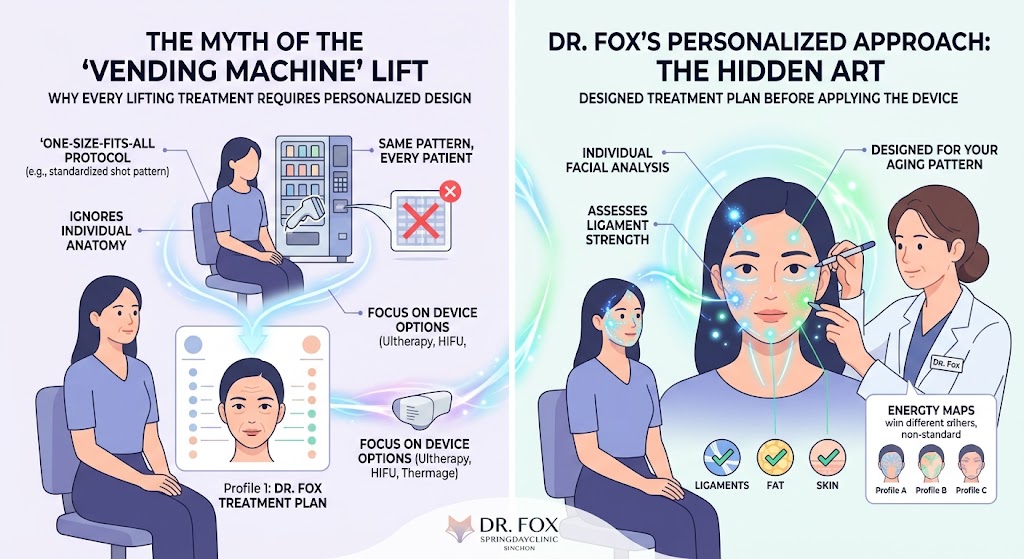
These subtle differences cannot be identified by following a standardized treatment template.
They require direct examination.
Experience.
And careful judgment.
Every Face Deserves Its Own Blueprint
This is the stage many people never see.
Before the machine is turned on, I mentally design the procedure.
Which areas deserve priority?
Which structures provide the greatest lifting effect?
Where should energy be reduced?
Where should it be avoided completely?
Only after answering these questions do I begin treatment.
The lifting procedure itself may take only minutes.
The planning behind it is what determines whether those minutes produce an average result—or an exceptional one.
Good Design Comes Before Good Technology
Modern lifting devices are extraordinary.
They allow us to deliver energy with remarkable precision.
But technology does not decide where that precision should be applied.
That's still the physician's responsibility.
No algorithm can fully appreciate facial balance, asymmetry, expression, aging patterns, and beauty the way an experienced clinician can.
Technology provides the instrument.
Clinical judgment creates the art.
In the next article, we'll explore why experienced hands still outperform standardized protocols—and why successful lifting depends on far more than simply operating an advanced device.