Gravity Never Lies: Why I Always Design a Face While My Patient Is Sitting Up (2) - Why the Same 300 Shots Are Never the Same
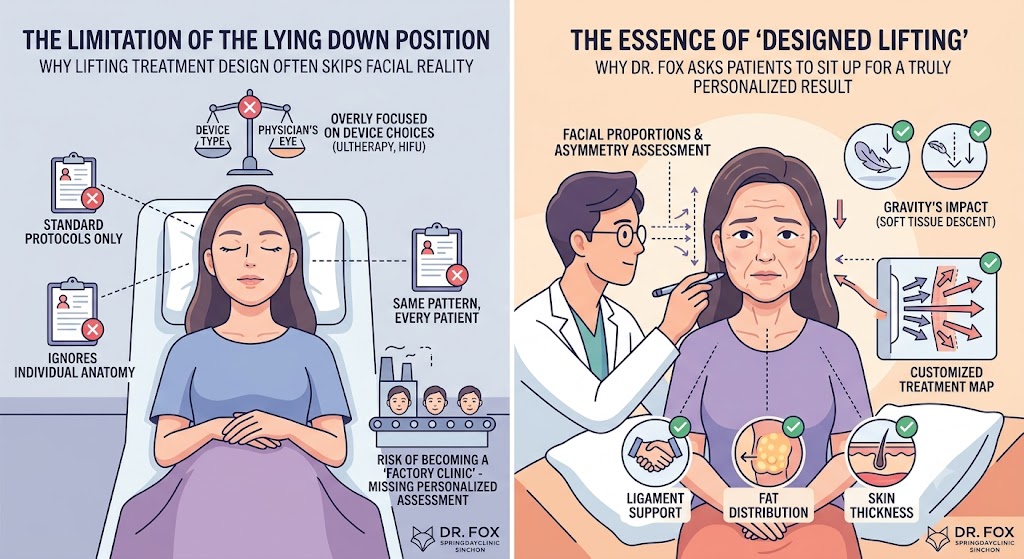
Gravity Never Lies: Why I Always Design a Face While My Patient Is Sitting Up
One of the biggest mistakes in facial lifting happens before the treatment even begins.
It happens when the physician designs the treatment while the patient is lying flat.
At first glance, this may seem perfectly reasonable. After all, the patient will receive the procedure lying down, so why not plan it that way?
Because we don't live our lives lying on our backs.
We spend our days sitting, standing, talking, laughing, eating, and expressing ourselves—all under the constant influence of gravity.
If I want to improve the face people actually present to the world every day, I must evaluate that face under real-life conditions.
Gravity Changes Everything
The moment a patient lies down, the face begins to change.
Gravity no longer pulls the soft tissue downward in the same way.
The jowls soften.
The jawline often appears sharper.
The submental fullness beneath the chin spreads backward.
The cheeks shift toward the ears.
Deep folds become less obvious.
Even the lower face can appear noticeably tighter.
In other words, the face lying on the treatment bed is not the face the patient sees every morning in the mirror.
If I design the lifting pattern based only on that position, I risk treating an illusion rather than reality.
The Face Patients Want to Improve Exists Only When They're Upright
Patients don't complain about how they look while lying down.
They worry about what they see:
- during video calls,
- in photographs,
- while speaking,
- while smiling,
- while looking in the bathroom mirror.
Every one of those situations happens with gravity acting on the face.
That's why I always ask my patients to sit upright before I finalize my treatment plan.
Only then can I accurately evaluate:
- the true position of the jowls,
- the degree of lower-face descent,
- the actual contour of the jawline,
- the depth of the nasolabial folds,
- the relationship between facial fat compartments,
- and the natural lifting vectors unique to that individual.
Gravity is not an inconvenience.
It is one of the most important diagnostic tools we have.
My Hands Tell Me What Machines Cannot
When my patient is sitting upright, I don't simply look.
I examine.
I gently lift different areas of the face with my fingertips.
I observe how the tissues respond.
I evaluate which ligament support has weakened.
I estimate how repositioning one area influences the rest of the face.
Sometimes lifting a single point near the lateral cheek dramatically improves the jawline.
Other times, the true problem lies much lower than the patient expected.
These subtle findings cannot be obtained from numbers on a screen.
They come from experience.
They come from touch.
They come from understanding facial anatomy beyond textbooks.
Every Face Ages Differently
No two faces age in exactly the same way.
Some patients lose volume early.
Others maintain volume but develop heavy descent.
Some develop strong marionette lines despite relatively good skin elasticity.
Others have excellent skin quality but weakened retaining ligaments.
Treating every patient with the same pattern simply because they purchased the same number of shots makes little medical sense.
The treatment should adapt to the anatomy—not the other way around.
Designing Before Treating
Only after this examination do I begin marking the face.
I decide:
- where more energy is truly needed,
- where conservative treatment is safer,
- which structures should be supported,
- and which regions should be preserved to maintain natural facial volume.
This design process often takes several minutes.
Some may see it as inefficient.
I see it differently.
Those few extra minutes frequently determine whether the final result looks naturally refreshed—or simply overtreated.
Precision Takes Time
Modern aesthetic medicine often celebrates speed.
Faster consultations.
Faster procedures.
More patients per day.
But precision rarely happens in a hurry.
Facial lifting isn't about completing a certain number of shots as quickly as possible.
It's about understanding the architecture of a unique human face.
The device delivers energy.
The physician determines where that energy belongs.
And that decision begins only after I ask one simple question:
"Would you mind sitting up for a moment?"
For me, that's not an extra step.
It's the beginning of truly personalized lifting treatment.
ultherapy treatment
ultherapy results
ultherapy 300 shots
hifu treatment
personalized treatment
skin laxity
jawline lifting
facial rejuvenation
cosmetic procedures
springdayclinic