Looking for a Thermage Alternative? Meet All-Tite, Korea's popular RF Lifting Treatment (Part 2)
If you haven’t read Part 1 of this article, I recommend starting there first, as it explains the basics of All-Tite RF lifting, including how it works, expected results, and how it compares to other energy-based devices such as Thermage and InMode.
In this second part, we will go deeper into the more frequently asked—and sometimes more controversial—questions about All-Tite, including facial hollowing concerns, device comparisons at a technical level, and why different patients can experience very different outcomes from the same treatment.
This article is written by Dr. Bo-Won Lee, the medical director of Spring Day Clinic (Shinchon branch), a dermatology and aesthetic clinic located in Seoul, Korea. All opinions and explanations are based on real clinical experience and patient consultations.

4. Can All-Tite Cause Facial Hollowing?
This is probably one of the most searched questions about All-Tite.
My answer is straightforward:
No lifting treatment can honestly be described as having a zero percent risk of facial hollowing.
The reason is simple.
Every face is different.
Factors such as:
- Facial fat volume
- Skin thickness
- Bone structure
- Energy settings used during treatment
all influence how a patient responds.
That's why the discussion shouldn't focus solely on the device itself.
The more important question is:
"Was the treatment appropriately designed for that specific face?"
Patients who naturally have:
- A slim face
- Minimal cheek fat
- Prominent facial structure
usually require more careful treatment planning and energy adjustment.
On the other hand, patients with heavier facial contours often experience improved definition and contouring after treatment, leading to higher satisfaction.
One point worth mentioning is that RF-based treatments such as Thermage and All-Tite generally carry a lower risk of facial volume loss compared to HIFU-based treatments such as Ultherapy and Shurink.
That doesn't mean volume loss is impossible, but in clinical practice, it tends to be less of a concern.
However, there is another side to this discussion.
Patients with significant facial fullness often want two things at the same time:
- Tighter skin
- A slimmer face
Since All-Tite primarily focuses on tightening and contour refinement rather than fat reduction, some patients hoping for a noticeable slimming effect may find the results less dramatic than expected.
For those individuals, treatments that target fat more directly—such as Ultherapy or microwave-based technologies like ONDA and Re:Ola (made by DRC Healthcare)—may sometimes be more appropriate options.
5. How Does All-Tite Compare to InMode, ONDA, and Thermage?

This is another question I hear almost daily.
The short answer is:
It's not about which treatment is "better."
They simply produce different types of results.
I often compare it to being asked:
"Which parent do you like more—your mother or your father?"
There's no universally correct answer.
Each treatment serves a different purpose.
InMode
- RF-based technology
- Combines skin tightening with fat reduction
- Often creates a noticeable facial slimming effect
- Popular among patients who want a more sculpted appearance
ONDA
- Microwave-based technology
- Targets fat layers more directly
- Produces a deeper heating sensation
- Frequently chosen for contouring and volume reduction
Thermage
- Traditional monopolar RF technology
- Focuses primarily on skin tightening
- Often associated with the classic RF "hot" sensation
- Well-known for improving skin firmness and elasticity
All-Tite
- Focuses on contour refinement and tissue tightening
- Produces natural-looking improvements rather than dramatic changes
- Often described as creating a "de-puffed" appearance
- Emphasizes definition rather than aggressive lifting
This is why treatment selection should always begin with the patient's goals.
Even though Thermage, InMode, and All-Tite all fall under the broad category of RF-based treatments, they each have a different character and treatment profile.
In other words, they are not interchangeable.
6. Who Tends to Be Most Satisfied With All-Tite?
Based on my clinical experience, the patients who tend to be happiest with All-Tite usually share a few characteristics.
Patients With Higher Satisfaction Rates
- Early signs of facial laxity
- Mild contour changes rather than severe sagging
- Preference for natural-looking improvement
- Hesitation toward surgery or thread lifting
- Desire to preserve facial volume
- Concern about treatment discomfort
These patients often appreciate the subtle but noticeable improvements All-Tite can provide.
Patients Who May Feel Underwhelmed
On the other hand, expectations may need adjustment if:
- Significant sagging is already present
- Dramatic lifting is the primary goal
- Surgical-level results are expected
- Large amounts of facial fat reduction are desired
- Facial slimming is the main objective
In these situations, a different treatment—or a combination approach—may deliver more satisfying results.
7. Final Thoughts
If I had to summarize All-Tite in a single sentence, it would be this:
All-Tite is less about pulling and more about tightening.
Rather than aggressively lifting the face upward, it focuses on:
- Refining facial contours
- Improving definition
- Creating a cleaner and more structured appearance
That's why I often describe it to patients using phrases like:
"Your face looks a little closer to the underlying bone structure."
or
"It looks like you've just finished a run and the puffiness has gone down."
No scientific paper came up with those descriptions.
They simply come from years of observing patients and trying to explain results in a way that actually makes sense.
Online reviews can be confusing.
Some people love the treatment.
Others feel it wasn't worth it.
But in reality, most of those differences come down to one thing:
Was it the right treatment for that person's face and goals?
The same device can be an excellent choice for one patient and a poor choice for another.
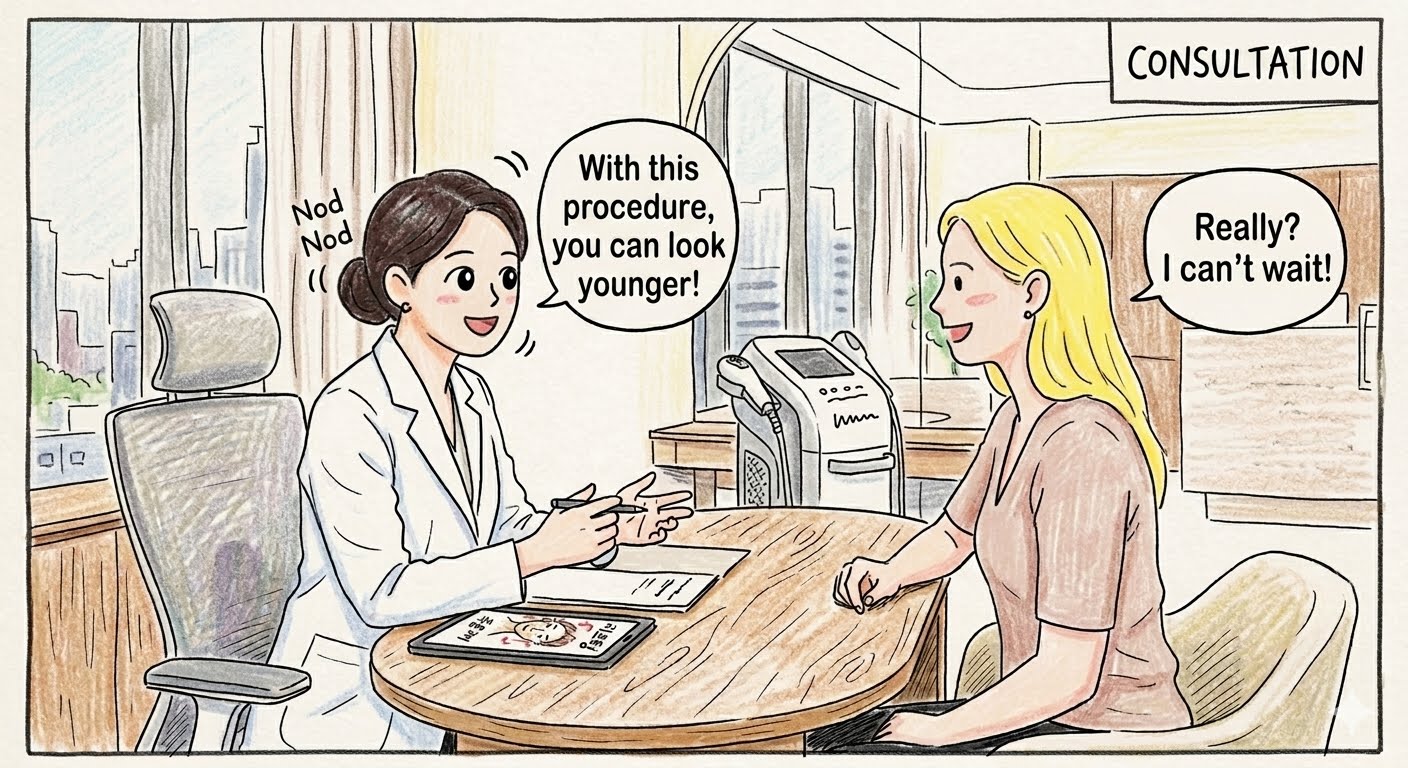
That's why a thorough consultation matters.
And if possible, it's even better when your treatment is performed by someone who has worked extensively with multiple lifting technologies, understands their differences, and has personally experienced many of them firsthand.
As I write this article, I actually have another All-Tite treatment scheduled later today.
The manufacturer promotes its proprietary DLTD technology as one of the key innovations behind the device, and after working with it extensively, I can confidently say that All-Tite is not simply "another RF machine."
It behaves differently.
It feels different.
And in many cases, it produces a different style of result.
Perhaps the best way to describe it is this:
It looks like RF.
It sounds like RF.
But it doesn't always behave quite like the RF devices most people are familiar with.
And that's exactly why it has attracted so much attention recently.
Coming Up Next
Many people read dozens—sometimes hundreds—of All-Tite reviews before finally reaching the same questions.
In my next article, I'll take a deeper dive into topics such as:
- Why do some patients say All-Tite feels similar to ONDA?
- Why doesn't it require a return pad, unlike many conventional RF devices?
- If All-Tite and Tune Face (Accent Prime) both use 40.68 MHz RF energy, why do they feel and behave differently?
- And perhaps the most controversial topic of all: the truth behind the facial hollowing debate.
We'll explore these questions from the perspective of real clinical experience rather than marketing brochures.
Stay tuned.