Evidence-Based Guide to Focused Ultrasound Lifting
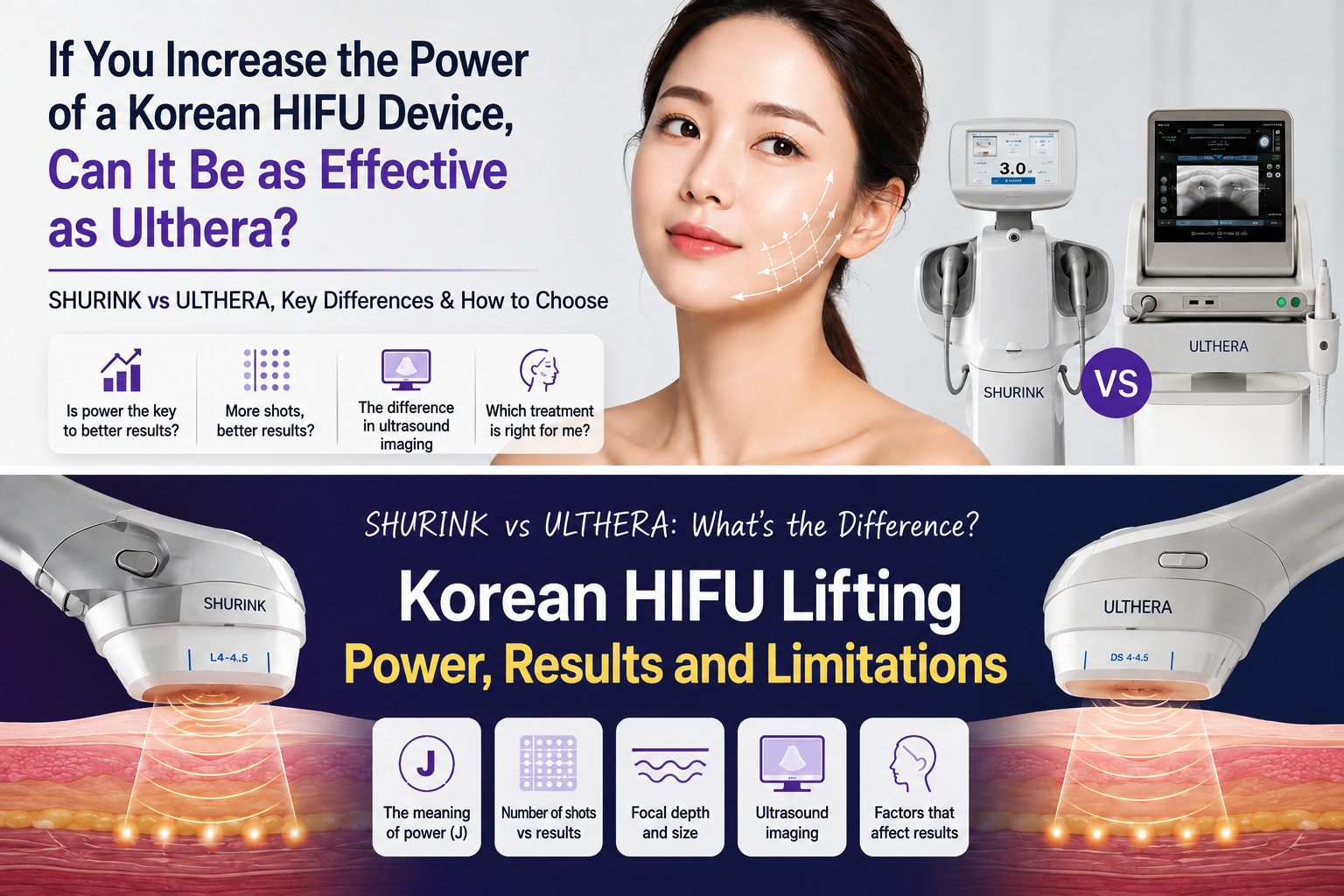
Can Shurink (Higher-Energy Korean HIFU) Match or Outperform Ultherapy?
Why the number on the energy setting does not tell the whole story
Written by M.D. Bo Won Lee, Director of Springday Clinic Sinchon, Seoul.
Increasing the displayed energy of a Korean HIFU device does not turn it into an Ulthera System.
Nominal joules cannot be compared directly across devices with different frequencies, focal geometries, pulse characteristics, and transducers.
A Korean HIFU device may still produce a meaningful or comparable result in a properly selected patient when the treatment is designed appropriately.
Takeaway 1
A higher setting does not reproduce another device's focal characteristics.
Takeaway 2
Equal joules or line counts do not necessarily create equal tissue effects.
Takeaway 3
The goal should be the appropriate dose for the anatomy, not the maximum available output.
The question is not simply which device is stronger
Patients often assume that focused-ultrasound devices can be compared by looking at the energy setting and the number of treatment lines. The reasoning appears straightforward: if two devices use focused ultrasound, a higher output or a larger number of shots should compensate for differences between them.
That conclusion is not supported by the available evidence. Different systems may use different transducer frequencies, focal volumes, treatment-line lengths, thermal coagulation point spacing, pulse durations, and acoustic conversion efficiencies.
A Korean HIFU treatment may produce a result that is clinically similar to Ultherapy in an individual patient, but simply raising the output cannot establish equivalence or superiority.
Why identical joule settings are not necessarily equivalent
A joule is a unit of energy, but a displayed joule value does not describe the complete acoustic exposure. The clinically relevant tissue response also depends on how that energy is converted, focused, distributed, and delivered over time.
Two devices showing 0.8 J may differ in focal width, focal length, pulse duration, frequency, line geometry, point spacing, and coupling. There is no verified universal clinical conversion table that makes nominal energy settings interchangeable across aesthetic HIFU platforms.
The number on the screen is only one component of the treatment dose.
What real-time visualization adds
The Ulthera System combines focused-ultrasound treatment with real-time ultrasound visualization. According to its official instructions for use, the DeepSEE transducer can visualize tissue up to 8 mm beneath the skin surface. The stated purposes include confirming appropriate skin coupling and checking treatment depth, including avoiding bone.
Visualization does not automatically create a better outcome. Its value depends on whether the clinician interprets the image and adjusts the treatment plan accordingly.
Energy setting
Influences how much energy is delivered under device-specific conditions.
Ultrasound visualization
Helps identify tissue layers and confirm contact before treatment energy is delivered.
Increasing output on a non-imaging platform does not replace the information provided by imaging.
Can a Korean HIFU device produce a comparable result?
It can in selected cases. Patients with mild to moderate laxity, suitable soft-tissue thickness, and realistic expectations may respond well to several focused-ultrasound platforms.
A favorable outcome may depend more on patient selection, treatment-zone mapping, cartridge depth, line orientation, density, and preservation of facial volume than on using the highest available energy.
Results may vary. A stronger visible contour change is not always synonymous with better lifting. In a thin face, reduction of soft-tissue volume may sharpen the cheekbone or nasolabial boundary without correcting the underlying structural cause.
What direct comparison studies show
A small split-face report included 22 women treated with Ultraformer III on one side and the Ulthera System on the other. No clear difference was found at six months. However, the sample was small, the energy settings and line counts differed between devices, and the assessment relied heavily on photographs and subjective scales.
Failure to detect a statistically significant difference is not proof that two treatments are clinically equivalent. The publication details and DOI of the accessible report could not be confirmed, which further limits its evidentiary weight.
A larger randomized non-inferiority study comparing Ultraformer MPT Plus with the Ulthera System is currently registered with an intended enrollment of approximately 273 participants. As of August 2026, results have not been posted.
Current evidence does not support a definitive conclusion that raising the output of a Korean HIFU device makes it equal or superior to Ultherapy.
Why maximum output may be the wrong goal
A higher setting may alter the thermal response, discomfort, and risk profile. The relationship is not necessarily linear and depends on the device, transducer, tissue properties, coupling, and technique.
Thin face
Excessive treatment of already deficient cheek or temple volume may make facial hollows more visible.
Structural volume loss
If skeletal support or soft-tissue depletion is the main problem, more ultrasound energy may not address the cause.
Nerve and bony areas
Anatomical mapping, appropriate depth, full contact, and avoidance of risk zones are essential.
Line count and pain are poor shortcuts
A larger number of treatment lines does not guarantee better coverage or better outcomes. Devices may differ in line length and the number and spacing of thermal coagulation points. Repeating energy in the wrong zone may add discomfort without improving the treatment objective.
Pain is also not a reliable surrogate for efficacy. It is affected by proximity to bone and nerves, coupling, treatment speed, repeated passes, analgesia, and individual sensitivity.
Suitable and less suitable candidates
Potentially suitable
- Mild to moderate laxity
- Gradual, nonsurgical improvement desired
- Blurring of the jawline or submental contour
- Adequate tissue thickness for the intended depth
- Realistic expectations about the magnitude of change
Requires greater caution
- Deficient cheek or temple volume
- Severe laxity that may require surgical assessment
- Recent fillers, threads, fat grafting, or energy treatments
- Active lesions or wounds in the treatment area
- Pre-existing sensory or facial nerve symptoms
Pre-treatment checklist
□ Confirm the exact device and transducer model.
□ Ask why each treatment depth was selected.
□ Review how treatment lines will be distributed by facial zone.
□ Identify areas where volume should be reduced or preserved.
□ Disclose previous fillers, threads, fat grafting, and energy treatments.
□ Discuss realistic benefits and limitations.
□ Review potential adverse effects and follow-up procedures.
□ Ask whether the proposed setting is anatomically appropriate rather than merely maximal.
Frequently Asked Questions
References
- Ulthera, Inc. Ulthera System Instructions for Use, Rev 05. 2024.
- Amiri M, et al. Microfocused Ultrasound With Visualization Effectiveness and Safety: A Systematic Review and Meta-Analysis. Aesthetic Surgery Journal. 2025;45(3):NP86-NP94. DOI: 10.1093/asj/sjae228.
- Pan R, et al. Efficacy and safety of intense focused ultrasound for skin rejuvenation. Archives of Dermatological Research. 2024;316:513. DOI: 10.1007/s00403-024-03263-y.
- Ayatollahi A, et al. Safety and efficacy of HIFU for face and neck rejuvenation. Lasers in Medical Science. 2020;35:1007-1024. PMID: 32026164.
- Fabi SG, et al. Optimizing Patient Outcomes by Customizing Treatment With MFU-V. Journal of Drugs in Dermatology. 2019;18(5):426-432. PMID: 31141851.
- Harker-Martinez S. High-Intensity Focused Ultrasound; Simultaneous Treatment with Market-leading Devices. Journal and DOI details were not confirmed in the accessible document.
- ClinicalTrials.gov Identifier NCT07229430. Randomized non-inferiority study comparing Ultraformer MPT Plus and the Ulthera System. No results posted as of August 2026.
Final note
The most appropriate focused-ultrasound treatment cannot be determined by nationality, brand name, nominal joules, or line count alone. Facial anatomy, tissue thickness, treatment history, volume preservation, and the intended clinical endpoint must be considered together.
Ultherapy, Korean HIFU, Shurink, Focused Ultrasound, MFU-V, Skin Tightening, Facial Lifting, HIFU Safety, Facial Anatomy, Springday Clinic Sinchon