ACNE MEDICATION GUIDE
How Long Should You Take Antibiotics for Acne?
Why 12 weeks is the first major review point—and why oral antibiotics should not become indefinite maintenance therapy.
Written by M.D. Bo Won Lee, Director of Springday Clinic Sinchon, Seoul.
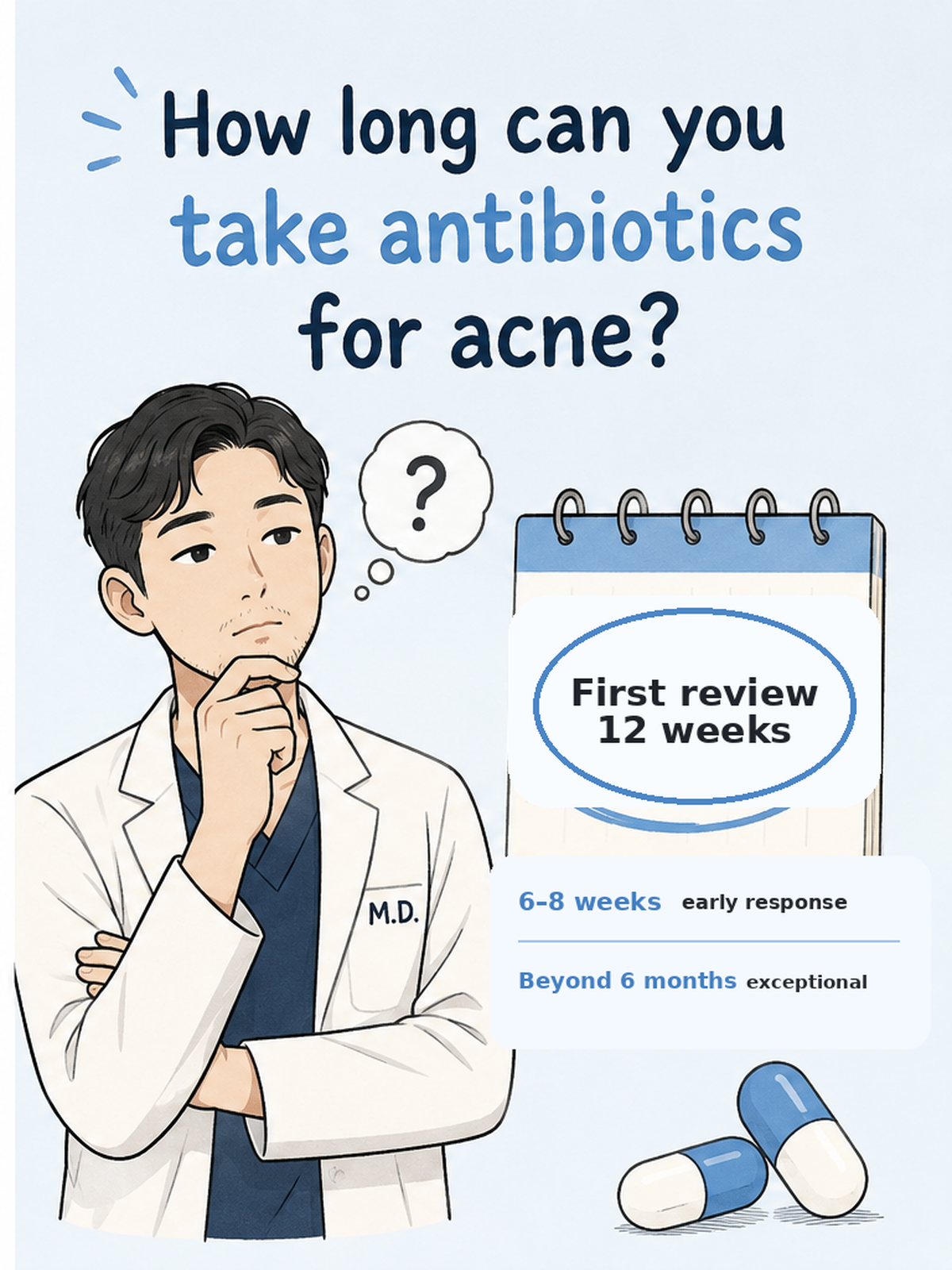
Oral antibiotics for acne are usually reviewed after approximately 12 weeks.
If acne has cleared, the antibiotic may be stopped while non-antibiotic topical maintenance continues.
Treatment beyond six months should generally be exceptional and regularly reassessed.
6–8 weeks
Early response check
Improvement may only begin to become noticeable around this stage.
12 weeks
Main reassessment
Stop, extend, or change treatment according to the clinical response.
Beyond 6 months
Exceptional use
The reason for continuing should be clear and reviewed regularly.
Patients are often given doxycycline, minocycline, or another oral antibiotic for inflammatory acne and then left with a deceptively simple question: when should the medication stop?
There is no single duration that applies to every patient. Treatment length depends on acne severity, the proportion of inflammatory lesions, truncal involvement, scarring risk, previous antibiotic exposure, adverse effects, and whether an effective topical regimen is being used.
The practical answer: oral antibiotics are commonly used in a defined treatment phase, with the first major reassessment at about 12 weeks. They should not automatically be continued until every mark or blemish has disappeared.
Why acne treatment is not judged after only two weeks
Acne does not behave like an acute bacterial infection that should resolve within several days. Lesions already developing below the surface can still become visible after treatment begins. In addition, post-inflammatory redness may remain long after an active lesion has settled.
Current NICE guidance notes that visible improvement may take six to eight weeks. Therefore, a patient who still develops occasional inflammatory lesions after two or three weeks has not necessarily failed treatment.
An early review should focus on trends rather than expecting complete clearance:
- Are new inflammatory lesions becoming less frequent?
- Are painful nodules occurring less often?
- Are existing lesions resolving more quickly?
- Is the medication being taken consistently?
- Is the prescribed topical treatment actually being used?
What should happen at the 12-week review?
Twelve weeks is not merely a date on the calendar. It is the point at which the benefits of continuing an antibiotic should be weighed against unnecessary exposure and antimicrobial resistance.
Acne has cleared
The oral antibiotic can usually be stopped while an appropriate non-antibiotic topical treatment is continued.
Acne has improved but remains active
A further limited course may be considered if improvement is continuing and the expected benefit is meaningful.
Little or no improvement
The diagnosis, adherence, treatment combination, acne severity, and need for another systemic strategy should be reconsidered.
Does this mean everyone can take antibiotics for six months?
No. NICE allows consideration of up to another 12 weeks when acne has improved but has not fully cleared. This does not mean that a six-month course should be planned automatically for every patient.
The 2025 EuroGuiDerm guideline recommends limiting systemic antibiotics to approximately three months as a general rule. Treatment beyond three months may be considered when topical treatment is insufficient and other systemic options are unsuitable, particularly in severe acne or substantial truncal involvement.
Usually too early for a final efficacy judgment.
Check whether the direction of change is favorable.
Main point for stopping, extending, or changing treatment.
A limited extension may be considered in selected patients with continuing improvement.
Should be exceptional, justified, and reassessed at regular intervals.
Why antibiotics cannot be the entire acne plan
Acne is a multifactorial inflammatory disorder. Increased sebum production, abnormal follicular keratinization, inflammation, and changes in the skin microbiome all contribute to lesion formation.
An antibiotic may reduce inflammatory lesions, but it does not fully correct comedone formation, hormonal drivers, excess sebum production, or established scars. This is why antibiotics are best viewed as one phase of treatment rather than permanent maintenance medication.
Oral antibiotic
Primarily targets active inflammatory disease during a defined treatment phase.
Non-antibiotic topical therapy
Helps control comedone formation and reduces the risk of relapse after the antibiotic is withdrawn.
Why benzoyl peroxide or a topical retinoid matters
Both the American Academy of Dermatology and NICE advise against relying on oral antibiotic monotherapy. Systemic antibiotics should generally be combined with non-antibiotic topical treatment, such as benzoyl peroxide, a topical retinoid, or azelaic acid.
NICE also advises against combining a topical antibiotic with an oral antibiotic during the same treatment course. Using two antibiotic routes does not replace a proper non-antibiotic maintenance strategy.
Clinical takeaway
The oral antibiotic helps calm current inflammation. The topical regimen helps prevent the next wave of lesions.
When extending the course may be reasonable
- Inflammatory lesion counts have clearly decreased and improvement is continuing.
- The face, chest, or back is extensively involved.
- Deep inflammatory lesions remain but scarring risk is improving.
- Topical therapy alone is not yet sufficient.
- Other systemic options are unsuitable or contraindicated.
- The antibiotic is well tolerated.
When a different strategy should be discussed
- There is little meaningful improvement after an adequate 12-week course.
- Deep nodules or cysts continue to cause scars.
- Acne relapses rapidly after every antibiotic course.
- Several antibiotic courses have already been repeated.
- Comedones, rather than inflammatory lesions, are the predominant problem.
- Adverse effects make continued treatment inappropriate.
Severe nodular acne, progressive scarring, or acne that has failed adequate standard therapy may require evaluation for oral isotretinoin or another non-antibiotic systemic strategy. This decision requires an individual risk–benefit assessment.
Doxycycline: practical safety considerations
Doxycycline can cause gastrointestinal discomfort, esophageal irritation, pain when swallowing, rash, and photosensitivity. It should be taken according to the prescribing instructions, including advice regarding water intake and positioning after the dose.
Patients with significant sun exposure should be aware that doxycycline-related phototoxicity can be influenced by the dose and the amount of ultraviolet exposure. Severe sunburn-like reactions, persistent swallowing pain, or a significant rash should prompt medical review.
Minocycline is not automatically the gentler option
Minocycline may cause less photosensitivity than doxycycline, but it has a different adverse-effect profile. Dizziness, pigmentation, hypersensitivity, hepatic dysfunction, and rare lupus-like reactions should be considered.
The EuroGuiDerm guideline favors doxycycline and lymecycline over minocycline when the overall safety profile is considered. Medication choice should therefore be individualized rather than based on the assumption that one drug is simply stronger or milder.
Pregnancy and pregnancy planning
Oral tetracyclines should be avoided during pregnancy and when pregnancy is being planned. Patients should tell the prescribing clinician about pregnancy potential, plans for conception, and breastfeeding before treatment begins.
Alternative regimens may include appropriately selected topical options, but treatment must be individualized according to current pregnancy and medication-safety guidance.
Who may or may not be a suitable candidate?
Oral antibiotics may be considered when
- Moderate inflammatory papules and pustules are present.
- The chest or back is substantially involved.
- Topical therapy alone has been insufficient.
- Inflammation creates a meaningful risk of scarring.
They may be a lower priority when
- Comedones are the predominant lesion.
- Inflammatory disease is minimal.
- Multiple prior antibiotic courses have failed.
- Severe nodules, cysts, or progressive scarring suggest another systemic option.
What I assess before continuing an antibiotic
- Diagnostic accuracy
Folliculitis, rosacea, and perioral dermatitis can resemble acne but require different treatment. - Inflammatory-to-comedonal ratio
Antibiotics are more relevant when inflammatory lesions are a major component. - Scarring risk
Persistent deep nodules may require a more effective non-antibiotic systemic strategy. - Previous antibiotic exposure
Repeated short courses without maintenance therapy should not become a cycle. - Ability to tolerate topical therapy
A theoretically effective regimen is not useful if irritation prevents adherence. - The exit plan
The maintenance regimen should be prepared before the oral antibiotic is stopped.
Practical checklist
□ Confirm that the diagnosis is acne rather than an acne-like disorder.
□ Tell your clinician which antibiotics you have previously taken and for how long.
□ Discuss pregnancy, pregnancy planning, or breastfeeding before treatment.
□ Use the prescribed non-antibiotic topical treatment consistently.
□ Assess the trend in inflammatory lesions after six to eight weeks.
□ Arrange a structured reassessment at approximately 12 weeks.
□ Report severe photosensitivity, rash, swallowing pain, or persistent gastrointestinal symptoms.
□ Establish a maintenance plan before stopping the antibiotic.
Frequently Asked Questions
References
1. Reynolds RV, Yeung H, Cheng CE, et al. Guidelines of care for the management of acne vulgaris. Journal of the American Academy of Dermatology. 2024. doi:10.1016/j.jaad.2023.12.017. PMID:38300170.
2. National Institute for Health and Care Excellence. Acne vulgaris: management. NICE guideline NG198. Published 25 June 2021; last reviewed 30 April 2026.
3. Nast A, et al. Update of the EuroGuiDerm evidence-based guideline for the treatment of acne. Journal of the European Academy of Dermatology and Venereology. doi:10.1111/jdv.70331. PMID:41847993.
4. Dessinioti C, Katsambas A. Antibiotics and Antimicrobial Resistance in Acne. Yale Journal of Biology and Medicine. 2022;95(4):429-443. PMID:36568833.
Final note
This article provides general medical information and does not replace an individual diagnosis or prescription. The appropriate antibiotic, treatment duration, and maintenance plan cannot be determined without assessing current acne severity, previous treatment, pregnancy considerations, and adverse-effect risk.
SPRINGDAY CLINIC SINCHON, SEOUL
The goal is not to keep an antibiotic working forever.
The goal is to know when it can be stopped.
For recurrent inflammatory acne in Sinchon, Hongdae, Ewha, or Mapo, treatment should be planned around diagnosis, scarring risk, previous medication exposure, and a realistic maintenance strategy.
#AcneAntibiotics #AcneTreatment #DoxycyclineForAcne #MinocyclineForAcne #AntibioticStewardship #InflammatoryAcne #AdultAcne #AcneMedication #SeoulSkinClinic #SpringdayClinicSinchon


