Too Many Skin Boosters? A Practical Guide to HA, Polynucleotides, Biostimulators, and Micro-Botox
Written by M.D. Bo Won Lee, Director of Springday Clinic Sinchon, Seoul.
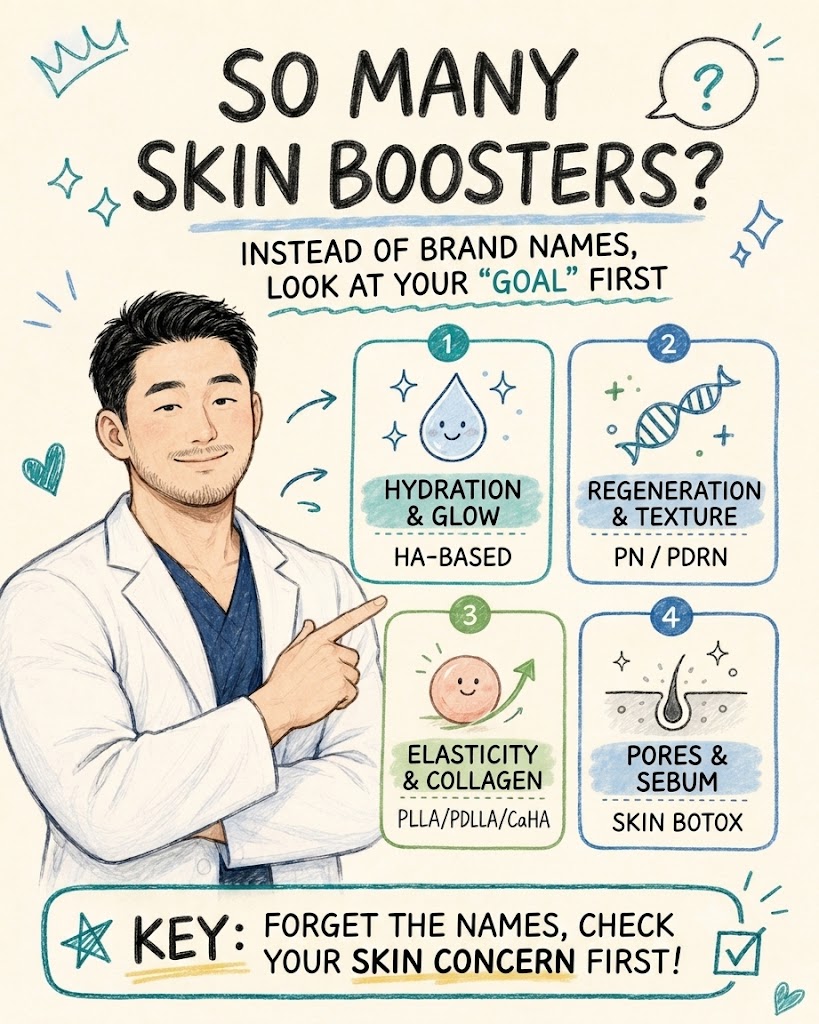
Skin boosters are often sold as if they were interchangeable. They are not. The most useful first step is to define the clinical target and then match the material, injection plane, reversibility, and risk profile to that target.
Three-line overview
Key takeaways
Best considered when dehydration, dullness, and fine surface roughness are the main concerns.
May be considered for gradual texture and fine-line improvement, but the evidence remains heterogeneous.
PLLA, PDLLA, CaHA, and PCL aim for tissue remodeling rather than immediate hydration.
Why the term “skin booster” creates confusion
“Skin booster” is not a single pharmacologic class. In practice, it is an umbrella label for injectable treatments intended to improve hydration, radiance, texture, fine lines, or firmness. Under the same label, patients may encounter hyaluronic acid gels, polynucleotides, particulate collagen biostimulators, micro-botulinum toxin, autologous blood products, extracellular-matrix products, exosome products, and mixed mesotherapy cocktails.
This matters because these materials do not share the same rheology, tissue persistence, injection depth, reversibility, or complication profile. A particulate biostimulator should not be treated as a simple “hydration shot,” and a micro-botulinum treatment does not replace a hydrating injectable. The name of the menu is less informative than the material and the treatment plan.
Start with four questions, not a brand name
First, what is the primary problem: dehydration, rough texture, laxity, sebum, pigmentation, vascular redness, acne scarring, or structural volume loss? Second, what material is being injected, and does it behave as a gel, a polymer, a particle, a toxin, or a biologic preparation? Third, where will it be placed and how densely will it be distributed? Fourth, what can and cannot be reversed if the outcome is uneven or an adverse event occurs?
These questions immediately separate treatments that are often placed on the same price list but should not be evaluated in the same way.
Category 1: HA-based hydration and texture injectables
Hyaluronic acid attracts and retains water, while product rheology and cross-linking influence spread, swelling, persistence, and tissue feel. A 2025 systematic review and meta-analysis found improvement in hydration and radiance after local HA injection, but did not demonstrate significant improvement in elasticity or melanin index. This is a useful boundary: an HA skin booster may be reasonable for dehydration and dullness, but it should not be presented as a universal treatment for pigmentation, laxity, and deep wrinkles.
Category 2: PN and PDRN products
Polynucleotide products are commonly used with the goal of improving fine texture, wrinkles, and overall skin quality without adding obvious structural volume. A 2025 systematic review found promising results, but the included studies were limited in number and generally of low to moderate quality. PN and PDRN should not automatically be treated as identical terms; molecular characteristics, manufacturing, purification, and formulation may differ.
A randomized split-face trial around the eyes found improvement with both PN and HA, with some measures favoring PN, but not a universal superiority across every outcome.
Category 3: collagen biostimulators
PLLA, PDLLA, CaHA, and PCL-based products aim to stimulate tissue remodeling and collagen formation. They are better understood as biostimulatory injectables than as simple moisturizers. Their effects may develop gradually, and immediate post-injection fullness can reflect carrier fluid or swelling rather than the final result.
Because particulate materials are not dissolved in the same way as HA, conservative dosing, homogeneous suspension, appropriate dilution when applicable, correct plane selection, and broad distribution are important. Nodules, granulomatous reactions, asymmetry, excessive fullness, infection, and vascular complications must be considered.
Category 4: micro-botulinum toxin
Micro-botulinum toxin is mechanistically different from HA or a collagen stimulator. It is sometimes used to reduce sebum, improve the appearance of pores, and soften fine dynamic lines. The treatment should be mapped to facial movement and function. Excessive dose or an inappropriate injection plane may alter smile mechanics, lip function, eyebrow position, or facial expression.
Category 5: PRP/PRF, exosomes, ECM products, and cocktails
This is the most heterogeneous group. Autologous platelet products, cell-derived preparations, extracellular-matrix materials, amino-acid mixtures, vitamins, and other cocktails cannot be assigned one shared level of evidence. Composition, source, sterility, regulatory classification, and human clinical data should be reviewed product by product.
The U.S. FDA has issued safety communications regarding unapproved exosome products. That warning does not determine the Korean regulatory status of a specific product, but it illustrates why the word “exosome” alone is not a sufficient safety or efficacy standard.
When a skin booster is not the first-line answer
Pigmentation requires diagnosis of pigment type and depth. Vascular redness and inflammatory rosacea require a different assessment. Tethered acne scars may need subcision, fractional laser, microneedle radiofrequency, or scar-directed filler. Structural sagging may be better addressed with ultrasound, radiofrequency, filler, thread lifting, or surgery.
A skin booster can complement these treatments, but it should not replace a treatment that directly addresses the dominant pathology.
Safety: common reactions and urgent warning signs
Pain, erythema, swelling, bruising, tenderness, and temporary papules are common after microinjection. Persistent edema, infection, inflammatory nodules, granuloma, migration, asymmetry, or sensory symptoms require assessment.
Increasing pain, blanching, gray-blue or reticular discoloration, cool skin, blistering, or visual symptoms may indicate vascular compromise and require urgent evaluation. The label “skin booster” does not remove the vascular risk associated with injecting material into the face.
How we structure the consultation
At Springday Clinic Sinchon, the consultation begins by separating hydration, texture, laxity, sebum, pigment, vascular, and scar-related concerns. We then assess regional skin thickness, facial movement, edema tendency, previous fillers or biostimulators, thread-lifting history, and prior energy-based treatments.
The final choice should explain why this material, this volume, this plane, and this distribution are appropriate—and what the realistic endpoint and limitations are. A treatment should create a meaningful change without forcing an excessive or unnatural result.
Mobile-safe comparison cards
Primary target: Hydration, radiance, superficial texture
Key limitation: Not a universal treatment for laxity, pigmentation, or deep wrinkles.
Primary target: Fine texture and gradual skin-quality improvement
Key limitation: Evidence is promising but heterogeneous; product-specific data matter.
Primary target: Firmness and tissue remodeling
Key limitation: Nodules, uneven distribution, and non-reversibility require careful technique.
Primary target: Sebum, pore appearance, fine dynamic lines
Key limitation: Overtreatment may change facial movement or function.
Primary target: Broadly marketed regenerative goals
Key limitation: Composition, sterility, regulatory status, and clinical evidence vary widely.
Practical checklist
Who may or may not be a suitable candidate
- Clearly defined hydration or texture concerns
- Realistic expectations about gradual and variable outcomes
- Ability to tolerate temporary papules, bruising, or swelling
- Willingness to attend follow-up if symptoms persist
- Active infection, dermatitis, or unstable rosacea
- Unexplained recurrent edema or prior delayed nodules
- Dominant pigmentation, vascular, scar, or structural sagging problem
- An important event too close to the expected downtime
Frequently asked questions
References
- Rho NK, Kim HS, Kim SY, Lee W. Injectable “Skin Boosters” in Aging Skin Rejuvenation: A Current Overview. Arch Plast Surg. 2024;51(6):528-541. doi:10.1055/a-2366-3436. PMID:39544509.
- Zhou R, Yu M. The Effect of Local Hyaluronic Acid Injection on Skin Aging: A Systematic Review and Meta-Analysis. J Cosmet Dermatol. 2025;24(1):e16760. doi:10.1111/jocd.16760. PMID:39807700.
- Ghatge AS, Ghatge SB. The Effectiveness of Injectable Hyaluronic Acid in the Improvement of the Facial Skin Quality: A Systematic Review. Clin Cosmet Investig Dermatol. 2023;16:891-899. doi:10.2147/CCID.S404248. PMID:37038447.
- Lampridou S, Bassett S, Cavallini M, Christopoulos G. The Effectiveness of Polynucleotides in Esthetic Medicine: A Systematic Review. J Cosmet Dermatol. 2025;24(2):e16721. doi:10.1111/jocd.16721. PMID:39645667; PMCID:PMC11845969.
- Lee YJ, Kim HT, Lee YJ, et al. Comparison of the effects of polynucleotide and hyaluronic acid fillers on periocular rejuvenation: a randomized, double-blind, split-face trial. J Dermatolog Treat. 2022;33(1):254-260. doi:10.1080/09546634.2020.1748857. PMID:32248707.
- Ferreira ACM, Silva LR, Espasandin I, et al. Efficacy, Durability, and Safety of Collagen Biostimulators Based on Poly-L-Lactic Acid (PLLA) and Calcium Hydroxyapatite (CaHA) in the Face: A Systematic Review. Aesthetic Plast Surg. 2026;50(3):1291-1300. doi:10.1007/s00266-025-05412-8. PMID:41184662.
- Hong GW, Hu H, Chang K, et al. Review of the Adverse Effects Associated with Dermal Filler Treatments: Part I Nodules, Granuloma, and Migration. Diagnostics. 2024;14(15):1640. doi:10.3390/diagnostics14151640. PMID:39125515.
- Hong GW, Hu H, Chang K, et al. Adverse Effects Associated with Dermal Filler Treatments: Part II Vascular Complication. Diagnostics. 2024;14(14):1555. doi:10.3390/diagnostics14141555. PMID:39061692.
- U.S. Food and Drug Administration. Public Safety Notification on Exosome Products. 2019.
Evidence is heterogeneous across products, injection techniques, treatment schedules, and outcome measures. A 2024 classification review that was retracted in November 2025 was not used as evidence.
Final note
This article provides general medical information and does not replace an in-person assessment. Product-specific Korean authorization, indications, contraindications, and instructions for use should be verified before treatment. Results may vary.
Choose a treatment plan, not a fashionable product name.
Springday Clinic Sinchon · Seoul
#SkinBooster #SkinBoosterGuide #SkinBoosterTypes #InjectableSkinTreatments #HyaluronicAcidBooster #PolynucleotideTreatment #CollagenStimulator #SkinRejuvenation #SeoulSkinClinic #SpringdayClinicSinchon


