SEOUL AESTHETIC MEDICINE GUIDE
Ultherapy, Thermage, DENSITY, and ONDA: Which Skin Lifting Treatment Is Right for Your Face?
Written by M.D. Bo Won Lee, Director of Springday Clinic Sinchon, Seoul.
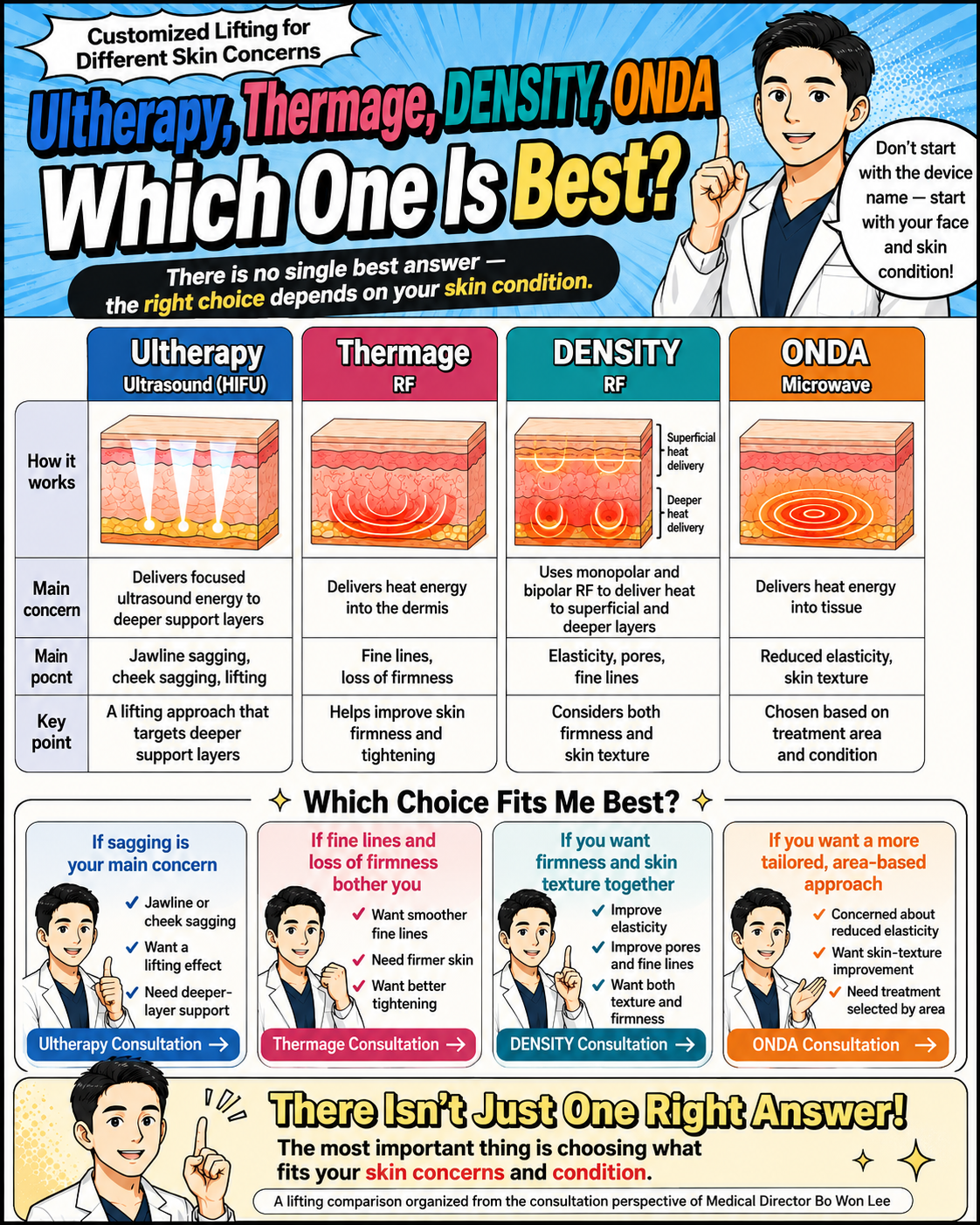
This article explains how four popular non-surgical lifting devices differ in energy type, target tissue, clinical use, and patient selection.
Recommended English Title
Ultherapy vs Thermage vs DENSITY vs ONDA: A Seoul Doctor’s Guide to Choosing the Right Lifting Treatment
KEY TAKEAWAY 01
There is no single “best” lifting device for everyone.
Ultherapy, Thermage, DENSITY, and ONDA target different tissue layers and are selected for different facial concerns.
KEY TAKEAWAY 02
The face should be evaluated by layer.
Skin laxity, facial fat, volume loss, ligament support, and jawline structure should be assessed before choosing a device.
KEY TAKEAWAY 03
A natural result depends on proper indication.
At Springday Clinic Sinchon, treatment planning is based on facial anatomy, skin thickness, previous procedures, and safety considerations.
Why comparing lifting devices is not as simple as it looks
Patients who visit a Seoul skin clinic often ask one question first: “Which is better, Ultherapy or Thermage?” Others ask whether DENSITY is a newer version of Thermage, or whether ONDA can lift the face while reducing fat.
From the clinical perspective of M.D. Bo Won Lee at Springday Clinic Sinchon, this is not the most useful starting point. The better question is: which tissue layer is actually causing the concern? Facial sagging may come from thin skin, collagen loss, downward movement of fat pads, submental fat, volume loss, or skeletal structure.
For patients looking for skin treatments in Seoul around Sinchon, Hongdae, Ewha, or Mapo, this distinction is important. A lifting device should not be chosen only by price, trend, or the number of shots. It should be chosen after evaluating the face.
In one sentence
Ultherapy, Thermage, DENSITY, and ONDA are not simply competitors; they are different tools for different tissue targets.
Mobile-friendly device comparison
Ultherapy
Energy: Microfocused ultrasound / HIFU-based technology
Main clinical focus: deeper support layers, jawline sagging, cheek descent, lifting vector
Caution: in very thin faces or hollow midfaces, overly aggressive treatment may make the face look more deflated.
Thermage
Energy: Monopolar radiofrequency
Main clinical focus: skin firmness, fine wrinkles, overall tightening, skin laxity
Caution: heat-based treatment requires careful control of energy, pain feedback, and treatment area.
DENSITY
Energy: Sequential monopolar and bipolar RF
Main clinical focus: RF-based tightening, skin texture, comfort-oriented treatment planning
Caution: published evidence is still more limited compared with older RF platforms.
ONDA
Energy: 2.45 GHz microwave / Coolwaves-based technology
Main clinical focus: localized adiposity, cellulite, submental fullness, skin laxity in selected areas
Caution: it should not be treated as a universal full-face lifting device.
When Ultherapy may be considered
Ultherapy uses focused ultrasound energy to create controlled thermal coagulation points at specific depths. Clinically, it is often considered when the concern is not just surface wrinkles but deeper support and lifting direction.
It may be discussed for early jawline blurring, cheek descent, mild to moderate laxity, and patients who want a non-surgical approach before considering more invasive procedures. However, in a very lean face, strong lifting energy can sometimes make hollowness more noticeable.
When Thermage may be a better fit
Thermage is a monopolar RF-based treatment commonly discussed for skin firmness, fine lines, and overall tightening. Patients often describe their concern as “loose skin,” “less firmness,” or “a tired texture” rather than a dramatic downward sagging.
Because RF is heat-based, the treatment plan should consider skin thickness, facial fat distribution, pain tolerance, previous filler or thread lifting history, and implanted electrical devices. A Seoul dermatology clinic should not treat RF lifting as a one-size-fits-all protocol.
How DENSITY differs from Thermage
DENSITY belongs to the broader RF category, but it is described as using both monopolar and bipolar RF. Manufacturer information highlights adjustable cooling and impedance feedback. This concept is often explained as a way to approach both deeper and more superficial RF responses.
However, DENSITY is a relatively newer platform compared with older monopolar RF systems, and long-term, large-scale comparative evidence is still limited. At Springday Clinic Sinchon, DENSITY is not explained as “automatically better” simply because it is newer. It is considered based on skin condition, patient comfort, and treatment goals.
Is ONDA a face-lifting treatment?
ONDA uses 2.45 GHz microwave-based technology and is discussed in the literature for localized adiposity, cellulite, and skin laxity. This means it should be viewed differently from a classic full-face lifting device.
For example, ONDA may be considered when submental fullness or localized fat contributes to a heavy lower face. It may also be considered in body contouring contexts. But if a patient has a thin face, midface hollowing, or mainly superficial skin laxity, a different plan may be more appropriate.
M.D. Bo Won Lee at Springday Clinic Sinchon emphasizes that the first step is not choosing a device name, but evaluating facial structure, skin thickness, fat distribution, previous procedures, and safety factors.
Pre-treatment checklist
- Do you have thin skin or a naturally lean face?
- Is the main concern skin laxity, facial fat, or volume loss?
- Have you had fillers, thread lifting, fat-dissolving injections, or facial surgery?
- Do you have a pacemaker, defibrillator, or implanted electrical device?
- Do you have metal implants or dental hardware near the treatment area?
- Are you pregnant or breastfeeding?
- Do you want facial slimming, firming, jawline definition, or subtle rejuvenation?
- How much downtime and discomfort are acceptable for you?
FAQ
References
- Ultherapy Official Website. ULTHERA System FDA-cleared indications and safety information.
- Contini M, et al. A Systematic Review of the Efficacy of Microfocused Ultrasound for Facial Skin Tightening. Int J Environ Res Public Health. 2023;20(2):1522.
- Gutowski KA. Microfocused Ultrasound for Skin Tightening. Clin Plast Surg. 2016;43(3):577-582.
- Dover JS, Zelickson B. Results of a survey of 5,700 patient monopolar radiofrequency facial skin tightening treatments. Dermatol Surg. 2007;33(8):900-907.
- Jeisys Medical. DENSITY official product information.
- Lin S, Kumar N. Clinical Evaluation of a Novel Dual-Mode Radiofrequency Device for Facial Laxity. Clin Cosmet Investig Dermatol. 2025;18:3013-3020.
- Hoffmann K, et al. Microwave-Energy-Based Device for the Treatment of Cellulite and Localized Adiposity. Bioengineering. 2024;11(12):1249.
Final note
If you are comparing skin treatments in Seoul, especially around Sinchon, Hongdae, Ewha, or Mapo, it is better to start with facial anatomy and treatment goals rather than device popularity alone.
English SEO Tags
Ultherapy Seoul, Thermage Seoul, DENSITY RF, ONDA Coolwaves, Seoul skin clinic, Seoul dermatology clinic, aesthetic clinic in Seoul, non surgical face lifting, skin tightening treatment, Springday Clinic Sinchon
#Ultherapy
#Thermage
#DENSITYRF
#ONDALifting
#SkinLifting
#NonSurgicalLifting
#SeoulSkinClinic
#SeoulDermatology
#SpringdayClinicSinchon
#FacialRejuvenation


