Doctors Are Among the Best Customers of Marketing Companies
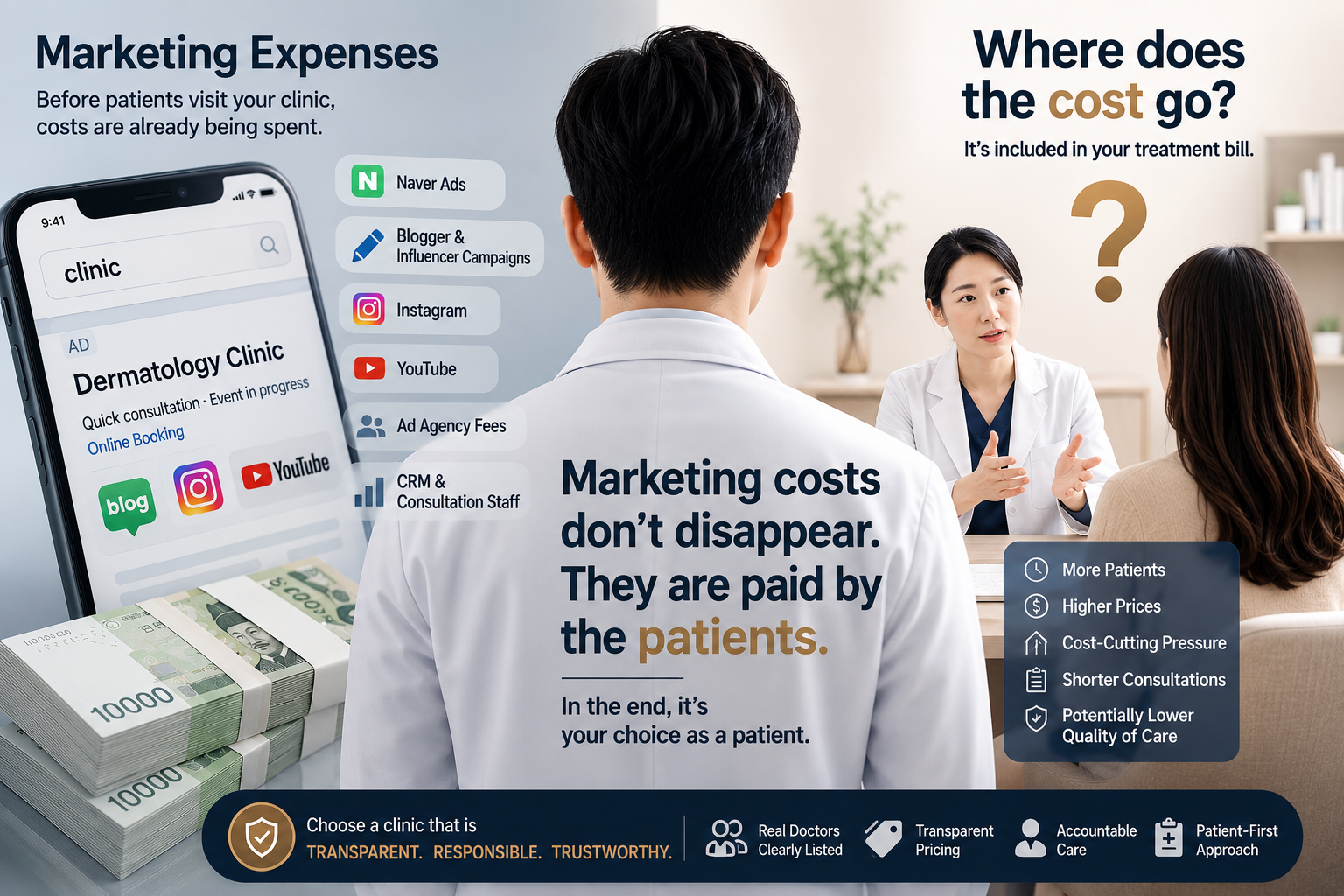
Before choosing a clinic, most patients search online first.
Blog reviews, Instagram posts, YouTube Shorts, influencer content, online reviews, and saved posts all influence medical decisions today.
Patients now have access to more information than ever before.
But after opening and operating my own clinic, I often found myself asking a simple question:
If a clinic spends a large amount of money on marketing, where does that money eventually come from?
The answer is straightforward.
Ultimately, it is paid for by patients.
Medical Marketing Is Bigger Than Most People Think
Many people view advertising as nothing more than a way for clinics to introduce themselves.
In reality, medical marketing can be a substantial expense.
Typical marketing costs may include:
- Search advertising
- Map and local listing promotions
- Influencer collaborations
- Sponsored blog content
- Social media management
- Video production and editing
- Marketing agency fees
- CRM systems
- Consultation staff and call center operations
All of these require ongoing investment.
In highly competitive markets, clinics may spend a significant amount of money simply to acquire a single new patient.
In other words, expenses often begin long before a patient ever walks through the clinic door.
Where Does the Advertising Budget Go?
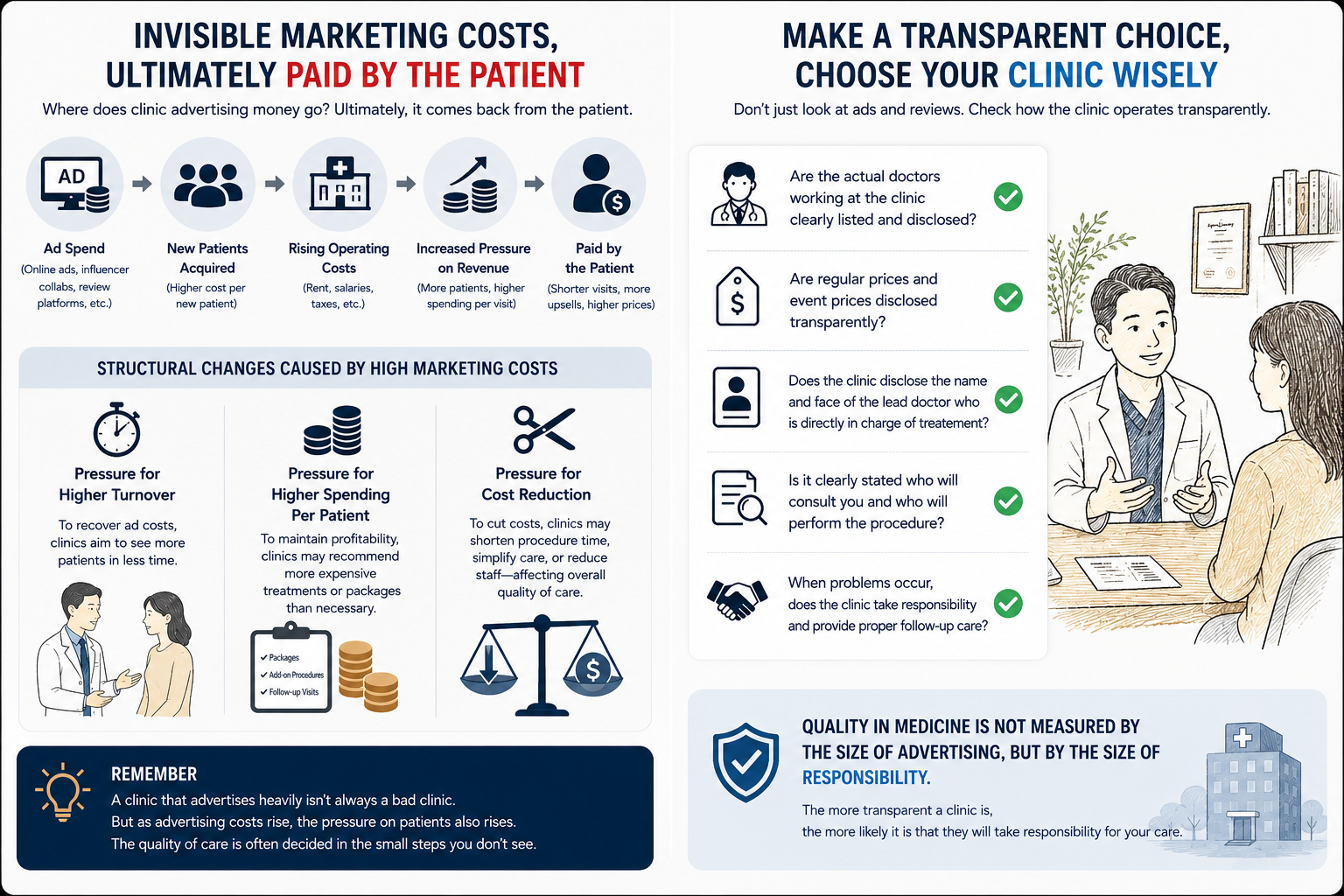
Imagine a clinic spends the equivalent of $100 to acquire one new patient.
That cost does not simply disappear.
A clinic still has to pay rent, salaries, taxes, equipment costs, and other operating expenses.
Marketing becomes part of the overall business structure.
This does not mean that clinics that advertise heavily are bad clinics.
Many excellent clinics invest in marketing.
However, the larger the marketing budget becomes, the greater the pressure to recover those costs.
Why Patient Turnover Becomes Important
As advertising costs rise, clinics naturally face pressure to see more patients.
From a business perspective, spending ten minutes with a patient is often more profitable than spending twenty.
As a result, consultation times may become shorter.
Explanations may become less detailed.
Efficiency and patient volume become increasingly important.
This does not apply to every clinic.
But it is a natural consequence of intense competition and rising acquisition costs.
Pressure to Increase Revenue Per Patient
Higher marketing expenses can also create pressure to generate more revenue from each patient.
In healthcare management, this is often referred to as increasing the "average revenue per patient."
Patients may receive recommendations for additional treatments, package programs, or follow-up procedures.
Sometimes these recommendations are entirely appropriate.
Sometimes they may be influenced by business considerations.
The important point is not whether upselling exists.
The important point is understanding the incentives created by the system itself.
For example, a treatment plan may be expanded beyond what is truly necessary.
More sessions, more products, or more procedures can generate higher revenue even when a simpler approach might have been sufficient.
My Greatest Concern: Cost Cutting
Personally, this is the issue that concerns me most.
There are only a limited number of expenses a clinic can reduce.
Rent is difficult to lower.
Staff salaries cannot be reduced indefinitely.
Eventually, cost reduction may begin to affect the clinical process itself.
This can appear in many forms:
- Shorter treatment times
- Simplified follow-up care
- Reduced staffing
- Streamlined procedures
- Less individualized attention
Each change may seem small.
But healthcare quality is often determined by the accumulation of many small details.
Visibility and Quality Are Not the Same Thing
Many people assume that a clinic with long waiting lists or strong online visibility must be the best choice.
Sometimes that is true.
Sometimes it is not.
A clinic may be popular because of exceptional medical care.
It may also be popular because of successful marketing.
Those are not always the same thing.
Likewise, a clinic that advertises very little may provide excellent care while remaining relatively unknown.
As consumers, we often mistake visibility for quality.
But they are not necessarily equivalent.
What Should Patients Actually Look For?
Advertising can help you discover a clinic.
It cannot replace medical judgment.
When evaluating a clinic, consider asking:
- Does the doctor take time to explain?
- Are questions welcomed?
- Is there a logical reason behind each recommendation?
- Are unnecessary treatments avoided?
- Does the clinic provide responsible follow-up care when problems arise?
These factors often tell you more about the quality of care than any advertisement ever could.
Transparency Matters
No patient can perfectly judge a doctor's skill before visiting.
Medicine is simply too complex for that.
However, patients can often evaluate how transparent a clinic is.
For example:
- Are all practicing doctors clearly listed?
- Are regular prices and promotional prices openly disclosed?
- Are the doctors willing to stand behind their work with their names and faces?
- Is it clear who will perform the consultation and who will perform the procedure?
None of these factors alone guarantee quality.
But clinics that openly disclose this information are often demonstrating a willingness to be accountable.
And accountability matters.
Final Thoughts
Healthcare should not be judged by the size of its advertising budget.
It should be judged by the size of its responsibility.
When choosing a clinic, look beyond reviews, rankings, and advertising exposure.
Pay attention to transparency.
Pay attention to honesty.
Pay attention to accountability.
Because good medicine is rarely defined by what patients see on social media.
It is defined by what happens behind the scenes.
Medicine is shaped where patients are not present.
By how much we explain, how honest we are, and how much responsibility we take.
— Bowon Lee, M.D.
About the Author
Bowon Lee, M.D. is the Medical Director of Spring Day Clinic Sinchon, a dermatology and aesthetic clinic located in Seoul, South Korea.
As an author of SCI-indexed scientific publications, Dr. Lee believes that aesthetic medicine should be guided by evidence, clinical judgment, and professional responsibility rather than marketing trends alone.
His practice focuses on personalized treatment plans, transparent patient communication, and natural-looking outcomes through advanced laser, injectable, and skin rejuvenation procedures.


